
What is Veo 2
Veo 2 is launched by Google DeepMind AI video generationmodel, capable of generating high-quality video content based on text or image prompts. Veo 2 supports video production up to 4K resolution, understands camera control instructions, and can simulate real-world physical phenomena and human expressions. Veo 2 performs excellently on Meta's MovieGenBench benchmark, outperforming other video generation models (such as Meta, Minimax). Videos generated by Veo 2 are embedded with SynthID watermarks, identifying their AI-generated nature.
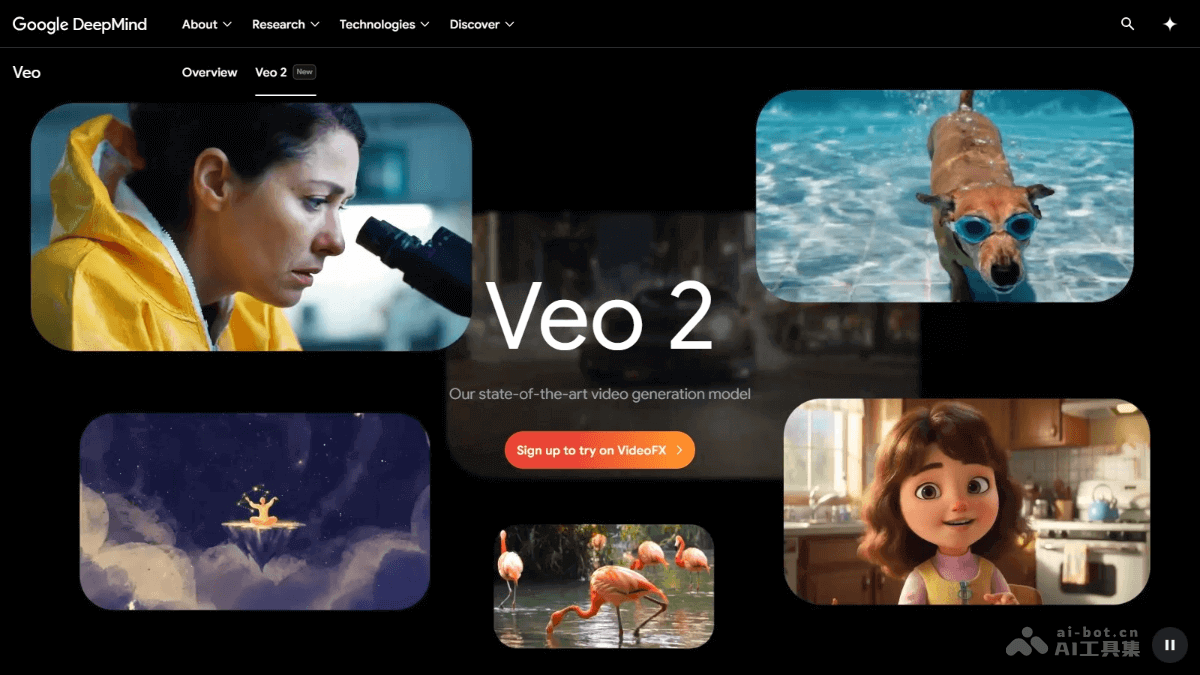
Main features of Veo 2
- High-resolution video generation: Generate videos up to 4K resolution, providing clearer visual effects.
- Understand camera control instructions: Understand and execute instructions related to camera movement and style, such as wide-angle, close-up, drone perspective, etc.
- Simulate physical phenomena and human expressions: The model can more realistically simulate real-world physical effects and changes in human expressions.
- Inpainting: Can intelligently remove unwanted background images, logos, or distracting elements from videos.
- Outpainting: Can extend the original video frame, filling the new space with AI-generated segments, achieving natural integration with the original footage.
- Cinematic filming technique presets: Users can combine cinematic filming technique presets with text descriptions when generating videos, precisely guiding camera composition, shooting angles, and pacing. Preset options include time-lapse effects, drone perspectives, and simulated camera pans in different directions, etc.
- Interpolation: Can create smooth video transitions between two static images, adding new frames to the beginning and end sequences of videos. Further enhances the smoothness and professional feel of videos.
- SynthID digital attribution watermark: To ensure the originality of content, Veo 2 adds a SynthID digital attribution watermark to its AI-generated outputs.
- Reduce erroneous generation: Significantly reduces common errors such as extra fingers or unexpected objects.
- Safety: Generated videos are embedded with invisible SynthID watermarks, making it easy to identify AI-generated video content.
Technical principles of Veo 2
- Deep learning model: Based on deep learning technology, especially the Transformers architecture, to understand and process input text or image prompts.
- Text-to-video synthesis: Veo 2 converts text descriptions into video content, involving a combination of natural language processing (NLP) and computer vision technology.
- Physical simulation: Integrates a physics engine to ensure that the generated video content is physically plausible.
- Facial and expression recognition: Uses facial recognition technology to capture and simulate human expressions, improving the realism of videos.
Veo 2 project address
- Project official website:deepmind.google/technologies/veo/veo-2
Application scenarios of Veo 2
- Film production: Filmmakers can preview complex special effects scenes, or generate realistic backgrounds and environments under limited budget and time, reducing dependence on actual filming locations.
- Virtual tourism: Travel companies create virtual travel experiences that let customers experience famous historical sites around the world through virtual reality headsets or other devices, unrestricted by time and space.
- Educational videos: Educational institutions generate educational videos, simulate complex scientific experiment processes, or recreate historical events, providing a more vivid and interactive learning experience.
- News reporting: News organizations recreate the scenes of news events, providing audiences with more intuitive and impactful reporting, especially in areas such as reporting natural disasters and recreating historical events.
- Advertising production: Advertising agencies quickly generate video advertisements that match product characteristics, improving the appeal and dissemination efficiency of advertisements.