
What is VARGPT
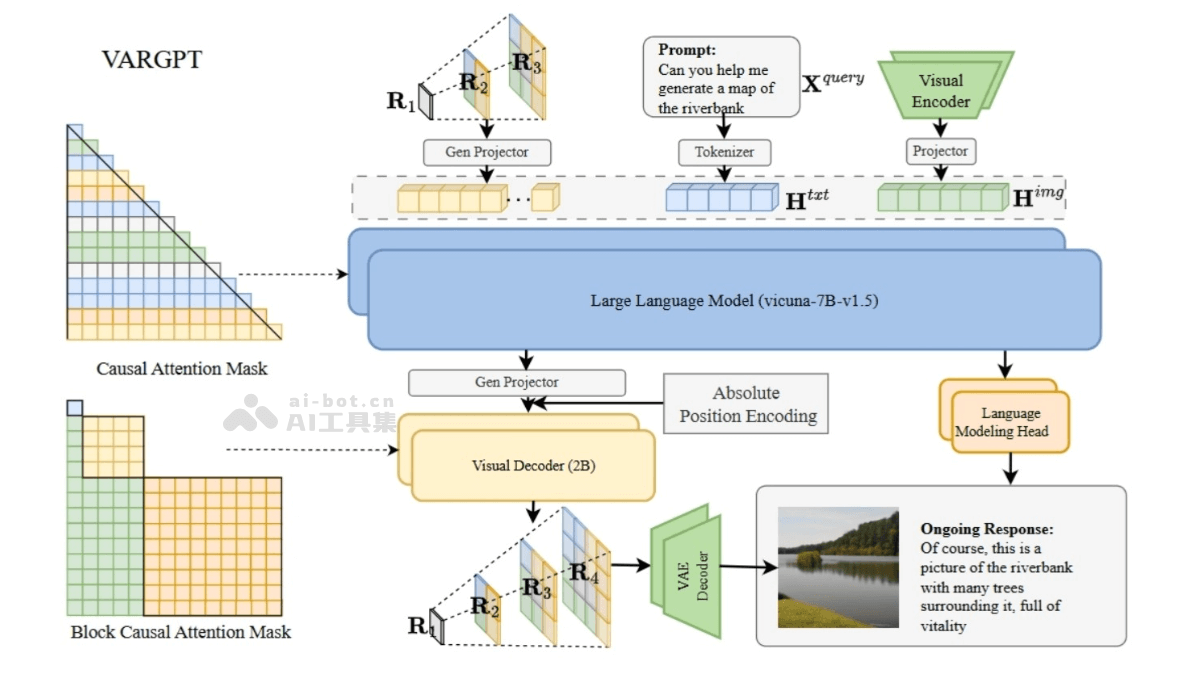
VARGPT is an innovative multimodal large language model focused on visual understanding and generation tasks. Based on an autoregressive framework, it unifies visual generation and understanding in a single model, avoiding the complexity of task switching. VARGPT extends the LLaVA architecture, achieving visual understanding through next-token prediction and visual generation through next-scale prediction, and can efficiently handle mixed-modal input and output. VARGPT adopts a three-stage training strategy: the pretraining stage learns language and visual features, and the mixed visual instruction fine-tuning stage further aligns visual and textual features and enhances instruction-following capabilities. This enables the model to perform excellently on tasks such as visual question answering and reasoning, while also demonstrating strong capabilities in visual generation tasks, naturally generating high-quality images.
VARGPT's Main Features
- Unification of Visual Understanding and Generation: VARGPT is a multimodal large language model that can achieve visual understanding and visual generation within a single autoregressive framework. It completes visual understanding tasks such as visual question answering and reasoning through the next-token prediction paradigm, and achieves visual generation based on the next-scale prediction paradigm.
- Mixed-Modal Input and Output: VARGPT supports mixed-modal input of text and images, and can simultaneously output text and images. It is more flexible and efficient when handling complex vision-language tasks.
- Efficient Visual Generation: VARGPT is equipped with a dedicated visual decoder containing 2 billion parameters for high-quality visual generation. It can generate images according to text instructions, gradually constructing image content during the autoregressive process.
- Broad Applicability to Multimodal Tasks: VARGPT outperforms other models on multiple vision-centric benchmarks and can naturally support instruction-to-image synthesis, making it suitable for a variety of vision-language tasks.
VARGPT's Technical Principles
- Unified Autoregressive Framework: VARGPT unifies visual understanding and generation tasks within a single autoregressive framework. For visual understanding, the model adopts the next-token prediction paradigm, that is, completing visual question answering and reasoning tasks by predicting the next text token; for visual generation, it adopts the next-scale prediction paradigm, gradually predicting the next scale information of the image. This enables the model to efficiently handle visual and language tasks within a single framework.
- Visual Decoder and Feature Mapping: VARGPT includes a dedicated visual decoder with 2 billion parameters for high-quality visual generation. The decoder consists of 30 Transformer blocks, each containing 30 attention heads, with a width of 1920, and adopts adaptive normalization (AdaLN).
- Multi-Scale Tokenization: To support visual generation, VARGPT uses a multi-scale variational autoencoder (VAE) architecture, similar to the VAR model. The architecture decomposes images into tokens at different scales through a multi-scale quantization scheme, with a vocabulary size of 4090, and the training data is the OpenImages dataset.
- Mixed-Modal Input and Output: VARGPT supports mixed-modal input of text and images, and can simultaneously output text and images. Through special tokens and prompt formats, the model flexibly switches between text and visual modalities to achieve mixed-modal generation.
- Three-Stage Training Strategy
- Pretraining Stage: Learns the mapping relationship between text and visual features.
- Mixed Visual Instruction Fine-Tuning Stage: By constructing a visual generation instruction dataset and combining it with a multi-turn dialogue instruction dataset for mixed training, the model's capabilities in visual question answering and instruction-to-image synthesis tasks are enhanced.
VARGPT Project Address
- Project Website:https://vargpt-1.github.io/
- GitHub Repository:https://github.com/VARGPT-family/VARGPT
- arXiv Technical Paper:https://arxiv.org/pdf/2501.12327
VARGPT Application Scenarios
- Visual Question Answering and Reasoning: VARGPT can handle complex visual question answering tasks by understanding image content and generating accurate text responses.
- Instruction-to-Image Generation: VARGPT supports generating high-quality images based on text instructions. Images of specific scenes can be generated through simple text descriptions.
- Multimodal Content Creation: VARGPT can handle mixed-modal input and output, supporting seamless switching between text and images. Input a text description, and the model generates the corresponding image, or generates related text content based on an image.
- Creativity and Entertainment: VARGPT's image generation capabilities can be applied in the creative and entertainment fields to generate personalized artworks, virtual characters, etc.