
What is V-JEPA 2
V-JEPA 2 is a world model launched by Meta AI that enables understanding, prediction, and planning in the physical world based on video data. V-JEPA 2 uses a 1.2-billion-parameter Joint Embedding Predictive Architecture (JEPA) and is trained via self-supervised learning from over 1 million hours of video and 1 million images. V-JEPA 2 achieves new levels of performance on tasks such as action recognition, action prediction, and video question answering, and can be used for zero-shot robot planning, enabling robots to interact with unfamiliar objects in new environments. V-JEPA 2 is an important step toward advanced machine intelligence and lays the foundation for future AI applications in the physical world.
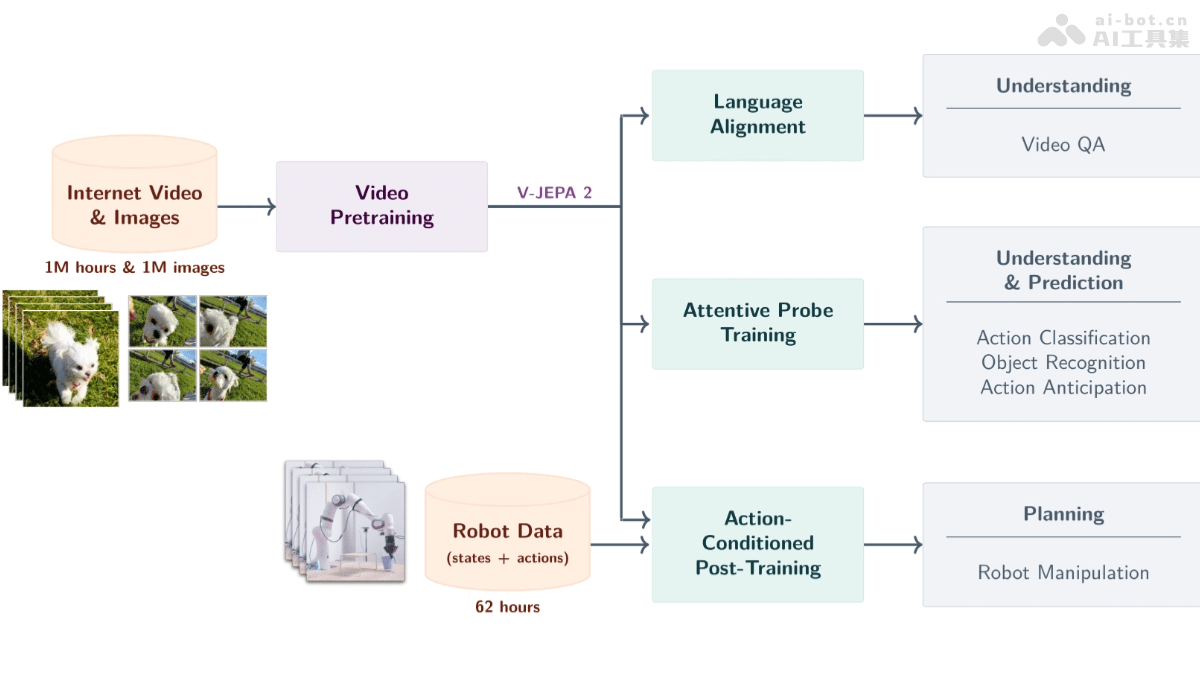
Main Features of V-JEPA 2
- Understanding the Physical World: Understands objects, actions, and motion from video inputs, capturing semantic information in scenes.
- Predicting Future States: Predicts the outcomes of future video frames or actions based on the current state and actions, supporting both short-term and long-term prediction.
- Planning and Control: Uses predictive capabilities for zero-shot robot planning, enabling robots to complete tasks in new environments, such as grasping, placing, and manipulating objects.
- Video Question Answering: Combined with language models, answers questions related to video content, involving physical causality, action prediction, and scene understanding, among others.
- Generalization Ability: Shows good generalization ability on unseen environments and objects, supporting zero-shot learning and adaptation in new scenarios.
Technical Principles of V-JEPA 2
- Self-Supervised Learning: Learns general visual representations from large-scale video data via self-supervised learning, without the need for manually annotated data.
- Encoder-Predictor Architecture:
- Encoder: Converts raw video input into semantic embeddings, capturing key information in the video.
- Predictor: Predicts future video frames or states based on the encoder's output and additional context (such as action information).
- Multi-Stage Training:
- Pre-Training Stage: Trains the encoder with large-scale video data to learn general visual representations.
- Post-Training Stage: Builds on the pre-trained encoder and uses a small amount of robot interaction data to train an action-conditioned predictor, enabling the model to plan and control.
- Action-Conditioned Prediction: Introduces action information so the model can predict the impact of specific actions on the world state, supporting model-based predictive control.
- Zero-Shot Planning: Uses the predictor for zero-shot planning in new environments, achieving goals by optimizing action sequences without additional training data.
Project Addresses for V-JEPA 2
- Project Website:https://ai.meta.com/blog/v-jepa-2-world-model-benchmarks/
- GitHub Repository:https://github.com/facebookresearch/vjepa2
- Technical Paper:https://scontent-lax3-2.xx.fbcdn.net/v/t39.2365-6
Application Scenarios of V-JEPA 2
- Robot Control and Planning: Supports zero-shot robot planning, enabling robots to complete tasks such as grasping and placing in new environments without additional training data.
- Video Understanding and Question Answering: Combined with language models, answers questions related to video content, supporting action recognition, prediction, and video content generation.
- Intelligent Surveillance and Security: Detects abnormal behavior and environmental changes, used in video surveillance, industrial equipment monitoring, and traffic management.
- Education and Training: Used in virtual reality and augmented reality environments to provide immersive experiences and skills training.
- Healthcare: Assists rehabilitation training and surgical operations, providing real-time feedback and guidance based on movement prediction and analysis.