
What is USO
USO (Unified Style-Subject Optimized) is a unified framework for content and style decoupling and recombination launched by ByteDance's UXO team. It can freely combine any subject with any style in any scene, generating images with high subject consistency, strong style fidelity, and a natural, non-plastic feel. USO builds a large-scale triplet dataset, adopts a decoupled learning scheme to simultaneously align style features and separate content from style, and introduces Style Reward Learning (SRL) to further improve model performance. USO has released the USO-Bench benchmark for comprehensively evaluating style similarity and subject fidelity. Experiments show that USO achieves top-tier open-source model performance in both subject consistency and style similarity.
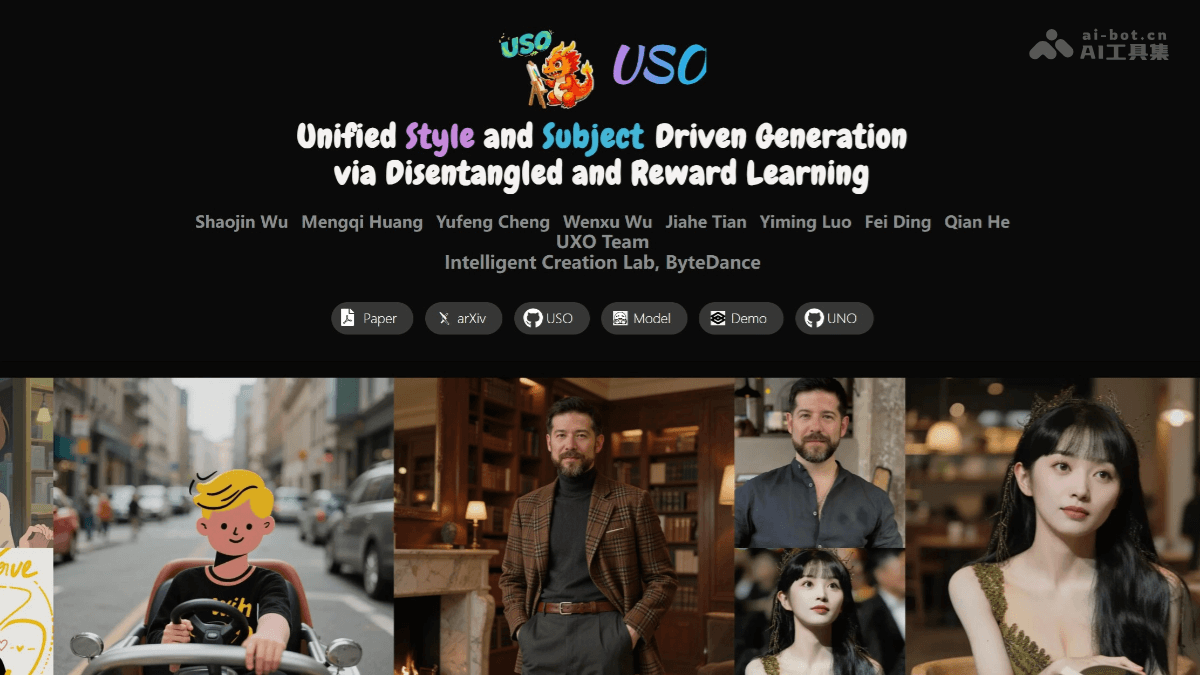
Main Features of USO
-
Style and Subject Fusion: It can freely combine any subject with any style, generating images that both preserve subject features and conform to the specified style, solving the problem of difficulty in fusing style and subject.
-
High-Fidelity Generation: When generating images, it can maintain high subject consistency and style fidelity, ensuring the generated images are natural and high-quality.
-
Multi-Scenario Applications: Suitable for multiple scenarios and can be widely applied in fields such as artistic creation, advertising design, and game development.
-
Open-Source Support: The project is fully open-source, including training code, inference scripts, model weights, and datasets, providing rich resources for researchers and developers.
-
Leading Performance: It achieves top-tier open-source model performance in both subject consistency and style similarity, improving performance through a large-scale triplet dataset and a decoupled learning scheme.
-
Benchmark: It has released the USO-Bench benchmark for comprehensively evaluating style similarity and subject fidelity, providing a unified comparison standard for subsequent models.
Technical Principles of USO
-
Construction of Large-Scale Triplet Dataset: A triplet dataset containing content images, style images, and corresponding stylized images was created, providing a rich data foundation for model training.
-
Decoupled Learning Scheme: Through two stages—style alignment training and content-style decoupling training—it simultaneously aligns style features and separates content from style, avoiding feature crosstalk and achieving precise fusion.
-
Style Reward Learning (SRL): Reward signals are introduced to optimize generation quality, balancing style similarity and subject consistency, and further improving model performance.
-
Unified Framework: It merges the two types of tasks, style-driven and subject-driven, into a single model framework, solving the problem of their opposition in traditional methods and achieving collaborative optimization of style and subject.
-
Two-Stage Training Process: In the first stage, style alignment training enables the model to acquire style reproduction capability; in the second stage, content-style decoupling training achieves joint conditional generation, and finally the entire training process is supervised through style reward learning.
Core Value of USO
- Proposed an Innovative Collaborative Decoupling Paradigm: It breaks the situation where style and subject generation tasks each fight alone, proving that more thorough content-style decoupling can be achieved through cross-task joint learning, with mutual reinforcement.
- Built a Powerful Unified Generative Model: USO is the first model to simultaneously achieve SOTA-level subject consistency and style similarity within a single framework, and its effectiveness and versatility are impressive.
- Introduced reward learning enhancement: Successfully applying the reward learning paradigm to style generation provides an effective path for further improving the fine-grained controllability and aesthetic quality of generative models.
- Released the first joint evaluation benchmark: USO-Bench fills the gap in comprehensive evaluation in this field and provides a fair and comprehensive comparison platform for subsequent research.
USO project address
- Project website:https://bytedance.github.io/USO/
- Github repository:https://github.com/bytedance/USO
- arXiv technical paper:https://arxiv.org/pdf/2508.18966
USO model results
-
Accurate style transfer: It can accurately transfer different styles to new content, and the generated images retain the brushstrokes and colors of the original style while not deforming the subject, with high style similarity.
-
Preservation of subject features: When the style changes, it can lock onto the subject features, adapt to multiple styles, and keep people or objects as they are, with good subject consistency.
-
Strong joint generation capability: It can simultaneously satisfy both style and subject requirements, generating in one step an image that matches the specified style while fully preserving the subject layout, achieving a perfect fusion of style and subject.
-
High generation quality: It has achieved SOTA (State-of-the-Art) results on subject-driven generation, style-driven generation, and joint style-subject-driven generation tasks, and the generated images are natural, realistic, and high-quality.
-
Strong adaptability: The model has strong adaptability to different subjects and styles, and can handle many types of content, such as people, animals, scenes, etc., as well as multiple styles, such as oil painting, ink painting, comics, etc.
-
Quantitative comparison: On USO-Bench, whether in subject-driven tasks or style-driven tasks, USO's various metrics (such as CLIP-I, DINO, CSD) are allsignificantly superior toall existing open-source SOTA models. On the more challengingjoint style-subject-driventask, USO also leads by a large margin, proving its powerful unified generation capability.
USO application scenarios
-
Artistic creation: Artists can use USO to apply different artistic styles to the same subject, quickly generating sketches or finished works in multiple styles, inspiring creative inspiration and improving creative efficiency.
-
Advertising design: Advertising designers can use USO to quickly generate advertising images with specific styles and subject features according to different advertising themes and target audiences, enhancing the appeal and targeting of advertisements。
-
Game development: Game developers can use USO to generate images in different styles for game characters and scenes, enriching the game's visual effects and enhancing the game's immersion. For example, converting a game character's appearance style from realistic to cartoon.
-
Film and television production: In film and television special effects production, USO can be used to quickly generate scenes or character images with specific styles, assisting special effects artists in creative conception and effect preview. For example, generating a futuristic-style character image for a science fiction film.
-
Education: In art education and design education, USO can serve as a teaching tool to help students better understand and master the characteristics of different artistic styles, and how to apply these styles to actual creation. For example, teachers can use USO to display the presentation of the same work under different styles.