
What is UnZipLoRA
UnZipLoRA is an image processing method proposed by researchers at the University of Illinois Urbana-Champaign that can decompose an image into its constituent subject (content) and style, represented by two different LoRAs (Low-Rank Adaptation). Unlike existing techniques, UnZipLoRA can simultaneously train two LoRAs from a single image to separate these elements, ensuring that the generated LoRAs are compatible and can be seamlessly combined through direct addition.
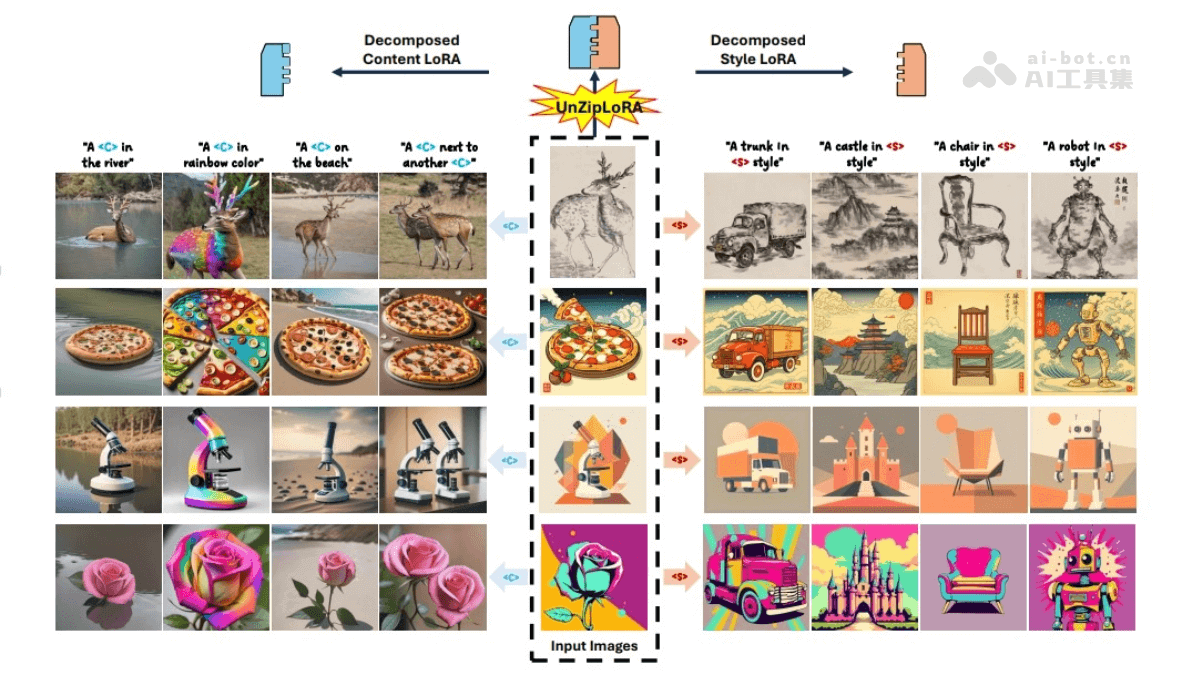
Main Features of UnZipLoRA
- Image Decomposition: UnZipLoRA can decompose a single image into two parts: subject (content) and style. This allows users to independently manipulate and recombine these two elements. Users can extract the style from an image and apply it to other subjects, or recombine a subject with different styles.
- Generate Variations of Subject or Style: Users can generate different variations of a subject or style, exploring different visual effects.
- Style Transfer: Apply the extracted style to a new subject to achieve style transfer.
- Reconstruct the Original Image or Create New Variations: By directly adding the subject and style LoRAs, the original image can be reconstructed or entirely new image combinations can be created.
- Compatibility: UnZipLoRA ensures that the two generated LoRAs are compatible and can be seamlessly combined through direct addition, achieving high-quality recontextualization.
Technical Principles of UnZipLoRA
- Solving the Entanglement Problem Between Content and Style: Content and style are often entangled in a single image. UnZipLoRA addresses this problem through the following three strategies:
- Prompt Separation Technique: By using different prompts for each LoRA, they are combined in the intermediate feature space of the diffusion model, ensuring that each LoRA focuses only on its specified concept.
- Column Separation Strategy: Dynamically allocate the columns of the LoRA weight matrices to ensure that high-importance columns do not interfere with each other between the two LoRAs.
- Block Separation Strategy: Reserve specific blocks in the U-Net for subject or style, further enhancing disentanglement.
- Efficient Training Method: UnZipLoRA reduces training time and computational resources by jointly training two LoRA models. Compared with methods that train two LoRAs separately, UnZipLoRA has shorter training time and updates fewer parameters.
UnZipLoRA Project Address
- Project Website:https://unziplora.github.io/
- arXiv Technical Paper:https://arxiv.org/pdf/2412.04465v1
Application Scenarios of UnZipLoRA
- Artistic Creation: UnZipLoRA provides artists with a powerful tool that can separate the subject (content) and style in a single image, enabling independent manipulation and recombination.
- Image Editing and Style Transfer: UnZipLoRA can generate independent LoRA models for subject and style. The models can be used to generate variations of the subject or style, and the extracted style can be applied to new subjects.
- Personalized Image Generation: UnZipLoRA supports extracting subject and style from a single image and generating new image variations through recombination. Users can generate personalized images according to their needs, repositioning the subject in different backgrounds or scenes while retaining its original style.
- Independent Manipulation of Content and Style: UnZipLoRA allows users to independently manipulate subject and style, generating different variants of a subject or style. It can generate multiple variants of a subject, or apply the extracted style to a new subject, exploring different visual effects.