
What is UNO
UNO is an innovativeAI image generationframework launched by ByteDance, breaking through the limitations of traditional models in multi-subject generation. Through a "few-to-many" generalization method, it can generate high-quality single-subject and multi-subject images, solving the consistency challenge in multi-subject scenarios. UNO generates highly consistent multi-subject data based on diffusion transformers, adopts progressive cross-modal alignment technology, trains the model in stages, and gradually improves the generation effect. It introduces Universal Rotary Position Embedding (UnoPE), supporting image generation at multiple resolutions and aspect ratios.
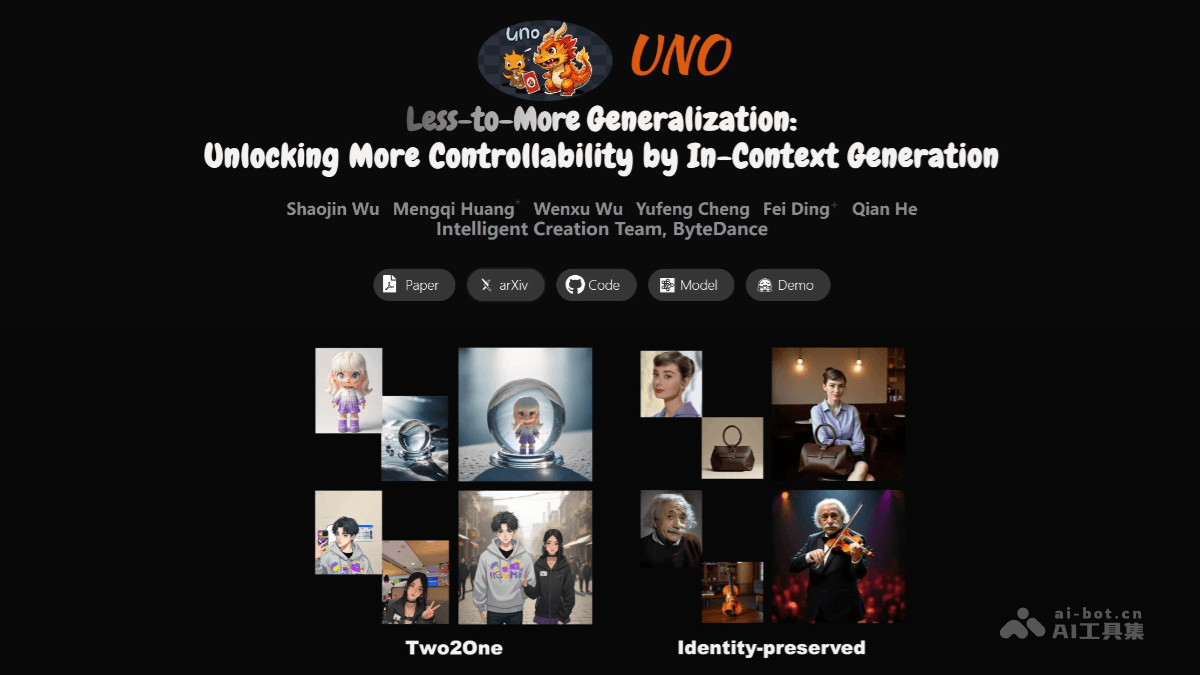
Main Features of UNO
- Single-subject customized generation: UNO can generate images that maintain the same subject features but place them in different scenes, poses, or styles based on a reference image.
- Multi-subject compositional generation: UNO can accept multiple reference images as input and generate a new image containing all reference subjects.
- Virtual try-on and product display: UNO supports virtual try-on functionality, allowing specific products (such as clothing, accessories, etc.) to be placed on different character models to display their effects. Products can be placed in various scenes while maintaining the original features of the product.
- Stylized generation: UNO can perform style transfer on reference subjects and generate images in different styles.
- Strong generalization ability: UNO has demonstrated strong generalization ability across multiple tasks and can adapt to various application scenarios, such as single-subject and multi-subject driven image generation, and can generalize to scenarios such as id, tryon, and style.
Technical Principles of UNO
- High-consistency data synthesis pipeline: UNO leverages the intrinsic in-context generation capability of Diffusion Transformers to generate highly consistent multi-subject paired data. It can automatically create large-scale, high-quality training data, solving the data acquisition challenge.
- Progressive cross-modal alignment: UNO adopts a progressive cross-modal alignment strategy, dividing the training process into two stages:
- First stage: Fine-tune a pretrained text-to-image (T2I) model using data pairs generated from single-subject context, enabling it to handle single-subject-driven generation tasks.
- Second stage: Introduce multi-subject data to continue training and enhance the model's ability to handle complex scenarios. Through this gradual alignment approach, the model can better adapt to generation tasks from single-subject to multi-subject.
- Universal Rotary Position Embedding (UnoPE): UNO introduces Universal Rotary Position Embedding (UnoPE), effectively solving the attribute confusion problem when extending visual subject control. UnoPE assigns specific position indices to text and image tokens, regulates the interaction between multimodal tokens, and enables the model to focus on obtaining layout information from text features, improving subject similarity while maintaining good text controllability.
- Model architecture: UNO is based on the open-source model FLUX.1 dev, inheriting its text-to-image foundational capabilities and multimodal attention mechanism, and adopts a universal customized model framework. This enables the model to be iteratively trained from a text-to-image model. Through its unique mechanisms such as progressive cross-modal alignment and universal rotary position embedding, it achieves both high consistency and controllability in single-subject and multi-subject driven generation.
- Data management and model evolution: UNO adopts a new paradigm of "model-data co-evolution"; the core idea is to use a weaker model to generate training data and train a stronger model. Letting the model gradually adapt to diverse scenarios during training can effectively handle complex situations that may be encountered in practical applications.
UNO's project address
- Project official website:https://bytedance.github.io/UNO/
- Github repository:https://github.com/bytedance/UNO
- HuggingFace model:https://huggingface.co/bytedance-research/UNO
- arXiv technical paper:https://arxiv.org/pdf/2504.02160
UNO's application scenarios
- Virtual try-on: UNO can place different products such as clothing and accessories on virtual character models to generate try-on effects in different scenarios.
- Product design: In product design, UNO can place products in various backgrounds and scenarios while preserving the original features of the product, providing designers with more flexible design ideas.
- Creative design: UNO can accept multiple reference images as input and generate a new image containing all the reference subjects.
- Personalized content generation: UNO can generate images based on one reference image that preserve the same subject's features but are in different scenarios, poses, or styles.
- Character and scene design: UNO can provide powerful image generation support for game development, helping developers quickly generate characters and scenes and spark creativity.