
What is UniWorld V2
UniWorld V2 is a new-generation image editing model launched by Rabbitpre Intelligent and the UniWorld team at Peking University. It adopts the innovative UniWorld-R1 training framework, applying reinforcement learning policy optimization to image editing for the first time, and achieves efficient training through DiffusionNFT technology. The model uses a multimodal large language model as the reward model, providing stable and fine-grained feedback, while introducing a low-variance group filtering mechanism to improve training stability. It can accurately understand and render complex Chinese fonts, supports fine-grained spatial control, such as specifying the editing area via a frame, and can achieve global lighting and shadow fusion, making images more natural and harmonious. It has achieved leading results on industry benchmarks such as GEdit-Bench and ImgEdit, comprehensively surpassing existing public models.
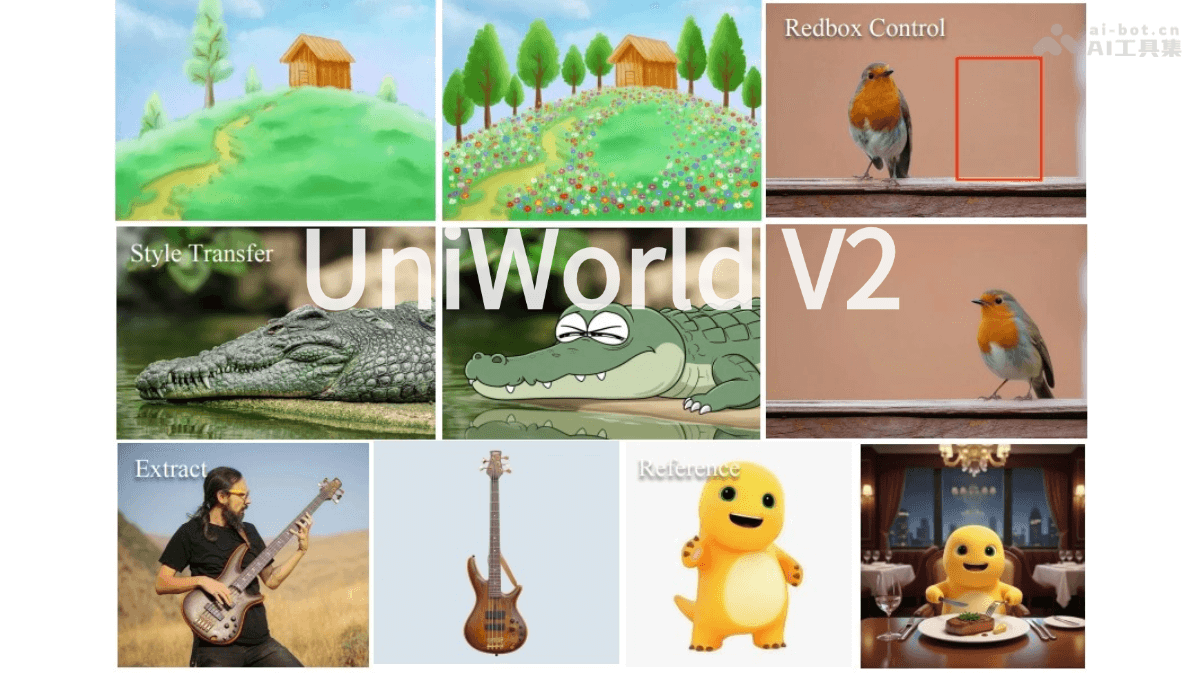
Main features of UniWorld V2
-
Accurate rendering of Chinese fonts: It can understand and generate complex artistic Chinese fonts, such as "月满中秋", with clear results and accurate semantics, and can modify text with just a simple instruction.
-
Fine-grained spatial control: It supports specifying the editing area via a frame, for example, "move the bird out of the red frame". The model can strictly comply with spatial constraints and complete highly difficult operations.
-
Global lighting and shadow fusion: It deeply understands lighting and shadow instructions, such as "relight the scene", so that objects naturally blend into the scene, with a high degree of lighting and shadow fusion and a unified and harmonious picture.
-
Instruction alignment and image quality improvement: It performs excellently in instruction alignment and image quality, and users prefer its output results, especially in instruction following.
-
Applicability to multiple models: The framework is model-agnostic and can be applied to a variety of base models, such as Qwen-Image-Edit and FLUX-Kontext, significantly improving the performance of these models.
Technical principles of UniWorld V2
-
Innovative training framework: It adopts the UniWorld-R1 training framework, applying reinforcement learning policy optimization to image editing for the first time, and uses Diffusion Negative-aware Finetuning (DiffusionNFT) technology to achieve policy optimization without likelihood estimation, improving training efficiency.
-
Multimodal reward model: It uses a multimodal large language model (MLLM) as the reward model, directly using the log values of its output to provide fine-grained feedback, avoiding the computational overhead and bias caused by complex reasoning and sampling.
-
Low-variance group filtering mechanism: To address the low-variance group problem in reward normalization, a filtering strategy based on reward mean and variance is designed to remove sample groups with high mean and low variance, stabilizing the training process.
-
Model-agnosticism: The framework is designed to be model-agnostic and can be applied to a variety of base image editing models, such as Qwen-Image-Edit and FLUX-Kontext, with broad applicability.
Project address of UniWorld V2
- Github repository:https://github.com/PKU-YuanGroup/Uniworld
- arXiv technical paper:https://arxiv.org/pdf/2510.16888
Application scenarios of UniWorld V2
-
Image editing and design: It can precisely edit images according to user instructions, such as modifying text in the image, adjusting object positions, and changing scene lighting, making it suitable for fields such as poster design, advertising creativity, and visual art.
-
Content creation and generation: It helps creators quickly generate image content that meets specific requirements, improving creation efficiency, and is suitable for scenarios requiring a large amount of image material, such as video production, animation design, and game development.
-
Product Display and Marketing: Enhance product display through image editing, such as adding special effects to products, adjusting backgrounds, and optimizing lighting and shadows, to increase product appeal. Suitable for e-commerce product displays, brand promotion, etc.
-
Education and Training: As a teaching tool, it helps students and trainees better understand and master image editing techniques. It can also be used to create education-related image materials, such as textbook illustrations, teaching courseware, etc.
-
Scientific Research and Experiments: In the field of scientific research, it can be used to generate simulated image data to assist experimental design and result presentation, for example, generating image samples under specific conditions in fields such as medical image processing and environmental science.