
What is UniRig
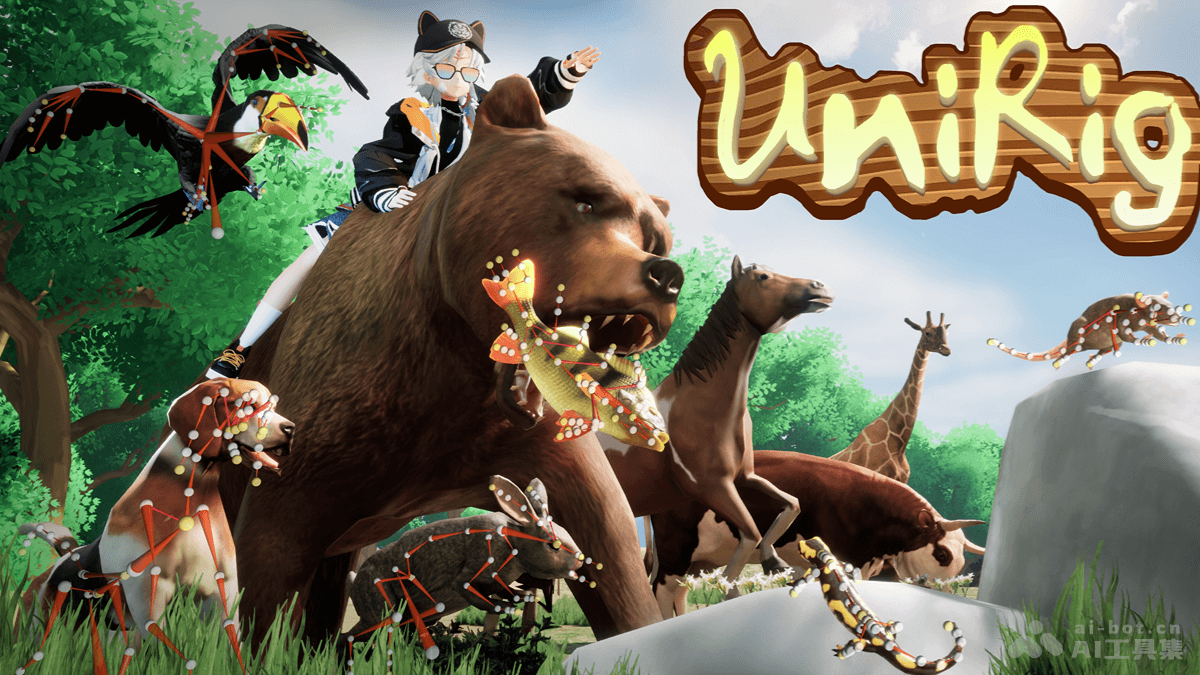
UniRig is an innovative automatic rigging framework jointly launched by the Department of Computer Science and Technology at Tsinghua University and VAST, used for handling complex and diverse 3D models. Based on a large autoregressive model and a bone point cross-attention mechanism, it generates high-quality skeletal structures and skinning weights. The framework introduces the Rig-XL dataset, containing over 14,000 3D models covering multiple categories, used for training and evaluation. UniRig significantly outperforms existing academic and commercial methods in rigging accuracy and motion accuracy, supports seamless application to various object categories from anime characters to complex organic and inorganic structures, and greatly improves the efficiency of animation production.
Main Features of UniRig
- Automatic Skeleton Generation: Generates topologically correct skeleton trees for various 3D models (such as humans, animals, fictional characters, etc.).
- Skinning Weight Prediction: Predicts the influence weight of each bone on mesh vertices, ensuring the mesh deforms naturally under skeletal animation driving.
- Support for Diverse Models: Applicable to multiple types of 3D models, including complex organic and inorganic structures.
- Efficient Animation Production: Improves the efficiency of animation production and reduces the time and workload of manual operations.
- Dynamic Effect Support: Generates skeletal attributes that support physical simulation (such as spring bones).
Technical Principles of UniRig
- Skeleton Tree Tokenization: Converts the skeleton tree structure into serialized tokens for efficient processing by the autoregressive model. Based on special tokens (such as <type>) to represent bone types (such as spring bones, template bones), it uses a depth-first search (DFS) algorithm to extract linear bone chains, compactly representing the skeleton structure.Skeleton tree tokenization can reduce sequence length and improve the model's training and inference efficiency.
- Autoregressive Model: A Transformer-based autoregressive model (such as Skeleton Tree GPT) predicts the skeleton tree. The model generates tokens one by one to build the skeleton tree, ensuring that the generated skeleton structure is topologically valid. The model's input includes a point cloud sampled from the 3D mesh and optional category information, and the output is a token sequence representing the skeleton tree.
- Bone Point Cross-Attention Mechanism: Based on a point cloud encoder and a skeleton encoder, it extracts features from the point cloud and skeleton tree respectively, and uses a cross-attention mechanism to combine the features to predict skinning weights.
- Large-Scale Dataset: To train and evaluate UniRig, the researchers constructed the Rig-XL dataset, containing over 14,000 3D models covering multiple categories. The diversity and scale of the dataset allow UniRig to learn different types of skeletal structures and skinning weights, improving the model's generalization ability.
- Physical Simulation-Assisted Training: Introduces physical simulation during training, based on simulating the movement of bones under physical forces (such as gravity, elastic forces), to evaluate the rationality of the predicted skinning weights and skeletal attributes. The indirect supervision method can guide the model to learn realistic skinning weights and improve the realism of animations.
UniRig Project Address
- Project Official Website:https://zjp-shadow.github.io/works/UniRig/
- GitHub Repository:https://github.com/VAST-AI-Research/UniRig
- HuggingFace Model Library:https://huggingface.co/VAST-AI/UniRig
- arXiv Technical Paper:https://zjp-shadow.github.io/works/UniRig/static/supp/UniRig.pdf
Application Scenarios of UniRig
- Animation Production: Quickly generates bones and skinning weights, reduces manual operations, and improves animation production efficiency.
- Virtual Characters: Generate natural and smooth skeletal rigging for virtual characters (such as VTubers), supporting real-time animation.
- Game Development: Quickly generate skeletal rigging for characters and objects, supporting dynamic effects and enhancing game visuals.
- 3D Content Creation: Suitable for architectural design, industrial design, etc., supporting skeletal rigging for diverse 3D models.
- Education: As a teaching tool, helping learners quickly grasp the basic concepts of skeletal animation.