
What is UniReal
UniReal is a framework jointly launched by the University of Hong Kong and Adobe Research, focused on implementing a variety of image generation and editing tasks. Based on simulating real-world dynamics, the framework can handle a wide range of tasks including image generation, editing, customization, and composition within a single model. UniReal treats different numbers of input and output images as video frames, using large-scale video data as a universal supervision source to learn consistency and variability, generating realistic images. UniReal demonstrates exceptional capabilities in handling complex scenarios such as shadows, reflections, lighting effects, and object pose changes, and can generalize to new application domains.
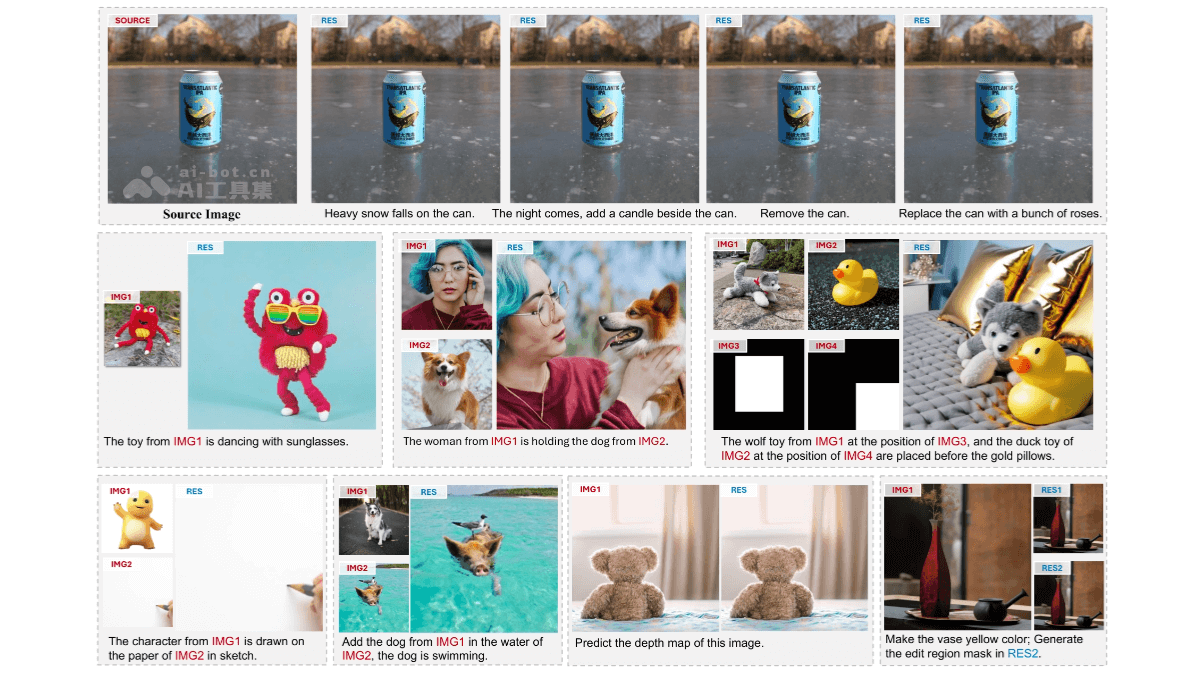
UniReal's Main Features
- Image Generation: Generate new image content based on text prompts.
- Image Editing: Supports editing existing images, such as adding, removing, or replacing objects in the image.
- Image Customization: Users can customize images to meet specific visual elements or style requirements.
- Image Composition: Combine elements from multiple images into a new image.
- Style Transfer: The framework can change the style of an image, such as converting an image into a watercolor painting style.
- Depth Estimation and Image Understanding: UniReal can predict the depth map of an image, performing image understanding and analysis.
UniReal's Technical Principles
- Video Generation Framework: Based on the design principles of video generation models, treating image tasks as "discontinuous" video frame generation problems.
- Full Attention Model: The framework uses a full attention mechanism to model the relationships between frames, processing input and output images.
- Hierarchical Prompts: UniReal designs a hierarchical prompt scheme, including base prompts, context prompts, and image prompts, reducing ambiguity during training and inference.
- Text-Image Association: Constructs embedding pairs to associate visual tokens with corresponding text, allowing the model to reference specific images based on text prompts.
- Data Construction: Constructs training data from video data, using the natural consistency and variability between video frames to support various image generation and editing tasks.
- Universal Supervision: The framework uses large-scale video data as a universal supervision source, learning how to maintain consistency and capture visual changes across different images.
UniReal's Project Address
- Project Website:xavierchen34.github.io/UniReal
- arXiv Technical Paper:https://arxiv.org/pdf/2412.07774
UniReal's Application Scenarios
- Digital Content Creation: Artists and designers generate or edit images to create new artworks or design concept images.
- Media and Entertainment: In film and game production, rapid prototyping and proof of concept, generating realistic backgrounds and scenes.
- Advertising and Marketing: Marketers customize advertising images to quickly respond to market changes and customer needs.
- E-commerce: E-commerce platforms provide virtual try-on services, showcasing how clothing looks on different models.
- Education and Training: In the education field, create realistic teaching materials and simulated scenarios to enhance the learning experience.