
What is UniBench
UniBench is a vision-language model (VLM) evaluation framework launched by Meta FAIR, providing comprehensive evaluation of vision-language models (VLMs). UniBench includes over 50 benchmarks, covering multi-dimensional capabilities such as object recognition, spatial understanding, and reasoning. Meta FAIR also launched a "self-taught evaluator" that is trained using synthetic data, reducing reliance on manual annotation, and its performance surpasses commonly used model reviewers such as GPT-4.
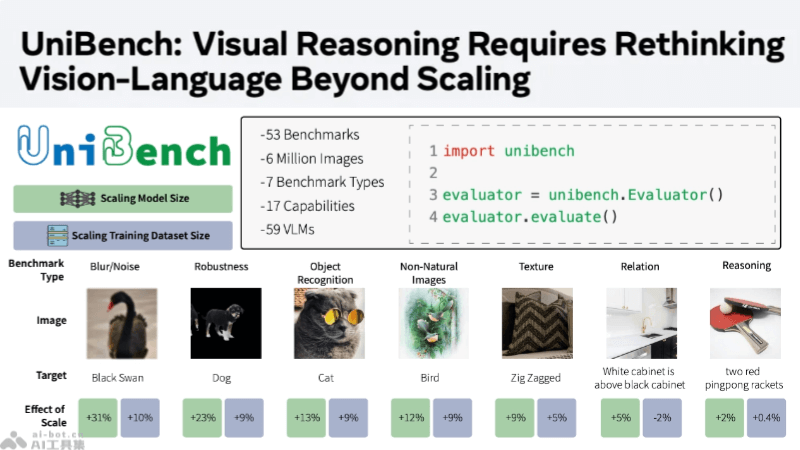
Main Features of UniBench
- Comprehensive Evaluation: Provides over 50 carefully categorized benchmarks, covering multiple dimensions of vision-language capabilities such as object recognition, spatial understanding, and reasoning.
- Unified Interface: Simplifies the process of adding models and benchmarks, improving the flexibility and scalability of evaluation.
- Performance Analysis: Generates visualization charts to help researchers gain a deeper understanding of the model's strengths and limitations.
- Dataset Support: Supports multiple datasets, including torchvision datasets and custom datasets.
- Processor Abstraction: Evaluation logic is abstracted into reusable processors, simplifying the addition of new evaluation methods.
Technical Principles of UniBench
- Benchmark Design: Over 50 benchmarks are carefully designed, covering different dimensions of visual and language processing capabilities to ensure the comprehensiveness of evaluation.
- Unified Evaluation Interface: Provides a standardized interface that supports researchers in easily adding new models or benchmarks.
- Modular Architecture: Adopts a modular design, abstracting evaluation logic into reusable handlers, simplifying the integration and application of new evaluation methods.
- Dataset Compatibility: Supports multiple types of datasets, including torchvision datasets and custom datasets, improving the adaptability of evaluation.
- Performance Analysis Tools: Provides detailed performance analysis tools that can generate various visualization charts to help researchers gain a deeper understanding of the model's performance characteristics.
- Streamlined Evaluation Set: By analyzing the correlations between benchmarks, the most representative benchmarks are selected to form a streamlined evaluation set, reducing the computational cost of comprehensive evaluation.
- Automation and Manual Review: Combines automated screening and manual review to ensure the quality of evaluation samples, reduce data leakage, and improve the fairness of evaluation.
- Multimodal Gain/Leakage Metrics: Introduces multimodal gain (MG) and multimodal leakage (ML) metrics to quantify the performance improvement and degree of data leakage of models in multimodal tasks.
Project Address of UniBench
-
GitHubRepository:https://github.com/facebookresearch/unibench
- arXiv Technical Paper:https://arxiv.org/html/2408.04810v1
Application Scenarios of UniBench
- Academic Research: Provides researchers with a standardized tool for evaluating and comparing the performance of different vision-language models.
- Model Development: Helps developers test and optimize their vision-language models, quickly identifying the model's strengths and weaknesses through benchmarks.
- Education: Serves as a teaching tool to help students understand the working principles and evaluation methods of vision-language models.
- Industrial Applications: Evaluate the practical application effectiveness of vision-language models in industrial fields such as automated image analysis, intelligent surveillance, and autonomous driving.
- Product Testing: Enterprises can use UniBench to comprehensively test the vision-language features integrated into their products, ensuring product quality.