
What is Uni-AdaFocus
Uni-AdaFocus is a general and efficient video understanding framework launched by a research team from the Department of Automation at Tsinghua University. Through an adaptive focusing mechanism, the framework dynamically adjusts the allocation of computational resources to achieve efficient processing of video content. Specifically, Uni-AdaFocus can intelligently screen video frames based on their importance, prioritizing frames that contain key information, while applying simplified processing or skipping processing for other frames, greatly reducing unnecessary computational overhead.
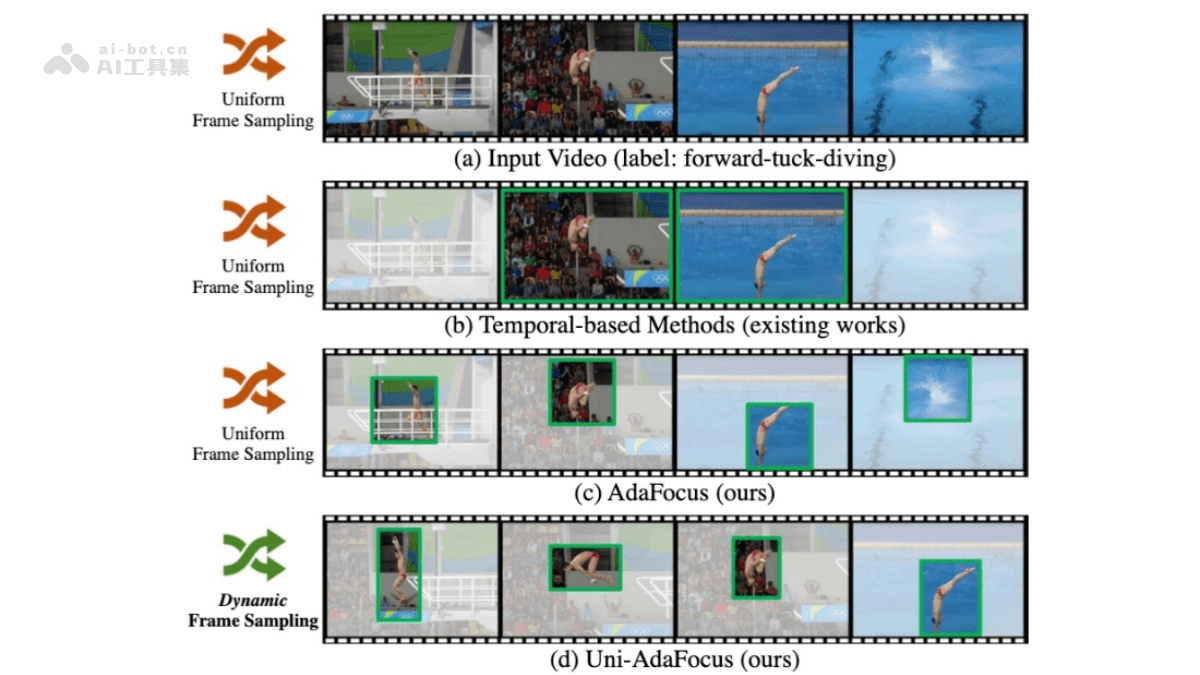
Main features of Uni-AdaFocus
- Reduce temporal redundancy: It can dynamically locate and focus on task-relevant key video frames, concentrating computational resources on these key frames, avoiding equal processing of all frames, reducing redundant computation in the temporal dimension, and improving processing efficiency.
- Reduce spatial redundancy: In each video frame, only a portion of the spatial regions is relevant to the task. Uni-AdaFocus can dynamically locate and focus on task-relevant spatial regions in video frames, performing focused processing only on these regions, reducing spatial redundancy and further improving efficiency.
- Reduce sample redundancy: It allocates more computational resources to more difficult samples, differentially allocating computational resources among different samples, and reducing computational investment for relatively "easy" videos, achieving redundancy modeling in the sample dimension and improving overall processing performance.
- Efficient end-to-end training: It uses some mathematical methods to handle the non-differentiable problem of spatiotemporal dynamic computation, allowing convenient and efficient end-to-end training without the need for more complex methods such as reinforcement learning.
- Strong compatibility: It is compatible with a variety of off-the-shelf efficient backbone networks, such as TSM and X3D, and can significantly improve the inference efficiency of these backbone networks.
- Flexibly adjustable inference cost: The inference cost of Uni-AdaFocus can be adjusted online without additional training, simply by modifying the criterion for sample-conditioned computation. It can fully utilize unstable computational resources or flexibly achieve the desired performance level with minimum power consumption.
Technical principles of Uni-AdaFocus
- Global encoder: It uses a lightweight feature extraction network (such as MobileNet-V2, etc.) to roughly process uniformly sampled video frames and obtain the overall spatiotemporal distribution information of the video, that is, global features.
- Policy network: Based on the global features extracted by the global encoder, it adaptively samples key frames and the key regions within them, obtaining patches worthy of attention. The shape and size of the patches are adaptively determined according to the specific characteristics of the video frames.
- Local encoder: A large-capacity neural network with a large number of parameters and high accuracy, which processes only the patches selected by the policy network, that is, local features.
- Classifier: It aggregates global features and local features frame by frame to obtain the optimal video understanding result, and at the same time models computational redundancy in the sample dimension through an early-exit mechanism.
Project address of Uni-AdaFocus
- GitHub repository:https://github.com/LeapLabTHU/Uni-AdaFocus
- arXiv technical paper:https://arxiv.org/pdf/2412.11228
Application scenarios of Uni-AdaFocus
- Video recommendation systems: Uni-AdaFocus can provide users with more personalized recommendation services by efficiently identifying key information in video content.
- Video surveillance and security alerts: By real-time monitoring of abnormal behaviors and emergencies in video streams, Uni-AdaFocus can respond quickly and issue alerts, helping relevant departments take timely measures.
- Intelligent Editing and Creation: For video creators, it can automatically identify key scenes and highlight moments in videos, helping creators quickly complete editing and post-production.
- Education and Training: Uni-AdaFocus can accurately capture teachers' teaching actions and students' learning responses, improving teaching quality and learning outcomes.
- Healthcare: When using brain magnetic resonance imaging (MRI) to diagnose Alzheimer's disease and Parkinson's syndrome, Uni-AdaFocus can efficiently identify and analyze key features in MRI images, assisting doctors in making more accurate diagnoses.