
What is Uni-1.1
Uni-1.1 is a new generationimage generationmodel and API service launched by Luma AI, adopting a decoder-only autoregressive Transformer architecture that integrates text reasoning and pixel generation into a unified process. The model supports joint input of up to 9 reference images, sentence-level image editing, complex layout generation, and multilingual text rendering, ranking third globally on the Arena.ai blind test leaderboard. The API offers two modes: pay-as-you-go billing and reserved throughput, with a minimum cost of approximately $0.04 per image, targeting enterprise-level scenarios such as advertising, e-commerce, and content creation.
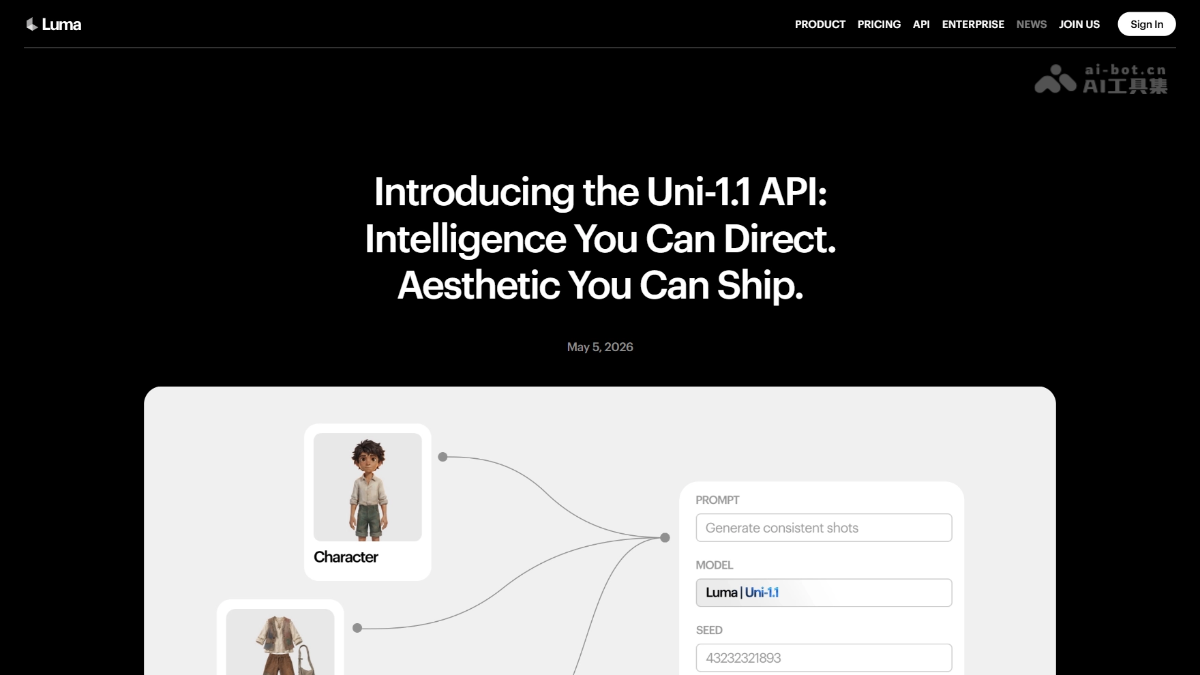
Main Features of Uni-1.1
-
Text-to-Image: Generates high-quality images based on text prompts, capable of outputting complex layouts containing a dozen or so types of layout elements such as headers, navigation, advertisements, and body text in a single pass.
-
Image Editing: Performs multi-round editing based on sentence-level instructions, preserving unmentioned elements by default, enabling iterative visuals much like editing a document.
-
Multi-Reference Image Fusion: A single call supports joint input of up to 9 reference images, performing semantic-level fusion of brand logos, products, real people, characters, etc. as model-level hard constraints.
-
Spatial and Pose Control: Supports precise control such as rotation, viewpoint switching, and spatial relationship adjustment, maintaining subject identity and texture without loss.
-
Multilingual Rendering: Supports high-quality text generation for non-Latin characters such as Chinese and Arabic, meeting global content needs.
Technical Principles of Uni-1.1
-
Unified Autoregressive Architecture: Adopts a decoder-only autoregressive Transformer, where text tokens and image tokens share the same sequence, enabling cross-modal joint reasoning.
-
Integrated Reasoning and Generation: The model performs cross-modal reasoning before generating pixels; constraints such as composition, space, and brand consistency are solved at the structural level, rather than translating first and then drawing.
-
Dual-Endpoint API Design: Provides a Reasoning endpoint (deconstructs instructions, plans composition, locks brand/character/product constraints) and a Generation endpoint (completes pixel rendering based on reasoning results).
-
Reference Image Hard Constraint Mechanism: Passes multiple reference images as model-level hard constraints to ensure visual identity remains consistent across all channels and versions.
How to Use Uni-1.1
-
Register an Account: Visit the Luma AI developer platform official website (https://platform.lumalabs.ai)注册并登录账号。
-
Obtain a Key: Create a project in the developer console and obtain an API Key.
-
Choose a Billing Mode: Choose the Build plan (pay-as-you-go, suitable for flexible calls) or the Scale plan (reserved throughput, minimum order of 8 units, suitable for large-scale production) based on usage.
-
Call the Reasoning Endpoint: Send text instructions and reference images, letting the model deconstruct requirements, plan composition, and lock brand/character constraints.
-
Call the Generation Endpoint: Complete pixel rendering based on reasoning results and obtain the final generated image.
-
Integrate the SDK: Integrate the API into existing workflows through the officially provided Python, JavaScript, TypeScript, Go, or CLI SDK.
-
Upload Reference Images: Pass up to 9 reference images as hard constraints in the request to ensure the output is consistent with the brand's visual identity.
-
Iterative Editing: Use sentence-level editing instructions to make multiple rounds of adjustments to generated results, gradually optimizing until satisfactory.
Key Information and Usage Requirements of Uni-1.1
-
Product Name:Luma Uni-1.1 / Uni-1.1-Max
-
Publisher: Luma AI (core research team of fewer than 15 people)
-
Release Date: May 6, 2026
-
Product Positioning: Enterprise-grade AI image generation model and API service
-
Technical Architecture: decoder-only autoregressive Transformer (integrated reasoning and generation)
-
Leaderboard Ranking: No. 3 globally on Arena.ai (behind OpenAI gpt-image-2 and Google nano-banana-2)
-
Price Range: Build plan text-to-image $0.0404–$0.1000 (2048px); Scale plan monthly fee $2,100–$3,800/unit
-
Enterprise Customers: Adidas, Mazda, Publicis Groupe, Serviceplan, Envato, Comfy, Krea, etc.
-
SDK Support:Python、JavaScript、TypeScript、Go、CLI
-
Core Team: Song Jiaming (Jiaming Song, author of DDIM), Shen Bokui (William Shen, CVPR Best Paper)
Core Advantages of Uni-1.1
-
World's No. 3 Generation Quality: Ranked No. 3 globally in Arena.ai user blind-test ELO ratings, behind only OpenAI gpt-image-2 and Google nano-banana-2.
-
Extreme Cost-Effectiveness: A single 2K-resolution image costs as little as $0.0404, with both price and latency less than half of comparable top-tier models.
-
Enterprise-Grade Consistency: Through hard constraints from reference images and sentence-level editing, it solves the pain points of traditional models such as character deformation, brand color drift, and inconsistent styles across markets.
-
Complex Tasks Completed in a Single Pass: It can generate a complete, readable news website page or a full set of advertising campaign assets in one go, without the need for multi-module stitching.
Comparison of Uni-1.1 with Similar Competitors
| Comparison Dimension | Luma Uni-1.1 / Uni-1.1-Max | OpenAI GPT-image-2 | Google Nano Banana 2 |
|---|---|---|---|
| Arena.ai Ranking | No. 3 (ELO 1193) | No. 1 (ELO 1398) | No. 2 (ELO 1268) |
| Publisher | Luma AI (15-person Chinese team) | OpenAI | |
| Core Architecture | decoder-only autoregressive Transformer, integrated reasoning and generation | Specific architecture not disclosed (presumed to be diffusion model + multimodal) | Specific architecture not disclosed (presumed to be Gemini series multimodal) |
| Integrated Reasoning and Generation | ✅ Text and image tokens share the same sequence, reasoning first and then generation | ❌ Traditional pipeline, with understanding and generation separated | ❌ Traditional pipeline, with understanding and generation separated |
| Multi-Reference Image Fusion | ✅ Up to 9 reference images jointly input in a single pass, with semantic-level fusion | ⚠️ Supports reference images but fusion accuracy is limited | ⚠️ Supports reference images but constraint capability is average |
| Sentence-Level Editing | ✅ Edit images sentence by sentence, preserving unmentioned elements by default | ⚠️ Supports editing but consistency control is weak | ⚠️ Supports editing but multi-round iteration easily collapses |
| Complex Layout Generation | ✅ Can generate a complete news website/advertising page in a single pass, with readable text | ⚠️ Prone to errors with long text and complex layouts | ⚠️ Complex layouts require stitching multiple modules together |
| Price per 2K resolution single image | Starting at $0.0404(less than half of competitors) | Higher (undisclosed, estimated $0.08+) | Higher (undisclosed, estimated $0.08+) |
| Enterprise-grade brand consistency | ✅ Reference images serve as model-level hard constraints, locking in visual identity across versions | ⚠️ Character/brand colors drift easily, requiring repeated retries | ⚠️ Style consistency control is average |
| Multilingual text rendering | ✅ Supports non-Latin characters such as Chinese and Arabic | ✅ Excellent in English, occasional flaws in Chinese | ✅ Good multilingual support |
| Latency performance | Low latency (less than half of competitors) | Medium | Medium |
| Key advantages | Extremely high cost-effectiveness, enterprise consistency, single-pass completion of complex tasks, clear ROI | Top-tier generation quality, leading aesthetics, mature ecosystem | Google ecosystem integration, stable generation, good multilingual performance |
| Key disadvantages | Small team, ecosystem still being built | High price, weak enterprise consistency, poor editing controllability | High price, weak complex layout and editing flexibility |
| Typical enterprise customers | Adidas, Mazda, Publicis Groupe, Serviceplan | Large enterprises, creative agencies | Google Cloud customers, advertisers |
| Applicable scenarios | Advertising localization, e-commerce batch generation, IP consistency, brand pipelines | High-end creativity, artistic exploration, prototype design | Multilingual content, production within the Google ecosystem |
Uni-1.1 application scenarios
-
Advertising localization: Rapidly expand key visuals into multilingual and multi-regional versions, lock in brand elements through reference images, and greatly shorten production cycles.
-
E-commerce product visualization: Generate consistent product images in real time based on product photos, fabric samples, and scene references, replacing traditional shooting and template-based workflows.
-
Character and IP consistency: Provide character consistency guarantees across scenes, poses, and lighting for game promotional art, comics, and film/TV pre-production.
-
Brand content pipeline: Integrate into enterprise content production systems to enable batch generation and style unification of visual assets across markets.
-
Creative prototype design: Combine hand-drawn sketches with material references to quickly generate realistic product concept images and 3D clothing renders.