
What is U2
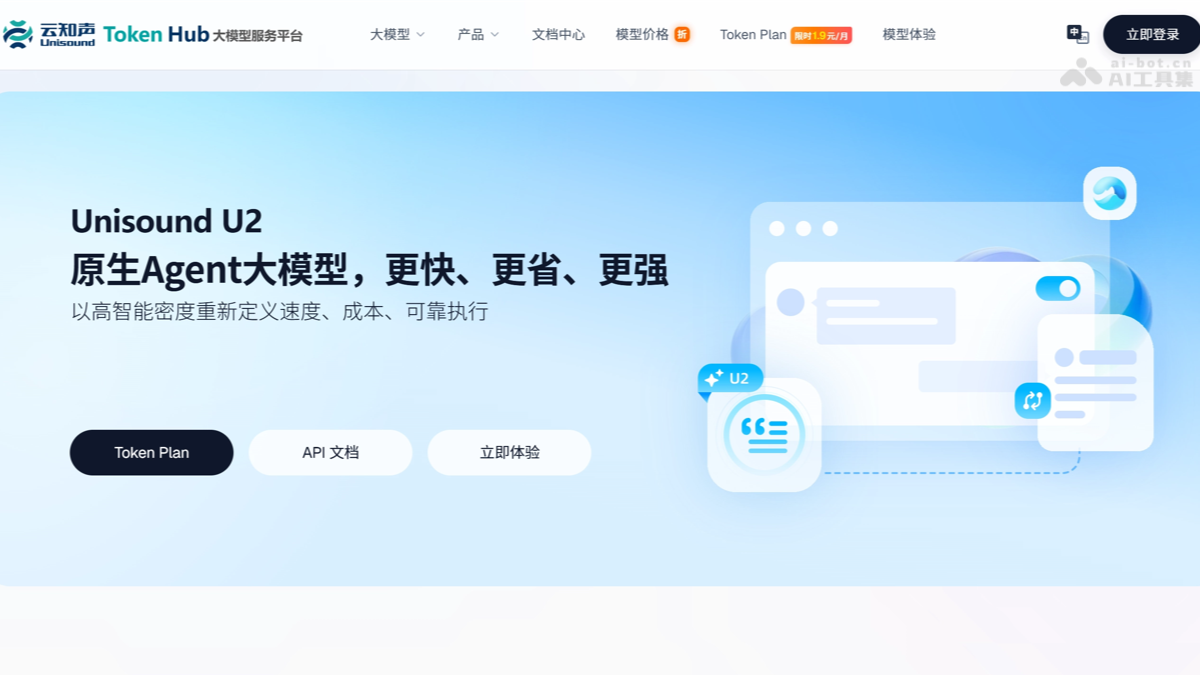
U2 is a native agent large model launched by Unisound for individuals, developers, and organizations. It has 266 billion parameters yet achieves performance at the 1.2 trillion parameter level. The model's core philosophy is high intelligence density × high Token value. Through a hybrid thinking mechanism and Agent-Harness collaborative training, it can autonomously decompose and complete 100+ step complex real-world workflows, and has entered the first tier of domestic large models in evaluations such as GPQA, SWE-Bench, and Claw-Eval.
U2's main features
-
Autonomous task execution: It can autonomously decompose and complete 100+ step complex real-world workflows, covering requirements understanding, task planning, environment interaction, tool calling, process error correction, and result acceptance.
-
End-to-end coding delivery: It supports generating code based on natural language requirements, understanding multi-file project structures, maintaining interface and dependency consistency, and autonomous Debug.
-
Multi-tool collaborative Agent: It supports combined calls of multiple tools, long-process orchestration, and interaction with external environments, dynamically adjusting execution strategies based on feedback.
-
Full-form interface generation: It can generate responsive web pages and mobile applications with production-grade layouts, real navigation flows, and complete interaction states.
-
Deep research and analysis: It supports cross-industry data retrieval, multi-source information cleaning, and structured analysis of professional literature, outputting PPT, Word, or interactive HTML reports.
-
Immersive application development: It can independently complete algorithm design, code writing, environment debugging, and error fixing, delivering applications such as games and physics simulators.
U2's technical principles
- High knowledge density data refinement: U2 adopts knowledge-point-level refinement and extraction technology, filtering out duplicate, low-quality, and hallucination-prone data, retaining only the high-knowledge-content parts, thereby improving the effective knowledge density per unit parameter of the model from the source.
- Semantic Token compression optimization: By optimizing tokenization and representation strategies, each Token carries more effective information, achieving shorter sequence lengths under the same semantics and reducing expression redundancy.
- Knowledge-point-level verification and self-feedback: A continuous correction mechanism is built to perform real-time verification and self-feedback on key knowledge points during generation, actively suppressing hallucinated outputs and adding a reliability safeguard for high knowledge density expression.
- Sparse MoE and knowledge distillation architecture: Based on a sparse mixture-of-experts (MoE) structure, combined with sparse knowledge encoding and knowledge distillation, it activates lean experts on demand; 266 billion parameters achieve performance at the 1.2 trillion parameter level, with parameter efficiency close to 5x.
- Hybrid Thinking mechanism: It dynamically switches between implicit and explicit thinking forms within the same reasoning process: in the early stage of a task, it efficiently completes path search and task decomposition in latent space, avoiding decoding every step into visible Tokens; when entering key judgment, complex constraint handling, or result convergence stages, it switches to an explicit chain of thought, completing logic calibration and precise derivation through readable, verifiable reasoning.
How to use U2
-
Visit the official website: Visit the Unisound Token Hub official website (https://maas.unisound.com/models/u2)注册并获取 API permissions.
-
Choose an access method: It supports mainstream Agent scaffolds such as OpenClaw and Hermes, and can seamlessly connect to existing development processes.
-
Define task objectives: Describe complex workflow requirements in natural language (such as "generate a multi-page responsive website" or "complete an in-depth industry research report").
-
Autonomous Execution and Iteration: U2 automatically decomposes tasks, invokes tools, generates code or documents, and autonomously self-corrects and performs acceptance checks during the process.
-
Result Delivery and Integration: Obtain the final deliverables, ready for direct use in the production environment or for further manual review.
U2's Core Advantages
-
Winning Big with Small: 266 billion parameters achieve the performance of 1.2 trillion parameter-level models, with parameter efficiency close to 5 times, and inference cost significantly lower than models of the same size scale.
-
Token Efficient: The hybrid thinking mechanism reduces thinking Token consumption by about 25%, requires fewer interaction rounds for complex tasks, and lowers the cost per business transaction.
-
Native Agent Capabilities: Agent capabilities are not bolted on; they support 100+ step long-chain execution and multi-tool collaboration.
-
Systematic Leadership: It has entered the top tier across multiple dimensions including reasoning, code, Agent, and office work, rather than being a single-point breakthrough.
-
Real Workflow Closed Loop: Moving from giving answers to completing tasks, covering end-to-end delivery scenarios such as design, coding, research, and office work.
U2's Project Address
- Online Experience:https://maas.unisound.com/models/u2
Comparison of U2 with Similar Competing Products
| Dimension | Unisound U2 | Kimi K2.5 (Moonshot AI) |
|---|---|---|
| Model Positioning | Native intelligent agent large model, oriented toward task execution and end-to-end delivery | Open-source native multimodal intelligent agent model, autonomously completing complex tasks |
| Core Architecture | Sparse MoE, 266 billion parameters, hybrid thinking mechanism | MoE architecture, specific parameters not disclosed, supports extended thinking mode |
| Agent Implementation Method | Agent-Harness collaborative training, natively built-in tool invocation, long-process orchestration, and environment interaction | Tool use capabilities are built into the model itself, without relying on external management workflows |
| Thinking Mechanism | Hybrid thinking (dynamic switching between implicit exploration + explicit verification), thinking Tokens reduced by about 25% | Extended Thinking mode, with explicit reasoning chains unfolded token by token |
| SWE-Bench Verified | 75 | 76.8 |
| LiveCodeBench | Not disclosed | 85 |
| GPQA Diamond | 87.9 | Not disclosed |
| Claw-Eval (pass@3) | 76.9 | Not disclosed |
| GDPval / IFBench | 72.9 / 77.3 | Not disclosed |
| Context Window | Supports long context (specific length not explicitly disclosed) | Supports long context (specific length not explicitly disclosed) |
U2's Application Scenarios
-
Intelligent Office Automation: Cross-system capture of core business data and completion of cross-validation, automatically generating visual dashboards and business/quarterly review reports, achieving automation of the organization's periodic review process.
-
Full-Stack Front-End Development: Directly deliver multi-page responsive websites or mobile Web Apps based on natural language descriptions, covering resource search, localization processing, interaction logic writing, and one-click packaging output.
-
In-Depth Industry Research: Autonomously retrieve multi-source data for cutting-edge complex domains, and output interactive HTML in-depth reports or PPTs with real data sources, meeting expert-level research delivery needs.
-
Games and Interactive Applications: Independently complete the closed loop of algorithm design, code writing, environment debugging, and error fixing, and deliver immersive interactive applications such as classic games or physics simulators.
-
Enterprise-grade Agent Integration: Connect to existing enterprise systems through APIs, serving as a native intelligent agent hub to schedule multiple tools and complete 100+ step complex business workflows, reducing the interaction cost of long-chain tasks.