
What is TurboEdit
TurboEdit is an AI instant image editing model launched by Adobe Research. Through encoder iterative inversion and text-based fine control, it can achieve precise image editing in a few steps. By using detailed text prompts and modifying a single attribute in the prompt, it can precisely change the corresponding attribute in the image while keeping other features unchanged. The advantage of TurboEdit lies in its speed, efficiency, and outstanding performance in text-guided image editing. It only needs 8 function evaluations to complete image inversion, and each edit requires only 4 function evaluations, greatly improving the speed and quality of image editing.
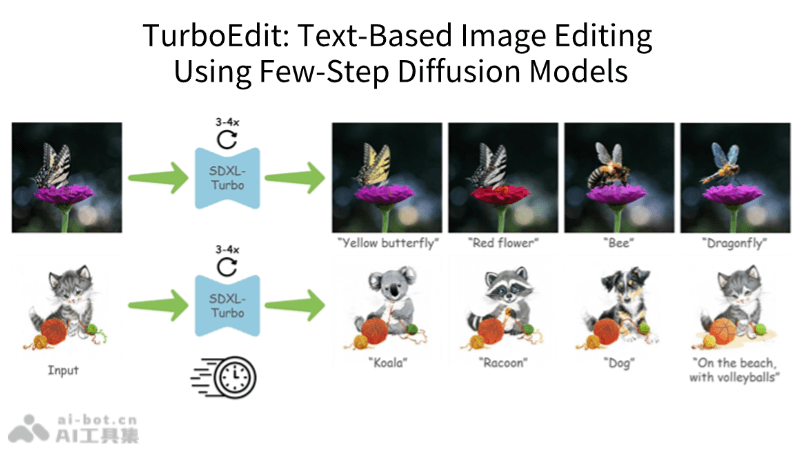
Main features of TurboEdit
- Text-based image editing: Users can guide image editing by modifying detailed text prompts to achieve precise modification of specific image attributes.
- Fast iterative inversion: By using encoder iterative inversion technology, TurboEdit can quickly reconstruct the input image from noise, laying the foundation for subsequent editing.
- Disentangled image editing: By adjusting text prompts, TurboEdit can change a single attribute in the image without affecting other parts.
- Real-time editing capability: TurboEdit can complete image inversion and editing in milliseconds, providing a real-time image editing experience.
Technical principles of TurboEdit
- Iterative inversion technology: Uses an encoder-based iterative network to predict noise and reconstruct the input image. The network takes the input image and the image reconstructed in the previous step as conditions, gradually correcting the reconstruction process.
- Conditional diffusion model: In the context of a few-step diffusion model, TurboEdit uses conditional diffusion to generate images. The model is required to consider text prompts during the generation process to ensure that the generated image matches the text description.
- Detailed control of text prompts: Through automatically generated or user-specified detailed text prompts, TurboEdit can achieve precise operations on specific attributes in the image. The level of detail in the text prompt helps disentangle editing and ensures that only the specified attribute is changed.
- Freezing and modifying the noise map: During editing, by freezing the noise map and modifying specific attributes in the text prompt, TurboEdit can generate a new image similar to the original image but with a single attribute change.
- Control of editing strength: By adjusting the linear interpolation of text embeddings, TurboEdit allows users to control the strength of the edit, achieving effects from subtle to significant.
- Instruction-based editing: By using large language models (LLM), TurboEdit can automatically convert descriptive source prompts into target prompts based on the user's instructional text prompts, and input them into the diffusion model to achieve instruction-based image editing.
- Local mask editing: TurboEdit supports users uploading binary masks to specify the editing area, and the editing effect is limited to a specific area, improving editing precision.
- Efficient computational performance: TurboEdit optimizes the computation process, and the image inversion and editing process is very fast. Each edit requires only minimal computational resources, enabling real-time editing.
TurboEdit project address
-
Project website:https://turboedit-paper.github.io/
-
Hugging Face model library:https://huggingface.co/spaces/turboedit/turbo_edit
-
arXivTechnical paper:https://arxiv.org/pdf/2408.08332
Application scenarios of TurboEdit
- Creative Editing: Artists and designers can quickly realize creative concepts with TurboEdit, adjusting image style, color, and layout through text prompts.
- Social Media: Users can share personalized images on social media with TurboEdit, such as changing clothing, hairstyles, or adding accessories.
- E-commerce: Online retailers can offer virtual try-on services, letting consumers see how clothing in different colors or styles looks on models.
- Game Development: Game designers can quickly iterate on the visual effects of game assets, such as real-time modifications to characters, environments, or props.
- Film and Video Production: In post-production, TurboEdit can be used to quickly adjust scene elements, such as changing the sky color or adding special effects.