
What is TripoSR
TripoSR is an open-source model jointly launched by Stability AI and VAST3D generation model, which can quickly generate high-quality 3D models from a single 2D image in less than 0.5 seconds. The model is based on the Transformer architecture and adopts the principles of the Large Reconstruction Model (LRM), with multiple improvements made to data processing, model design, and training techniques. TripoSR outperforms other open-source alternatives on multiple public datasets, and TripoSR supports running on devices without a GPU, greatly lowering the barrier to use. It is licensed under the MIT License and supports commercial, personal, and research use.
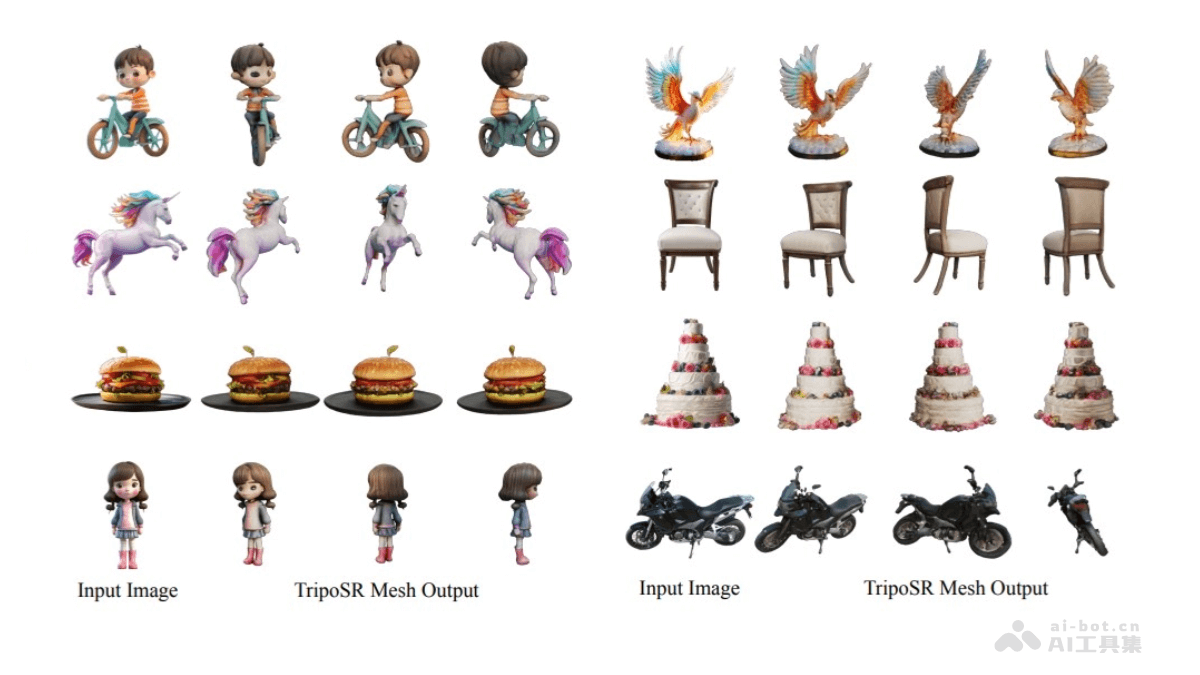
TripoSR's main features
- Generate 3D objects from a single image: TripoSR can automatically create a three-dimensional model from a single 2D image provided by the user. It identifies the objects in the image, extracts their shapes and features, and constructs the corresponding 3D geometric structure.
- Fast conversion: TripoSR's processing speed is extremely fast. On an NVIDIA A100 GPU, it can generate high-quality 3D models in less than 0.5 seconds, greatly reducing the time and resources required for traditional 3D modeling.
- High-quality rendering: TripoSR focuses on the quality of the output 3D models and can ensure the detail and realism of the models.
- Adapts to a variety of images: TripoSR can process various types of 2D images, including static images and images with a certain degree of complexity.
TripoSR's technical principles
- Architecture design: TripoSR's architecture design is based on LRM (Large Reconstruction Model), with multiple technical improvements made on this basis.
- Image Encoder: It uses the pretrained vision transformer model DINOv1 to project the input RGB image into a set of latent vectors. These vectors encode the global and local features of the image, providing the necessary information for subsequent 3D reconstruction.
- Image-to-Triplane Decoder: It converts the latent vectors output by the image encoder into a triplane-NeRF representation. The triplane-NeRF representation is a compact and expressive 3D representation suitable for representing objects with complex shapes and textures.
- Triplane-based NeRF: It is formed by stacking multilayer perceptrons (MLPs) and is responsible for predicting the color and density of 3D points in space. In this way, the model can learn detailed shape and texture information of object surfaces.
- Technical algorithms: TripoSR uses a series of advanced algorithms to achieve its fast and high-quality 3D reconstruction capability:
- Transformer architecture: TripoSR is based on the Transformer architecture, especially self-attention and cross-attention layers, to process and learn the global and local features of images.
- Neural Radiance Field (NeRF): The NeRF model is composed of MLPs and is used to predict the color and density of points in 3D space, achieving fine-grained modeling of object shapes and textures.
- Importance sampling strategy: During training, TripoSR adopts an importance sampling strategy and performs training by rendering random 128×128 patches from the original high-resolution images. This ensures faithful reconstruction of object surface details and effectively balances computational efficiency and reconstruction granularity.
- Data processing methods: TripoSR has made multiple improvements in data processing:
- Data Management: By selecting a carefully curated subset of the Objaverse dataset, TripoSR enhances the quality of the training data.
- Data Rendering: A variety of data rendering techniques are employed to more closely simulate the distribution of real-world images and enhance the model's generalization ability.
- Triplane Channel Optimization: To improve model efficiency and performance, TripoSR optimized the channel configuration in the triplane NeRF representation. Through experimental evaluation, a configuration of 40 channels was selected, using larger batch sizes and higher resolutions during the training phase while maintaining lower memory usage during inference.
- Training Techniques: TripoSR also made several innovations in training techniques:
- Mask Loss: A mask loss function was incorporated during training, which can significantly reduce "floater" artifacts and improve reconstruction fidelity.
- Local Rendering Supervision: The model relies entirely on rendering loss for supervision, and therefore requires high-resolution rendering to learn detailed shape and texture reconstruction. To address the computational and GPU memory load issues that high-resolution rendering and supervision may cause, TripoSR renders random patches of 128×128 size from the original 512×512 resolution images during training.
- Optimizer and Learning Rate Schedule: TripoSR uses the AdamW optimizer and adopts a cosine annealing learning rate scheduler (CosineAnnealingLR). During training, a weighted combination of LPIPS loss and mask loss is also used to further improve reconstruction quality.
TripoSR Project Address
- Github Repository:https://github.com/VAST-AI-Research/TripoSR
- HuggingFace Model Hub:https://huggingface.co/stabilityai/TripoSR
- arXiv Technical Paper:https://arxiv.org/pdf/2403.02151
TripoSR Performance Results
- Quantitative Results: On the GSO and OmniObject3D datasets, TripoSR outperforms other methods on the Chamfer Distance (CD) and F-score (FS) metrics, achieving a new state-of-the-art level.
- Qualitative Results: The 3D shapes and textures reconstructed by TripoSR are visually significantly better than other methods, and can better capture the complex details of objects.
- Inference Speed: On an NVIDIA A100 GPU, TripoSR takes about 0.5 seconds to generate a 3D mesh from a single image, making it one of the fastest feedforward 3D reconstruction models.
TripoSR Application Scenarios
- Game Development: Game designers can use TripoSR to quickly convert 2D concept art or reference images into 3D game assets, accelerating the game development process.
- Film and Animation Production: Filmmakers can use TripoSR to create 3D characters, scenes, and props from still images for film special effects or animation production.
- Architecture and Urban Planning: Architects and urban planners can quickly generate 3D building models based on existing 2D blueprints or photos for visualization and simulation.
- Product Design: Designers can use TripoSR to convert 2D design drawings into 3D models for product prototyping, testing, and presentation.
- Virtual Reality (VR) and Augmented Reality (AR): Developers can use TripoSR to create 3D virtual objects and environments for VR games, educational applications, or AR experiences.
- Education and Training: Teachers and trainers can create 3D teaching models for education in fields such as science, engineering, and medicine.