
What is TransPixar
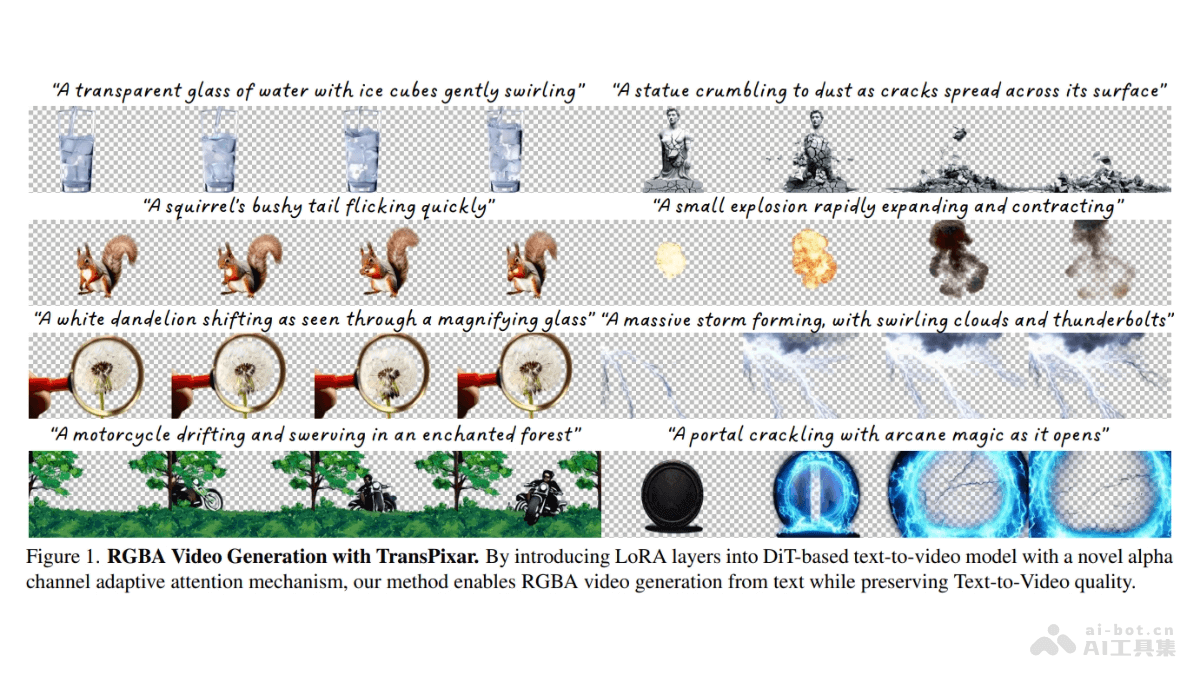
TransPixar is an advanced text-to-video generation method jointly open-sourced by The Chinese University of Hong Kong, Adobe Research, The Hong Kong University of Science and Technology, and Smart Moore. It extends pre-trained RGB video models to generate RGBA videos that contain transparency information. TransPixar is based on the Diffusion Transformer (DiT) architecture. By introducing alpha-specific tokens and LoRA-based fine-tuning, it achieves joint generation of RGB and alpha channels while maintaining high consistency. TransPixar optimizes the attention mechanism, preserving the advantages of the original RGB model, and can generate diverse and highly aligned RGBA videos under limited training data. TransPixar supports creating videos containing transparent elements such as smoke and reflections, and provides highly realistic visual effects. TransPixar has broad application prospects in fields such as entertainment, advertising, and education, offering new possibilities for visual effects (VFX) and interactive content creation.
Main Features of TransPixar
- RGBA Video Generation: Generates videos containing RGB color channels and alpha transparency channels from text descriptions, enabling the creation of complex visual effects.
- Transparency Effect Processing: Supports generating elements with transparent properties, such as smoke and reflections, seamlessly integrating into background scenes, suitable for applications such as visual effects (VFX).
- High-Quality Video Generation: While generating RGBA videos, it retains the high quality of the original RGB video generation model, ensuring video clarity and detail representation.
- Multi-Scene Adaptability: Suitable for video generation across various scenes and object types, including character actions, natural landscapes, and dynamic effects, with good generalization ability.
- Text-Driven Content Creation: Generates video content matching the input text description, enabling automated text-to-video creation and improving the efficiency and creativity of content production.
Technical Principles of TransPixar
- Diffusion Transformer (DiT) Architecture: Based on the DiT model, it uses self-attention mechanisms to capture long-range dependencies between video frames, achieving fine-grained modeling and generation of video content.
- Alpha Channel Generation: Introduces alpha-specific tokens into the DiT model and jointly generates them with RGB tokens to achieve alpha channel generation and support RGBA video output.
- LoRA Fine-Tuning: A fine-tuning scheme based on LoRA (Low-rank Adaptation) that fine-tunes the projection of alpha tokens, optimizing alpha channel generation while maintaining RGB generation quality.
- Attention Mechanism Optimization: Systematically analyzes and optimizes the attention mechanism in the RGBA generation process, including Text-attend-to-RGB, RGB-attend-to-Text, RGB-attend-to-Alpha, etc. By adjusting attention computation, it achieves strong alignment and high-quality generation between RGB and alpha channels.
- Dataset Expansion and Training Strategy: Trains on limited RGBA video datasets. Through reasonable data preprocessing and training strategies, it improves the model's adaptability to diverse scenes and object types, enhancing the diversity and consistency of generated content.
TransPixar Project Address
- Project Website:https://wileewang.github.io/TransPixar/
- GitHub Repository:https://github.com/wileewang/TransPixar
- arXiv Technical Paper:https://arxiv.org/pdf/2501.03006
- Online Experience Demo:https://huggingface.co/spaces/wileewang/TransPixar
Application Scenarios of TransPixar
- Entertainment Field: Quickly generates planet explosion special effect clips, assisting in post-production for science fiction films.
- Advertising: Produce an advertisement video showcasing the appearance and driving dynamics of a new electric vehicle to attract consumer attention.
- Education: Generate a video of an object under force and in motion to assist in explaining physical laws and improve student understanding.
- Augmented reality (AR): Generate a realistic panoramic video of Paris to provide an immersive experience for VR tourism applications.
- Creative industry: Create videos of fantasy worlds to expand the forms of digital art expression and creative space.