
What is Transfusion
Transfusion is a newly launched multimodal AI model by Meta that integrates text and images. Transfusion combines the next-token prediction of language models with diffusion models to process mixed-modality data such as text and images on a single transformer. The Transfusion model can generate both text and images simultaneously without the need to quantize image information. During pretraining, the Transfusion model uses large amounts of text and image data, demonstrating efficient scalability and superior performance across multiple benchmarks. Transfusion also supports image editing, enabling precise modifications to images based on instructions, marking a new breakthrough for multimodal AI models in understanding and generating rich content.
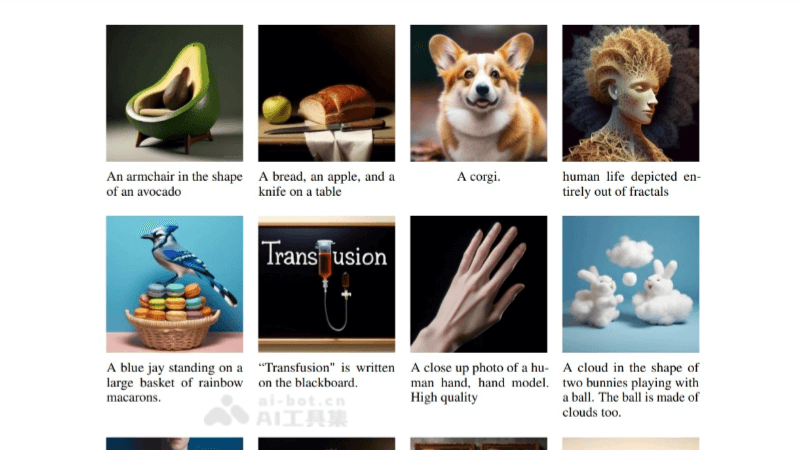
Main features of Transfusion
- Multimodal generation: Transfusion can generate both text and images simultaneously, handling discrete and continuous data types.
- Mixed-modality sequence training: The model is pretrained using mixed text and image data, optimizing text and image generation separately through different loss functions.
- Efficient attention mechanism: Combines causal attention and bidirectional attention, optimizing the encoding and decoding of text and images.
- Modality-specific encoding: Introduces specific encoding and decoding layers for text and images, improving the model's ability to handle different modalities of data.
- Image compression: Through the U-Net structure, the model can compress images into smaller patches, reducing inference cost.
- High-quality image generation: Transfusion can generate high-quality images comparable to the current state-of-the-art diffusion models.
- Text generation capability: In addition to images, Transfusion can also generate text and achieve high performance in text benchmarks.
- Image editing: The model supports editing existing images, changing image content based on instructions.
Technical principles of Transfusion
- Multimodal data processing: The Transfusion model is designed to process mixed-modality data, containing both discrete text data and continuous image data.
- Mixed loss functions: The model combines two loss functions, the language model loss function (for next-token prediction of text) and the diffusion model loss function (for image generation). The two losses work together in a unified training process.
- Transformer architecture: Transfusion uses a single Transformer architecture to process sequence data of all modalities, regardless of whether the data is discrete or continuous.
- Attention mechanism:For text data, a causal attention mechanism is used, ensuring that future information is not used when predicting the next token.For image data, a bidirectional attention mechanism is used, supporting information exchange among the various parts (patches) within the image.
Project address of Transfusion
- arXiv technical paper:https://arxiv.org/pdf/2408.11039
How to use Transfusion
- Install dependencies: Ensure that all necessary software dependencies are installed in the environment, such as Python, deep learning frameworks (e.g., PyTorch or TensorFlow), etc.
- Prepare data: According to the task to be performed (such as text generation, image generation, or image editing), prepare the corresponding input data. For text, it is a sequence of tokens; for images, it is pixel values or feature vectors.
- Encode the data: Convert the input data into a format that the model understands. For example, text needs to be tokenized and converted into a sequence of IDs; images need to be encoded into specific feature vectors.
- Set parameters: Configure model parameters according to task requirements, such as the length of generated text, the size of images, the number of diffusion steps, etc.
- Perform inference: Use the model for inference. Text generation involves sampling the next token; image generation involves iteratively removing noise to reconstruct the image.
Application scenarios of Transfusion
- Art creation assistance: Artists and designers can use Transfusion to generate images, guiding the style and content of the images through text descriptions.
- Content creation: Automatically generate text and image content that matches a specific theme or style, for use in social media, blogs, or marketing materials.
- Education and training: In the field of education, Transfusion can be used to create teaching materials or simulated scenarios to help students better understand complex concepts.
- Entertainment and game development: In video games or interactive media, Transfusion can be used to generate images of game environments, characters, or items.
- Data augmentation: In machine learning, Transfusion can be used to generate additional training data to improve the model's generalization ability.