
What is TrafficVLM
TrafficVLM is a traffic vision-language model launched by Amap Navigation based on large model technology. Through traffic twin restoration capabilities, it transforms massive real-time traffic data into dynamic twin video streams, constructing a "digital traffic world" synchronized with the real world. Built on the Tongyi Qwen-VL foundation, TrafficVLM can accurately perceive traffic elements, analyze vehicle interaction relationships, reason about traffic situations in real time, and generate optimal decision recommendations. The model gives drivers a "sky-eye" perspective, allowing users to fully understand the overall traffic situation, break through local field-of-view limitations, calmly respond to potential risks, and enhance the driving experience. Users can experience the latest model by updating to the latest version of Amap in the app store.
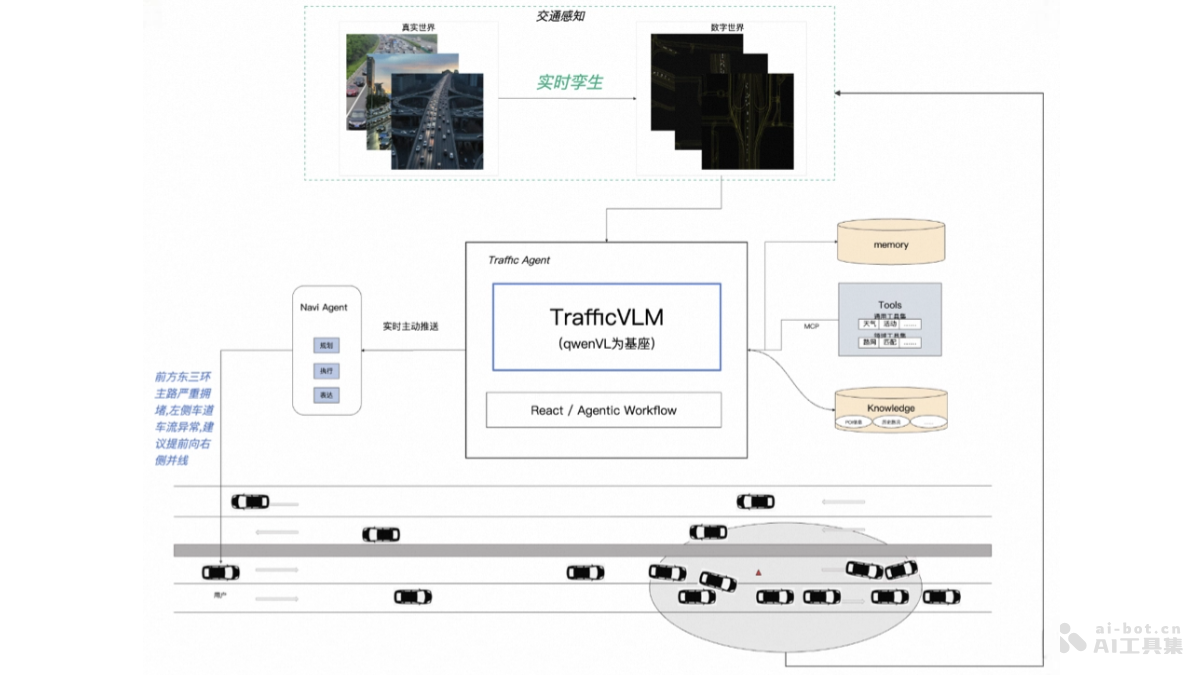
TrafficVLM's Main Features
-
Global Traffic Situation Awareness: Through traffic twin restoration technology, real-time traffic data is transformed into dynamic twin video streams, constructing a "digital traffic world" synchronized with the real world, allowing users to fully understand the overall traffic situation and break through local field-of-view limitations.
-
Real-Time Traffic Situation Reasoning: Performs real-time reasoning on the traffic situation along the route at minute-level frequency, quickly identifies ahead traffic conditions (such as congestion, accidents, etc.), and generates optimal decision recommendations, such as route adjustments or explanations of congestion causes.
-
Semantic Understanding of Traffic Elements: Based on the Tongyi Qwen-VL foundation, it has semantic understanding capabilities for traffic elements (such as vehicles, roads, traffic signs, etc.), can accurately identify and analyze interaction relationships between vehicles, and provides users with more accurate navigation suggestions.
-
Intelligent Decision Support: Combining real-time traffic data and historical dynamic analysis, it predicts traffic congestion trends and generates optimal decision recommendations, helping users plan trips in advance, avoid congestion, and enhance the driving experience.
TrafficVLM's Technical Principles
- Traffic Twin Restoration Technology: By collecting massive real-time traffic data (such as vehicle positions, speeds, road conditions, etc.) and based on advanced data processing and modeling technology, the data is transformed into dynamic twin video streams, constructing a "digital traffic world" fully synchronized with the real world.
- Tongyi Qwen-VL Foundation: Based on the Tongyi Qwen-VL large model, through reinforcement learning and data training, it adapts to the visual modality of maps and traffic twin restoration, enabling the model to have semantic understanding capabilities for traffic elements and perform complex traffic analysis tasks.
- Intelligent Closed-Loop System: From perceiving traffic elements to analyzing traffic situations, and then to generating decision recommendations, it forms a complete intelligent closed loop. The model can perceive traffic elements in real time, analyze interaction relationships between vehicles, and combine current traffic flow and historical dynamics to generate optimal decision recommendations.
- Multimodal Data Fusion: The model integrates multiple data sources (such as satellite images, sensor data, user feedback, etc.) to improve the model's accuracy and reliability. Through the fusion of multimodal data, the model can more comprehensively understand and predict traffic conditions.
TrafficVLM's Application Scenarios
-
Daily Commuting: Helps users understand road conditions in real time, plan optimal routes in advance, avoid congestion, and save commuting time.
-
Long-Distance Driving: Provides global traffic situation awareness, gives early warnings of accidents or congestion ahead, and ensures safe and smooth long-distance travel.
-
Urban Travel: In complex urban traffic environments, quickly analyze traffic flow, provide users with precise navigation suggestions, and improve travel efficiency.
-
Special Event Response: When encountering special situations such as traffic accidents and road construction, provide detour plans to reduce waiting time.
-
Public Transportation Planning: Provide real-time traffic condition support for public transportation such as buses and taxis, optimize operating routes, and improve service quality.