
What is TrackVLA
TrackVLA is a product-grade end-to-end navigation large model launched by Galaxy General. The model has pure vision environmental perception, language instruction-driven, autonomous reasoning, and zero-shot generalization capabilities, and can achieve a full-chain closed loop from visual perception to action output. It requires no prior mapping, navigates autonomously in complex environments, flexibly avoids obstacles, and recognizes and tracks target objects according to natural language instructions. TrackVLA enables robots to demonstrate strong autonomy and intelligent interaction capabilities in real scenarios, provides important support for the commercial implementation of embodied intelligence, and drives robots from the laboratory to daily life, becoming intelligent partners for humans.
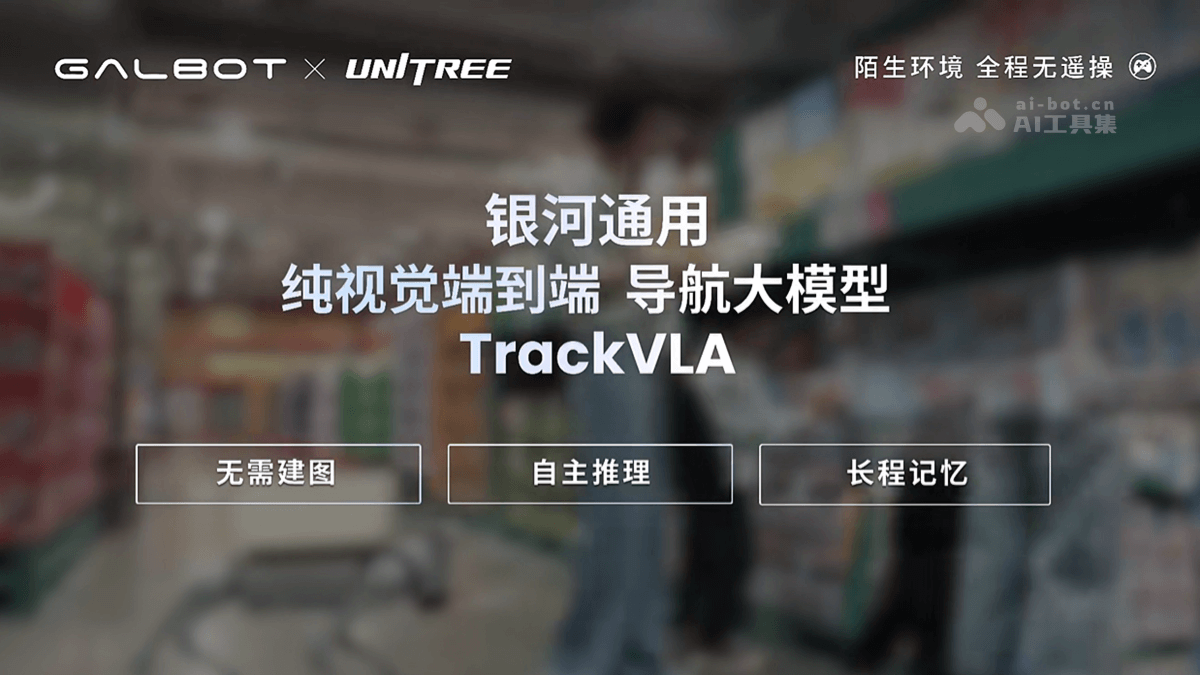
TrackVLA's main features
- Natural language understanding and target recognition: Understands natural language instructions and recognizes target objects.
- Target tracking in complex environments: Accurately tracks target objects in crowded environments.
- Mapping-free autonomous navigation: In unfamiliar environments, navigates autonomously without prior mapping and adapts to various scenarios.
- Flexible obstacle avoidance: Recognizes and avoids obstacles in real time and adapts to complex scenarios.
- Adapts to changes in ambient lighting: Maintains stable performance under different lighting conditions.
- Remote visual guarding: Views the robot's perspective in real time through the App and provides mobile guarding functions.
- Emergent skills: Supports generalization to tasks not trained on, such as following animals.
TrackVLA's technical principles
- Pure vision environmental perception: TrackVLA relies on cameras to obtain environmental image information and processes and analyzes images based on deep learning algorithms to achieve perception of the surrounding environment.
- Language instruction-driven: TrackVLA can understand natural language instructions and, based on natural language processing (NLP) technology, converts instructions into specific action tasks.
- End-to-end model: TrackVLA uses an end-to-end (End-to-End) model architecture to integrate visual perception, language understanding, target recognition, path planning, and action execution into a unified model. The architecture is similar to an animal's brain, directly inferring an action plan from input images and instructions without manually splitting multiple steps.
TrackVLA's application scenarios
- Companionship and service: Accompanies children and the elderly in public places (such as parks and supermarkets), provides guarding services, and helps carry items.
- Security patrol: Autonomously patrols in public places (such as shopping malls and parking lots), monitors the environment, identifies anomalies, and issues alarms.
- Logistics delivery: Completes item transportation and last-mile delivery tasks in indoor environments (such as hospitals and office buildings) or within communities.
- Education and scientific research: Serves as a teaching tool to assist education, or as a scientific research platform to study cutting-edge technologies.
- Entertainment and interaction: Interacts with people in theme parks or home environments, providing entertainment performances or adding family fun.