
What is TPO
TPO (Test-Time Preference Optimization) is a novel AI optimization framework that dynamically optimizes language model outputs during inference to better align with human preferences. TPO converts reward signals into textual feedback, marking high-quality responses generated by the model as "chosen" outputs and low-quality responses as "rejected" outputs, thereby generating "textual loss" and proposing "textual gradients" to iteratively improve model outputs without updating model parameters. Experiments show that after a small number of iterations, even models without alignment training can significantly improve performance on multiple benchmarks, increasing the LC metric on AlpacaEval 2 from 27.8% to 37.8%.
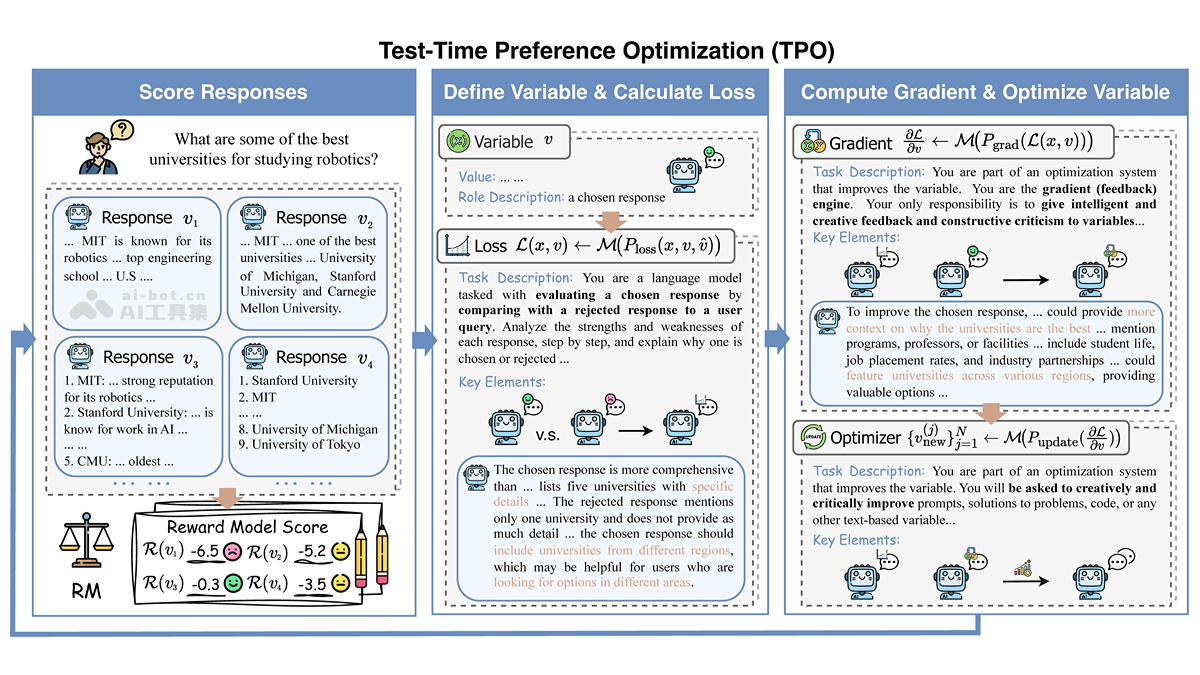
Main features of TPO
- Dynamic alignment with human preferences: TPO can dynamically adjust the model's output during inference based on feedback from the Reward Model, making it better align with human preferences and expectations.
- No need to retrain the model: TPO does not require retraining the model or updating weights, and can optimize model outputs during inference.
- Efficient optimization and scalability: TPO has good scalability in search width and depth during inference, and can efficiently optimize model outputs.
- Improved model performance: TPO can significantly improve model performance on multiple benchmarks, approaching or exceeding models that have undergone preference alignment during training.
- Enhanced model interpretability and understandability: Through textual feedback, TPO makes the model optimization process more transparent and understandable.
- Improved inference stability: TPO can significantly improve the inference stability of models and reduce the probability of generating unexpected or harmful responses.
- Lightweight and efficient: TPO is a lightweight optimization method with low computational cost, suitable for rapid deployment in practical applications.
Technical principles of TPO
- Converting reward signals into textual feedback:The core of TPO lies in converting the numerical signals of the Reward Model into interpretable textual feedback. Specifically, the model generates multiple candidate responses at each inference step, and these responses are scored by the Reward Model. TPO then selects the highest-scoring ("chosen" response) and lowest-scoring ("rejected" response) responses, analyzes their strengths and weaknesses, and generates a "textual loss".
- Iterative optimization process: Based on the "textual loss", TPO generates "textual gradients" that guide the model on how to improve its output in the next iteration. The process is similar to traditional gradient descent optimization, but is performed entirely at the text level rather than directly updating model parameters. Through multiple iterations, the model's output gradually aligns with human preferences.
- Depends on the model's instruction-following ability: The success of TPO depends on the policy model having basic instruction-following ability, because the model must accurately interpret and respond to the feedback from the Reward Model. If the model lacks this ability, TPO may not work effectively.
TPO project addresses
- Github repository:https://github.com/yafuly/TPO
- arXiv technical paper:https://arxiv.org/pdf/2501.12895
Application scenarios of TPO
- Instruction following:TPO can improve model performance in instruction-following tasks. This makes TPO suitable for scenarios that require the model to generate accurate responses based on specific instructions, such as intelligent assistants and customer service robots.
- Preference alignment: TPO can be used to optimize the model's output to better align with human preferences. It has important application value in fields such as recommendation systems and content generation, and can help the model generate content that better meets user expectations.
- Safety: In safety benchmarks such as BeaverTails-Evaluation and XSTest, models optimized with TPO can more effectively avoid generating harmful or unsafe responses. This is of great significance for application scenarios that need to ensure the safety and reliability of model outputs (such as medical consultation, financial advice, etc.).
- Mathematical Reasoning: TPO can improve the model's performance in mathematical reasoning tasks. In mathematical benchmarks such as MATH-500, models optimized with TPO show significantly improved accuracy in solving mathematical problems.