
What is TPDM
TPDM (Time Prediction Diffusion Model) is an image generation model jointly launched by the MAPLE Lab at Westlake University, Southern University of Science and Technology, Peking University, and the Institute of Advanced Technology at the Westlake University Institute for Advanced Study. It can adaptively adjust the denoising schedule to optimize image quality and generation efficiency. The model uses a plug-and-play Time Prediction Module (TPM) to predict the next noise level at each denoising step based on the current latent space features. TPDM is trained based on reinforcement learning, with the goal of maximizing the image quality reward that takes the number of denoising steps into account, achieving high-quality image generation aligned with human preferences. Under the Stable Diffusion 3 Medium architecture, TPDM demonstrates the ability to achieve better performance with fewer denoising steps, significantly improving the performance and efficiency of image generation.
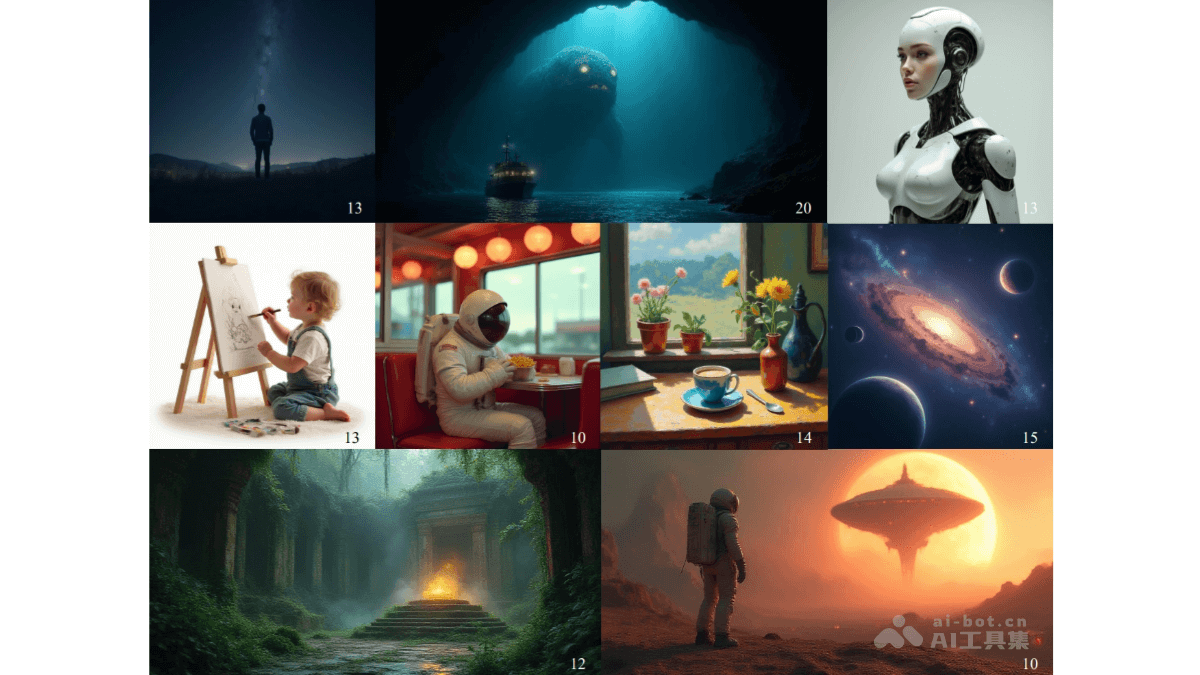
TPDM's main features
- Adaptive noise scheduling: TPDM automatically adjusts the denoising steps and noise levels according to each inference instance, adapting to different image generation needs.
- Balancing quality and efficiency: Based on dynamically adjusting the denoising process, TPDM reduces the required denoising steps while maintaining generated image quality, improving the model's operating efficiency.
- Reinforcement learning optimization: Based on reinforcement learning techniques, TPDM trains its Time Prediction Module (TPM) to maximize the image quality reward discounted by the number of denoising steps.
- High-quality image generation: TPDM can generate high-quality images highly aligned with human preferences, meeting the needs of aesthetics and practical applications.
TPDM's technical principles
- Time Prediction Module (TPM): The core of TPDM is a plug-and-play module that predicts the next noise level after each denoising step based on the current latent space features.
- Reinforcement learning training: TPM is trained based on reinforcement learning, specifically using the Proximal Policy Optimization (PPO) algorithm, treating the multi-step denoising process as a complete trajectory and using the final image quality (considering the number of denoising steps) as the reward signal.
- Image quality evaluation: Image quality is measured based on a reward model aligned with human preferences, ensuring that generated images have high clarity and meet human aesthetic standards.
- Dynamic scheduling strategy: TPDM dynamically adjusts the noise schedule during inference, automatically determining the number of denoising steps based on the complexity and content of the image, enabling flexible responses to different image generation tasks.
- Optimizing the diffusion process: During training, TPDM's diffusion process remains consistent with the inference process, directly optimizing inference performance and reducing denoising steps, making the model more efficient in practical applications.
- Lightweight integration: As a lightweight module, TPM can be easily integrated into any existing diffusion model, adding almost no extra computational burden, and automatically adjusting hyperparameters to achieve the best balance between image quality and efficiency.
TPDM's project address
- arXiv technical paper:https://arxiv.org/pdf/2412.01243
TPDM's application scenarios
- Text-to-image generation: Automatically generate corresponding images based on given text descriptions, suitable for fields such as advertising, game design, and virtual scene construction.
- Art creation assistance: Assist artists and designers in quickly generating sketches or concept images, improving creative efficiency.
- Digital media content production: In film, television, and animation production, generating backgrounds, scenes, or special effects elements.
- Virtual Reality and Augmented Reality: Generating realistic images and environments for virtual reality (VR) and augmented reality (AR) applications.
- Social Media and Entertainment: Users generate personalized images and memes based on their own ideas, adding fun to social media interactions.