
What is Tora
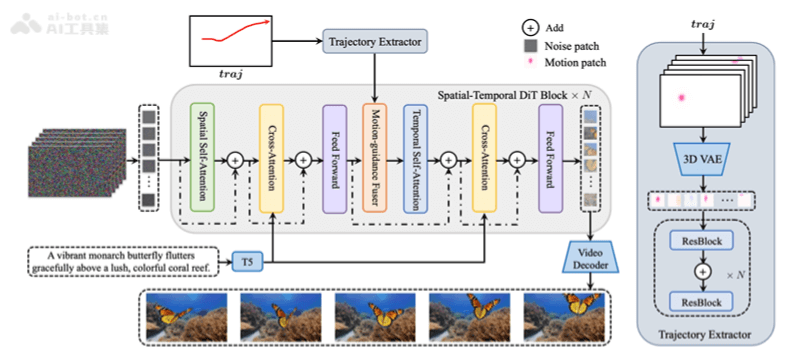
Tora is an AI video generation framework launched by Alibaba. Based on trajectory-oriented Diffusion Transformer (DiT) technology, it integrates text, visual, and trajectory conditions to generate high-quality video content that conforms to real-world dynamics. Tora consists of a Trajectory Extractor, a Spatial-Temporal DiT, and a Motion-guidance Fuser. It can precisely control the dynamic performance of videos and supports video production up to 204 frames at 720p resolution. Tora excels in motion fidelity and simulating real-world physical dynamics, providing a powerful new tool for the field of video generation.
Tora's Main Features
In simple terms, Tora can produce realistic and smooth videos based on the instructions you provide (such as text descriptions, images, or object movement paths).
- Trajectory Extractor (TE): Converts input trajectories into hierarchical spatiotemporal motion blocks, which match the latent space of the video content.
- Spatial-Temporal DiT: Combines spatial and temporal self-attention mechanisms to process video data, enabling the model to understand and generate videos with coherent motion.
- Motion-guidance Fuser (MGF): Responsible for integrating the spatiotemporal motion blocks generated by the Trajectory Extractor into the DiT model, ensuring that the generated video content follows the predetermined trajectories and dynamics.
Tora's Technical Principles
- Trajectory Understanding: Tora uses a tool called the "Trajectory Extractor," which can understand given trajectory information. It's like giving Tora a map, telling it where and how objects in the video should move.
- Spatiotemporal Encoding: Tora converts this trajectory information into a special encoding form called "spatiotemporal motion blocks." These motion blocks are like the skeleton of the video, determining how objects in the video move.
- Video Generation Framework: Tora adopts an advanced technology called the "Diffusion Transformer" (DiT). This technology combines the advantages of diffusion models and transformer architectures, enabling Tora to generate high-quality videos.
- Dynamic Fusion: Tora also has a "Motion-guidance Fuser," whose role is to combine the spatiotemporal motion blocks obtained earlier with the video content. This allows Tora to ensure that the generated video not only looks good but also has very natural and smooth object motion.
- Two-Stage Training: To help Tora better understand and generate motion, it learns through a two-stage training process. It learns how to extract motion information from dense optical flow (a type of dense data describing object motion). It learns how to generate videos based on simpler trajectory information provided by users.
- Data Preprocessing: Before training, Tora also needs to process video data, such as splitting long videos into short clips based on scene detection, and then selecting suitable video clips for training based on aesthetic scores and motion segmentation results.
Tora's Project Address
- Project Website:https://ali-videoai.github.io/tora_video/
- GitHub Repository:https://github.com/ali-videoai/Tora
- arXiv Technical Paper:https://arxiv.org/pdf/2407.21705
Tora's Application Scenarios
- Film and Television Production: Tora can be used to generate special effects scenes in movies, TV series, or short films, generating complex dynamic scenes through trajectory control, reducing actual filming costs and time.
- Animation Creation: In the field of animation, Tora can automatically generate animation sequences based on scripts, providing animators with preliminary dynamic sketches and accelerating the creative process.
- Virtual Reality (VR) and Augmented Reality (AR): Tora can generate dynamic environments that interact with users, providing realistic visual effects for VR and AR applications.
- Game Development: In video games, Tora can be used to quickly generate game environments and character animations, improving the efficiency of game design.