
What is ToddlerBot
ToddlerBot is Stanford University's open-source machine learning and humanoid robot platform for locomotion and manipulation, designed for efficiently collecting large-scale, high-quality training data. ToddlerBot has 30 active degrees of freedom, uses Dynamixel motors, and keeps the total cost under $6,000. Based on digital twin technology and zero-point calibration, ToddlerBot can achieve zero-shot sim-to-real transfer, and its teleoperation device supports efficient real-world data collection. ToddlerBot performs well in locomotion and manipulation tasks, such as arm span, payload, endurance, and dynamic movement capabilities. ToddlerBot's open-source design and detailed assembly manual make it easy to replicate and maintain, suitable for a wide range of research applications.
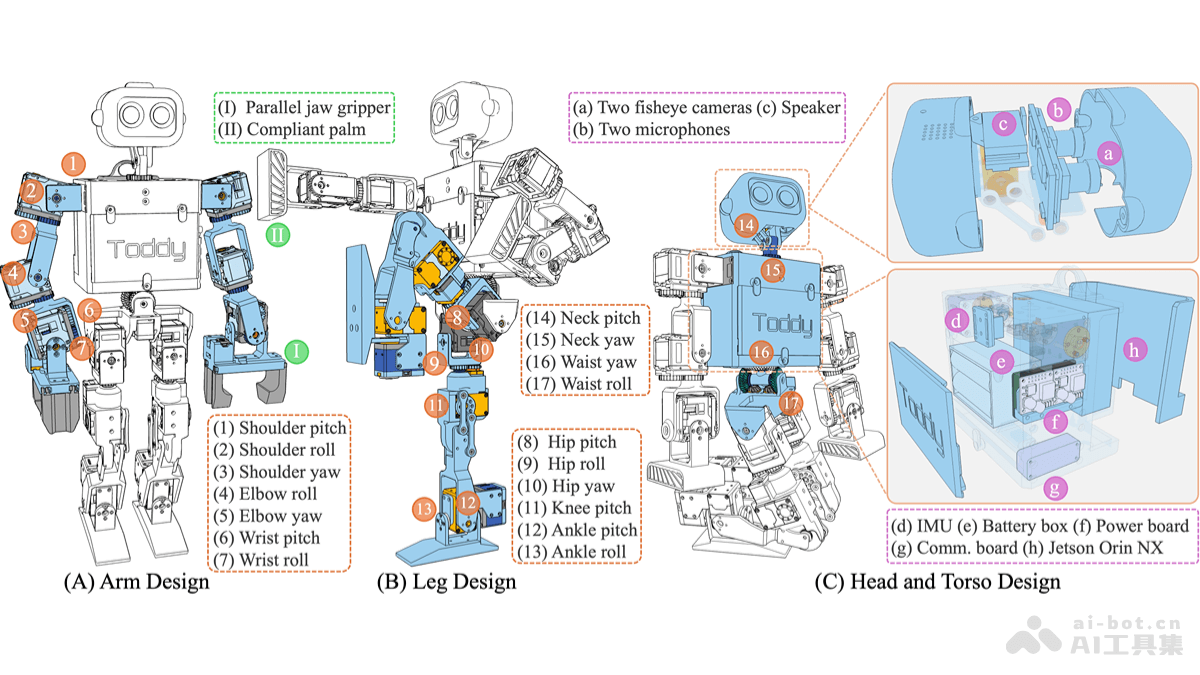
ToddlerBot's Main Features
- Efficient Data Collection: Can collect high-quality training data simultaneously in simulated environments and the real world, supporting large-scale machine learning tasks.
- Whole-Body Locomotion and ManipulationManipulation: With 30 active degrees of freedom, it can perform complex whole-body locomotion and manipulation tasks, such as walking, push-ups, pull-ups, dual-arm manipulation, and whole-body manipulation.
- Zero-Shot Sim-to-Real Transfer: Based on high-fidelity digital twin technology and motor system identification, it achieves seamless policy transfer from simulation to reality.
- Teleoperation and Data Collection: Equipped with an intuitive teleoperation device, it supports rapid collection of real-world data based on human demonstrations, used for learning motor skills.
- Human-Robot Interaction and Collaboration: Supports multi-robot collaborative tasks, such as jointly completing complex scenarios like room cleaning.
ToddlerBot's Technical Principles
- Digital Twin and Zero-Point Calibration:
- Digital Twin: Based on precise physical models and system identification technology, it creates high-fidelity simulation models to ensure consistency between simulated data and the real world.
- Zero-Point Calibration: Uses 3D-printed calibration equipment to quickly calibrate the robot's zero-point position, ensuring the accuracy of motion control.
- Motor System Identification (SysID): Based on commanding motors to track sweep signals, collects position tracking data, fits the actuator model, and ensures the accuracy of dynamic parameters. This gives the robot the same motion characteristics in both simulated and real worlds.
- Teleoperation Technology: Uses a second upper limb as the teleoperation device, controlling the robot's movement based on force-sensitive resistors and a handheld gaming computer (such as Steam Deck or ROG Ally X). Supports human operators in intuitively guiding the robot to complete complex tasks.
- Reinforcement Learning and Imitation Learning:
- Reinforcement Learning (RL): Based on MuJoCo and the PPO algorithm, trains walking and turning policies, outputting joint position setpoints to achieve efficient motion control.
- Imitation Learning: Based on real-world data collected via teleoperation, trains a Diffusion Policy to achieve complex manipulation tasks.
ToddlerBot's Project Address
- Project Website:https://toddlerbot.github.io/
- GitHub Repository:https://github.com/hshi74/toddlerbot
- arXiv Technical Paper:https://arxiv.org/pdf/2502.00893
ToddlerBot's Application Scenarios
- Home Toy Organization: Two robots collaborate, one picking up toys and one pushing a cart, to jointly complete toy storage.
- Educational Programming Platform: Students program robots to complete tasks such as walking and push-ups.
- Laboratory Motor Skill Research: Reinforcement learning trains robots to complete highly difficult actions such as jumping and climbing.
- Home Companion RobotPerson: Interacts with children and completes puzzles or sports games.
- Industrial Component Operation: Operates small electronic components or mechanical parts.