
What Is TinyVLA
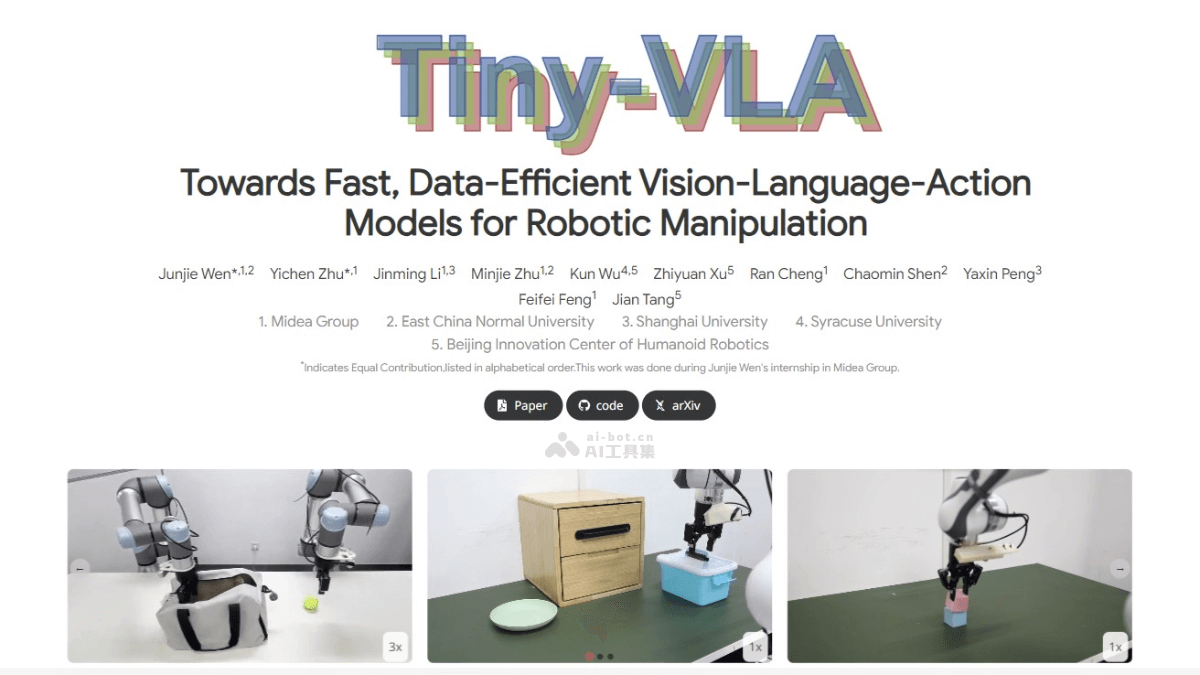
TinyVLA is a vision-language-action (VLA) model for robotic manipulation, introduced by teams from East China Normal University and Shanghai University. It proposes solutions to the shortcomings of existing VLA models, such as slow inference speed and the need for large-scale data pretraining. TinyVLA is based on a lightweight multimodal model and a diffusion policy decoder, significantly improving inference speed and reducing dependence on large-scale datasets. The model has been extensively tested on simulated and real robotic platforms, proving that it outperforms the existing state-of-the-art model OpenVLA in terms of speed, data efficiency, multi-task learning, and generalization ability. The introduction of TinyVLA provides a fast and efficient new method for the field of robot control, and is expected to enable rapid deployment and application in resource-constrained environments.
Main Features of TinyVLA
- Fast inference: TinyVLA can process visual data and language instructions in an extremely short time and generate corresponding robot actions, significantly improving the speed of decision-making and execution.
- Data efficient: The model reduces dependence on large-scale robot datasets, requires no expensive pretraining process, and lowers training costs and resource consumption.
- Multi-task processing: It can handle a variety of different tasks, such as grasping, placing, and stacking, demonstrating strong multi-task learning ability.
- Strong generalization ability: In unseen new environments, new objects, and new instructions, TinyVLA can still maintain a high execution success rate, showing powerful generalization ability.
Technical Principles of TinyVLA
- Multimodal model initialization: TinyVLA uses a pretrained multimodal model (such as Pythia) as the foundation of the policy network; the model has already been trained on a large amount of vision-language data and possesses good semantic understanding ability.
- Policy backbone optimization: By training a lightweight multimodal model (VLM), TinyVLA reduces the number of model parameters while maintaining model performance.
- Diffusion policy decoder: During the fine-tuning stage, a diffusion policy decoder is integrated to directly output robot actions, replacing the traditional token-based prediction method and improving the continuity and accuracy of action prediction.
- LoRA fine-tuning technology: Low-rank adaptation (LoRA) technology is used to fine-tune the pretrained VLM part, updating only a small subset of parameters in the model, thereby preserving the model's original knowledge and improving training efficiency.
- One-shot multi-step prediction: TinyVLA can predict a series of future actions at once rather than single-step prediction, improving the coherence and overall efficiency of action prediction.
TinyVLA Project Address
- Project official website:tiny-vla.github.io
- GitHub repository:https://github.com/lesjie-wen/tinyvla(to be open-sourced soon)
- arXiv technical paper:https://arxiv.org/pdf/2409.12514v1
Application Scenarios of TinyVLA
- Home automation: In smart home environments, TinyVLA enables robots to understand natural language instructions to perform household tasks, such as tidying up clutter or turning lights on or off.
- Industrial automation: On manufacturing and packaging production lines, TinyVLA can control robots to perform precise assembly, sorting, and quality inspection work.
- Service robots: In the catering or medical service industry, TinyVLA helps robots understand customer needs and provide ordering, food delivery, or medical guide services.
- Disaster response: In disaster rescue scenarios, TinyVLA guides robots to conduct search and rescue missions in complex environments.
- Education and training: As the brain of educational robots, TinyVLA assists children's education or professional skills training through interactive learning.
- Laboratory assistant: In scientific laboratories, TinyVLA guides robots to perform repetitive work such as sample processing and chemical analysis.