
What is TimeSuite
TimeSuite is a new framework launched by Shanghai AI Lab that can improve the performance of multimodal large language models (MLLMs) in long video understanding tasks. Based on the introduction of an efficient long video processing framework, a high-quality video dataset TimePro used for grounding adjustment, and an instruction tuning task called Temporal Grounded Caption, it explicitly incorporates grounding supervision into the traditional question-answering format. TimeSuite can enhance the model's temporal perception of video content, reduce the risk of hallucination, and achieve significant performance improvements on long video question answering and temporal grounding tasks. Using technical means such as video token compression and temporally adaptive position encoding, TimeSuite enables MLLMs to more accurately understand and locate events in videos, unlocking the potential of MLLMs in the field of long video understanding.
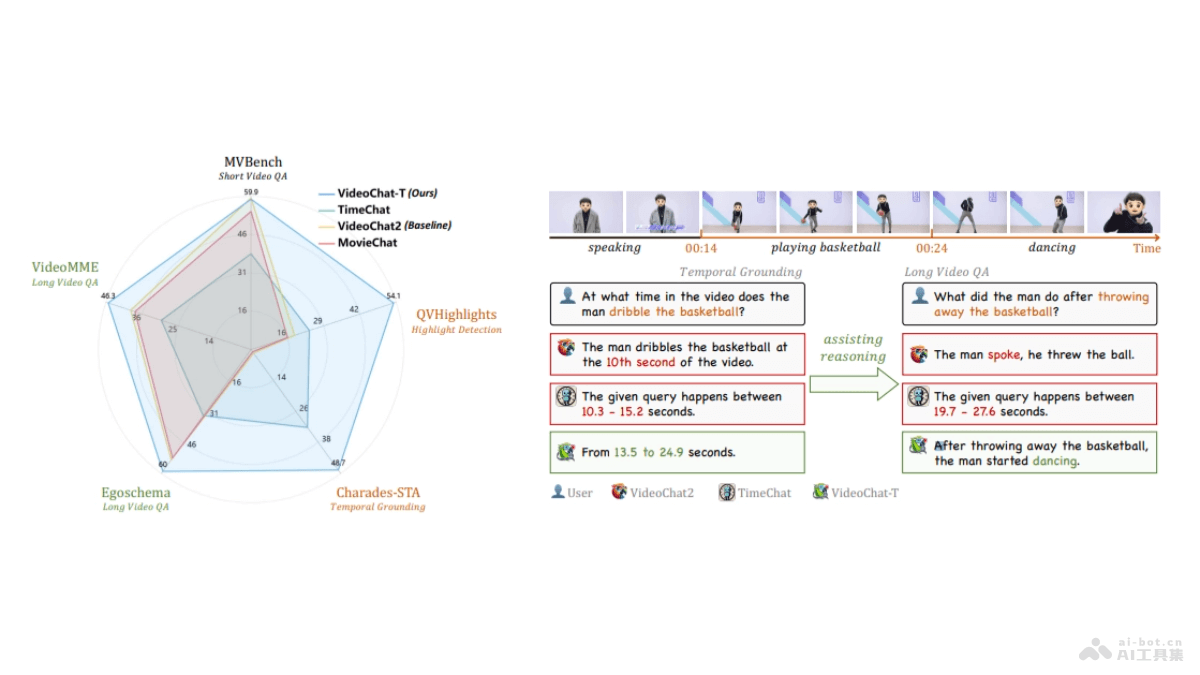
Main features of TimeSuite
- Long video processing framework: Provides a simple and efficient framework for processing long video sequences, using compressed visual tokens and enhanced temporal awareness to adapt to long video understanding.
- High-quality video dataset TimePro: Contains multiple tasks and a large number of high-quality grounding annotations, used for grounding adjustment of MLLMs to enhance the model's temporal perception ability.
- Temporal Grounded Caption task: Designs a new instruction tuning task that requires the model to generate detailed video descriptions, predict corresponding timestamps, reduce the risk of hallucination, and improve the accuracy of temporal grounding.
- Improved video understanding ability: Based on the above features, TimeSuite significantly improves the performance of MLLMs on long video question answering and temporal grounding tasks.
Technical principles of TimeSuite
- Video token compression (Token Shuffle): Reduces the number of visual tokens in long videos by merging adjacent visual tokens, lowers computational complexity, and maintains temporal consistency.
- Temporally adaptive position encoding (TAPE): Introduces an adapter to add temporal position information to visual tokens, enhancing the model's understanding of the temporal order of video content.
- U-Net structure: Uses a U-Net-like structure in TAPE, gradually downsampling and upsampling the temporal feature sequence based on one-dimensional depthwise separable convolutions, and uses encoding and restoration of the relative temporal positions of video tokens.
- Residual connections: Uses residual connections during the upsampling process, preserves temporal features at different scales, and enhances the model's temporal sensitivity.
- Diverse task training: Trains based on diverse tasks in the TimePro dataset, improving the model's temporal grounding and video understanding abilities in different scenarios.
- Instruction tuning: Based on the Temporal Grounded Caption task, the model learns to correctly focus on video content when generating descriptions, improving the accuracy of temporal grounding.
Project address of TimeSuite
- arXiv technical paper:https://arxiv.org/pdf/2410.19702
Application scenarios of TimeSuite
- Video content creators: Video bloggers, filmmakers, and video editors analyze and edit long video content, extract key segments, and improve creation efficiency.
- Online education providers: Teachers and educational institutions locate key teaching points in educational videos, enhancing the interactivity and effectiveness of remote teaching.
- Social media managers: Social media managers responsible for content marketing and brand promotion extract and create video summaries and highlight moments that attract user attention.
- Security Monitoring Analyst: Security personnel and monitoring center operators, who locate anomalous events in surveillance video to improve response speed.
- Video Platform Operator: Video sharing and streaming platforms, enhancing the accuracy of video search and recommendation systems and improving user experience.