
What is TimesFM 2.0
TimesFM 2.0 is an open-source time series forecasting model launched by the Google Research team. It has powerful forecasting capabilities, can handle univariate time series of up to 2048 time points, and supports arbitrary forecast horizons. The model uses a decoder-only architecture, combined with input patching and patch masking techniques, to achieve efficient training and inference, and supports zero-shot forecasting. The pretraining dataset is rich and covers multiple domains, giving the model good generalization ability. TimesFM 2.0 can be used in common scenarios such as retail sales forecasting and financial market trend analysis, and can play an important role in many fields such as website traffic forecasting, environmental monitoring, and intelligent transportation, providing strong decision support for various industries.
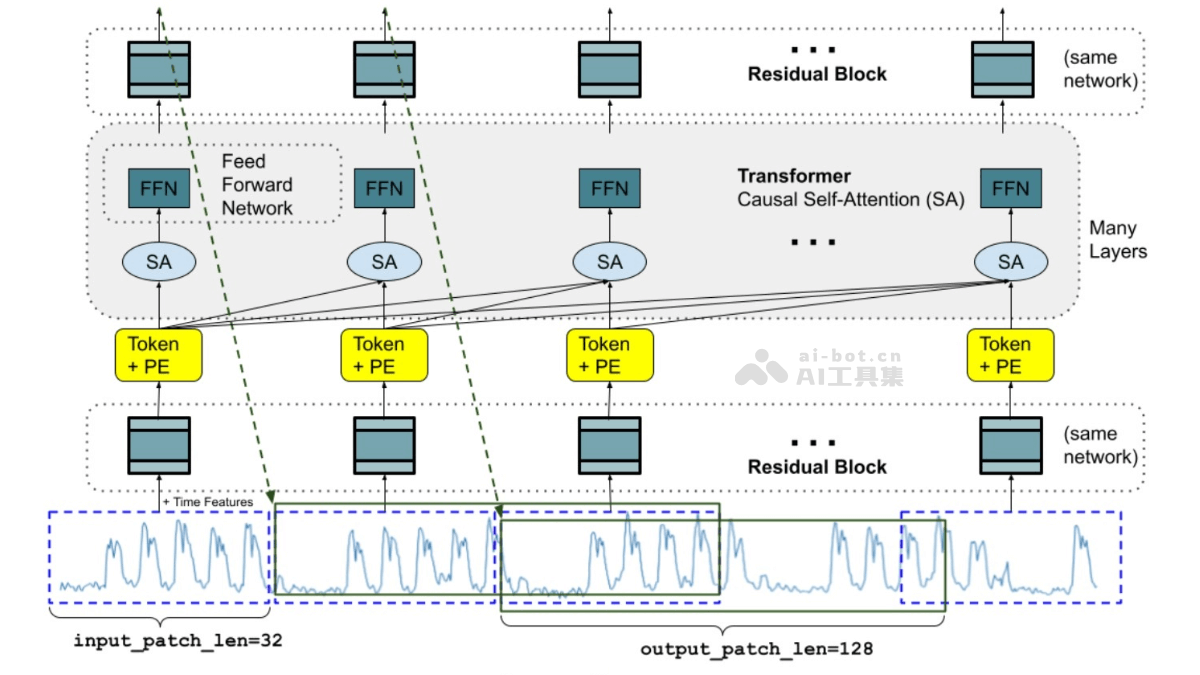
Main features of TimesFM 2.0
- Powerful forecasting capability: It can handle univariate time series forecasting of up to 2048 time points and supports arbitrary forecast horizons.
- Flexible forecast frequency selection: Users can freely choose the forecast frequency according to different time series characteristics, enhancing forecasting flexibility.
- Experimental quantile head forecasting: The model mainly performs point forecasting, while also experimentally providing 10 quantile heads for generating uncertainty estimates of forecasts, but these have not been calibrated after pretraining.
- Rich data pretraining: It integrates multiple datasets, including the pretraining set of TimesFM 1.0 and additional datasets from LOTSA, covering multiple domains such as residential electricity load, solar power generation, and traffic flow, providing a broad foundation for model training.
- Zero-shot learning capability: Although the model's maximum training context length is 2048, it can handle longer contexts in practical applications, demonstrating excellent zero-shot learning capability.
Technical principles of TimesFM 2.0
- Decoder-only architecture: TimesFM 2.0 adopts a decoder-only architecture, which has higher computational efficiency when processing time series data, can more effectively capture long-range temporal dependencies, and performs unidirectional forecasting more naturally.
- Time series patching and positional encoding: The model patches the time series, injects positional encoding, and extracts the temporal order information in the data and the relationships between different time points through stacked Transformer layers.
- Input patching and patch masking: Through input patching and patch masking techniques, the model achieves efficient training and inference processes and also supports zero-shot forecasting, improving the model's training efficiency and generalization ability.
- Pretraining process: TimesFM 2.0 is pretrained on a large-scale time series corpus containing 100 billion real-world time points, covering data from multiple domains and different temporal granularities. The pretraining process uses a self-supervised learning method to predict the next time point in the sequence.
- Flexible input processing: It supports processing time series inputs of different lengths and frequencies, adapting to various practical application scenarios. Although the maximum context length during pretraining is 2048, in practical applications the model can be extended to handle longer time series.
- Experimental support for quantile forecasting: The model introduces 10 quantile heads, allowing users to obtain forecast values at different quantiles on the basis of point forecasting, providing new possibilities for uncertainty analysis.
Project address of TimesFM 2.0
- Project official website:https://research.google/blog/a-decoder-only-foundation-model-for-time-series-forecasting/
- Github repository:https://github.com/google-research/timesfm
- HuggingFace Model Repository:https://huggingface.co/google/timesfm-2.0
- arXiv Technical Papers:https://arxiv.org/pdf/2310.10688
Application Scenarios of TimesFM 2.0
- Retail: It can be used to forecast sales, helping merchants better manage inventory and formulate sales strategies.
- Financial Markets: It can predict stock trends, among other things, providing investors with decision-making references.
- Website Operations: It can predict website traffic, helping with website optimization and resource allocation.
- Environmental Monitoring: Based on historical data, it predicts environmental change trends, such as air quality and climate change, providing a basis for environmental protection and response measures.
- Intelligent Transportation: Based on historical traffic flow data, it predicts future road conditions, providing a reference for urban planning and traffic signal optimization, helping with peak-hour management and reducing traffic congestion.