
What is Time-MoE
Time-MoE is an innovative time series foundation model based on the Mixture of Experts (MoE) architecture, scaling the parameter size of time series pre-trained models to the billion level. The model uses a sparse activation mechanism, activating only part of the network nodes during forecasting tasks, effectively improving computational efficiency and reducing computational costs. The Time-MoE model supports input and output ranges of arbitrary length and can handle various time series forecasting tasks from short-term to long-term. The model is pre-trained on the newly introduced large-scale dataset Time-300B, which contains over 300 billion time points and covers more than 9 domains. It is currently the largest public time series dataset, providing rich multi-domain data for model training and ensuring its excellent generalization ability across various tasks.
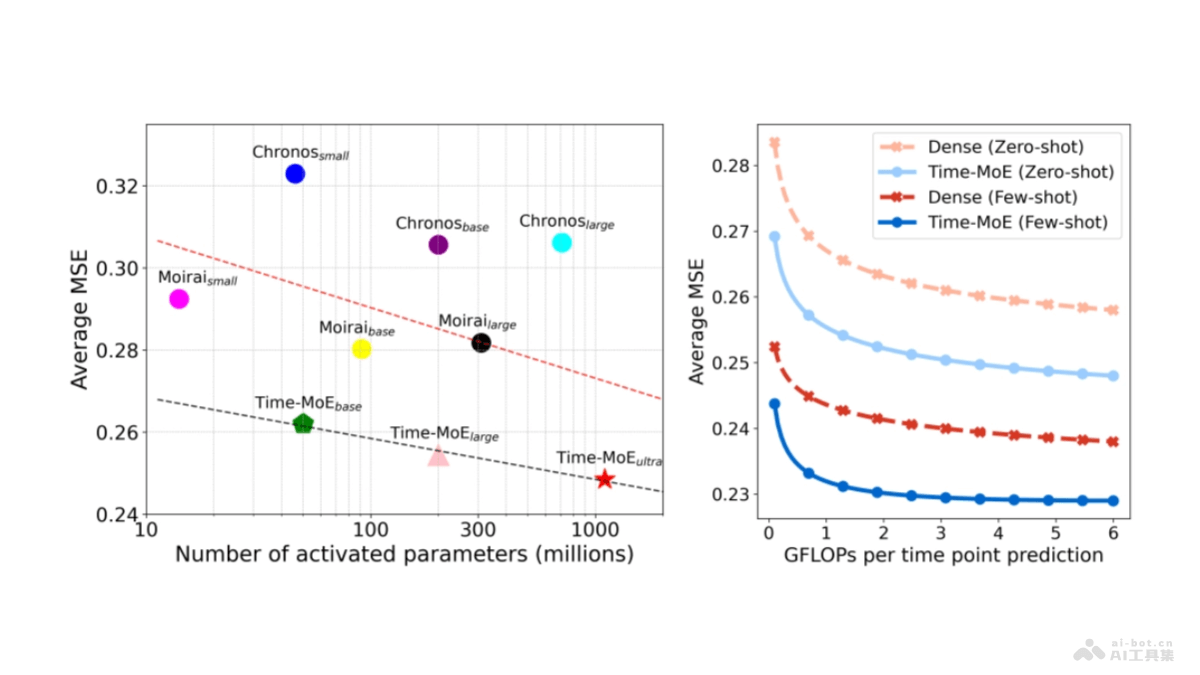
Main Features of Time-MoE
- High-precision time series forecasting: Time-MoE can perform high-precision time series forecasting, suitable for various domains and application scenarios.
- Flexible input and output range: Supports input and output of arbitrary length, suitable for time series forecasting tasks from short-term to long-term.
- Multi-resolution forecasting: Can perform forecasting at different scales, providing model flexibility.
- Pre-training capability: Pre-trained on the large-scale dataset Time-300B, capturing complex temporal dependencies.
- Generalization ability: Trained on multi-domain data, with excellent generalization ability across different tasks.
Technical Principles of Time-MoE
- Mixture of Experts architecture (MoE): Based on a sparse activation mechanism, activating only part of the network nodes during forecasting, improving computational efficiency.
- Autoregressive operation mode: Composed of a decoder-only Transformer model, supporting flexible forecasting ranges.
- Point-wise tokenization and encoding: Time series data is point-wise tokenized and encoded, preserving the integrity of temporal information.
- Multi-head self-attention and sparse mixture of experts layers: Uses multi-head self-attention mechanisms and sparse mixture of experts layers to process the encoded sequences.
- Multi-task learning: Optimizes prediction heads of different resolutions during training, improving the model's generalization ability.
Project Addresses of Time-MoE
- GitHub repository:https://github.com/Time-MoE/Time-MoE
- HuggingFace model library:https://huggingface.co/datasets/Maple728/Time-300B(Time-300B dataset)
- arXiv technical paper:https://arxiv.org/pdf/2409.16040
Application Scenarios of Time-MoE
- Energy management: Forecast electricity demand, energy consumption, or renewable energy generation, helping optimize energy allocation and reduce costs.
- Financial forecasting: Analyze and forecast stock market prices, exchange rates, or economic indicators, providing support for investment decisions.
- E-commerce sales: Forecast product sales, helping enterprises manage inventory and adjust sales strategies.
- Weather forecasting: Forecast weather changes, providing important meteorological information for industries such as agriculture, transportation, and tourism.
- Traffic planning: Forecast traffic flow and congestion, assisting urban traffic management and planning.