
What is TheoremExplainAgent
TheoremExplainAgent (TEA) is a multimodal agent system open-sourced by the University of Waterloo, Votee AI, and other institutions. It is based on generating long-form animated videos to help people better understand mathematical and scientific theorems. TheoremExplainAgent supports the generation of educational videos over 5 minutes long, covering multiple STEM fields (such as mathematics, physics, chemistry, and computer science). To evaluate performance, researchers have introduced the TheoremExplainBench (TEB) benchmark dataset, which includes 240 theorems and evaluates across multiple dimensions such as accuracy, depth, logical flow, visual relevance, and element layout. Experiments show that TheoremExplainAgent performs excellently in the success rate of generating long-form videos, can reveal deep-level reasoning errors that are easily missed in textual explanations, and provides new ideas for AI-generated educational content.
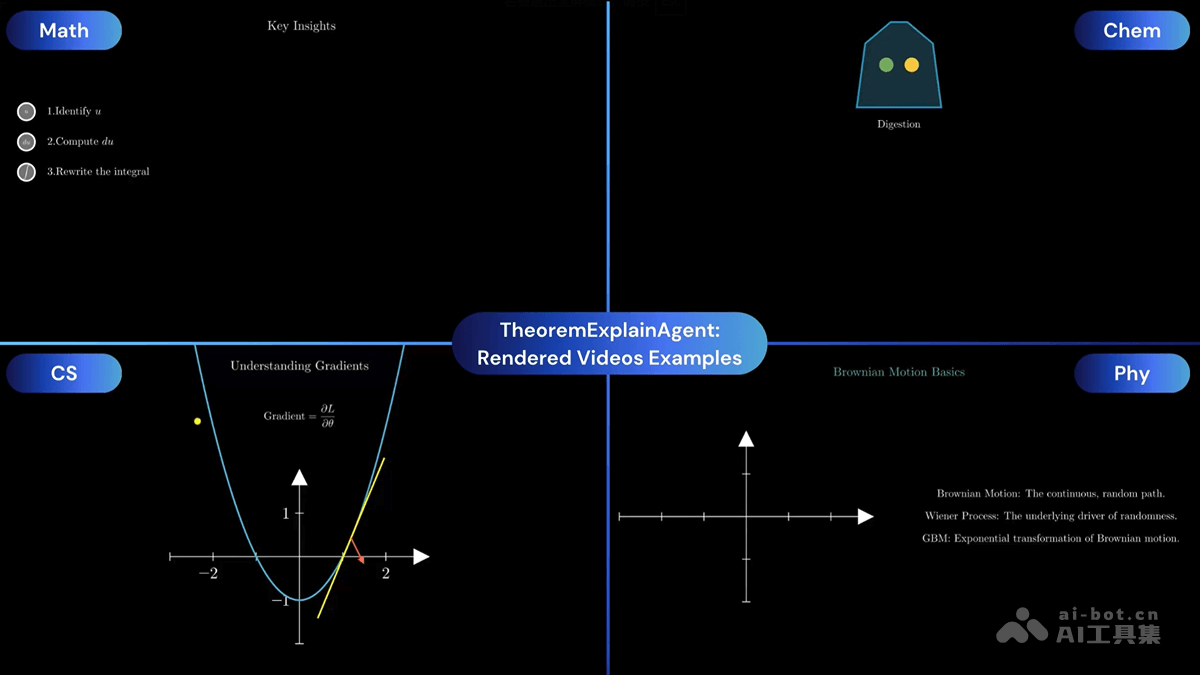
Main Features of TheoremExplainAgent
- Generate long-form videos: Generate explanation videos over 5 minutes long based on input theorems, covering multiple disciplines such as mathematics, physics, chemistry, and computer science.
- Multimodal explanation: Combine text, animation, and speech to enhance understanding of abstract concepts through visualization.
- Automatic error diagnosis: Expose reasoning errors through video form, helping developers more clearly diagnose logical flaws in models.
- Cross-disciplinary generality: Support theorems of different difficulty levels (from high school to graduate level), applicable to multiple STEM fields.
- Systematic evaluation: Systematically measure the quality and accuracy of generated videos based on the TheoremExplainBench benchmark and multidimensional evaluation metrics.
Technical Principles of TheoremExplainAgent
- Planning agent: Responsible for generating the overall plan for the video based on the input theorem, including scene division, the goal of each scene, content description, and visual layout.
- Use techniques such as Chain-of-Thought and Program-of-Thought to ensure the logical coherence and depth of the video content.
- Coding agent: Based on the detailed plan generated by the planning agent, use Manim (a Python library for creating mathematical animations) to generate animation scripts. Based on retrieval-augmented generation (RAG) technology, use Manim documentation as a knowledge base to dynamically retrieve code snippets and API documentation, improving the accuracy and efficiency of code generation. During the code generation process, automatically detect and fix errors to ensure the video renders correctly.
- Multimodal fusion: Video content combines textual narration, animated demonstrations, and voiceover explanations to enhance understanding of theorems through visualization. Use image processing technology and natural language processing models (such asGPT-4oand Gemini 2.0 Flash) to conduct multidimensional evaluation of the generated videos, ensuring the accuracy and visual quality of the content.
- Systematic evaluation: Introduce the TheoremExplainBench benchmark, which includes 240 theorems and covers multiple disciplines and difficulty levels. Introduce five automatic evaluation metrics (accuracy, visual relevance, logical flow, element layout, and visual consistency) to comprehensively measure the quality of AI-generated videos.
Project Address of TheoremExplainAgent
- Project official website:https://tiger-ai-lab.github.io/TheoremExplainAgent/
- GitHub repository:https://github.com/TIGER-AI-Lab/TheoremExplainAgent
- HuggingFace model library:https://huggingface.co/datasets/TIGER-Lab/TheoremExplainBench
- arXiv technical paper:https://arxiv.org/pdf/2502.19400
Application Scenarios of TheoremExplainAgent
- Online education: Provide students with vivid theorem explanation videos to assist online learning.
- Classroom Teaching: As a teaching aid tool for teachers, it enhances students' visualized learning experience.
- Academic Research: Help researchers quickly understand complex theorems and generate accompanying research videos.
- Technical Development: Generate explanation videos for algorithms and models to help engineers and technical personnel understand the principles.
- Science Popularization: Produce science popularization videos for the public to improve the effectiveness of science communication.