
What is The Language of Motion
The Language of Motion is a multimodal language model introduced by the team of Fei-Fei Li at Stanford University, capable of integrating verbal and nonverbal language in human motion. The model can process text, speech, and motion data, and generate the corresponding target modality, which is crucial for creating virtual characters that communicate naturally. The Language of Motion demonstrates outstanding performance on the co-speech gesture generation task, and compared with traditional models, it requires far less data for training. The model can perform new tasks such as emotion prediction, recognizing emotions from motion. The Language of Motion is of great significance for application fields such as gaming, film, and virtual reality, advancing the development of technology for natural communication between virtual characters and humans.
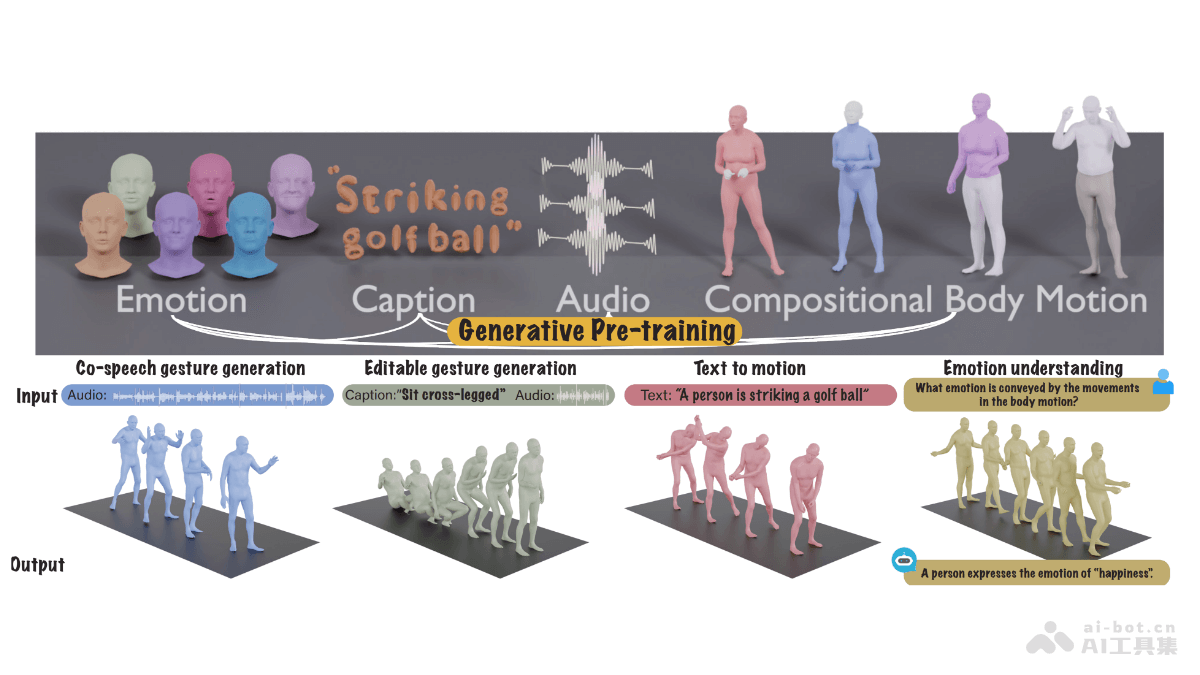
Main Features of The Language of Motion
- Multimodal Input Processing: Can accept text, speech, and motion data as input, flexibly handling data from multiple modalities.
- Motion Understanding and Generation: Based on the input speech, text, or motion data, understands and generates the corresponding 3D human motion.
- Co-Speech Gesture Generation: Generates gestures synchronized with speech, enhancing the natural communication ability of virtual characters.
- Emotion Prediction: Predicts emotions from motion data, providing support for fields such as mental health and psychiatry.
- Editable Gesture Generation: Supports users in editing the motion of specific body parts based on speech or text prompts, enhancing the expressiveness of motion.
Technical Principles of The Language of Motion
- Modality Tokenization: Tokenizes the motion of the face, hands, upper body, and lower body separately based on Vector Quantized Variational Autoencoders (VQ-VAE), converting continuous motion data into discrete tokens.
- Multimodal Vocabulary: Combines tokens from different modalities into a unified multimodal vocabulary, enabling the language model to process inputs from different modalities.
- Encoder-Decoder Architecture: Uses a language model with an encoder-decoder structure, inputting mixed tokens and generating output token sequences.
- Generative Pre-training: Based on self-supervised learning, aligns the relationships between different modalities, such as the corresponding relationships of motion across body parts and audio-text alignment.
- Instruction-Following Training: After pre-training, fine-tunes the model through instruction templates, enabling it to perform specific downstream tasks according to natural language instructions.
- End-to-End Training: The model undergoes end-to-end training during both pre-training and post-training, maximizing alignment between modalities.
Project Address of The Language of Motion
- Project Official Website:languageofmotion.github.io
- arXiv Technical Paper:https://arxiv.org/pdf/2412.10523
Application Scenarios of The Language of Motion
- Game Development: Creates more realistic and natural non-player characters (NPCs) in games, capable of richer interaction with players through body language and gestures.
- Film and Animation Production: Generates more natural and fluid 3D character motion in films or animations, reducing the workload of manual animation production and improving production efficiency.
- Virtual Reality (VR): Provides a more realistic interactive experience in virtual reality environments, making the motion and reactions of virtual characters closer to those of real humans.
- Augmented Reality (AR): In AR applications, coordinating the movements of virtual objects or characters with the user's gestures and actions in the real world.
- Social Robots: Providing more natural communication methods for social robots, enhancing robot-human interaction, and making them more effective in fields such as service, education, or companionship.