
What is TextDiffuser-2
Text-Diffuser 2 is a newly introduced diffusion model-based text rendering method by researchers from Microsoft Research, the Hong Kong University of Science and Technology, and Sun Yat-sen University. It aims to address the limitations of image diffusion models in generating text in terms of flexibility, automation, layout prediction capability, and style diversity, in order to improve the quality and diversity of visual text in generated images.
The innovation of TextDiffuser-2 lies in its use of the powerful capabilities of language models to automatically plan and encode text layouts, thereby increasing the diversity and visual appeal of generated images while maintaining text accuracy. Compared with the first-generation TextDiffuser, it has been improved and optimized in multiple aspects, such as improvements in layout planning, line-level text encoding, dynamic adjustment of text layouts through chat interaction, optimization of text rendering, and more diverse text styles.
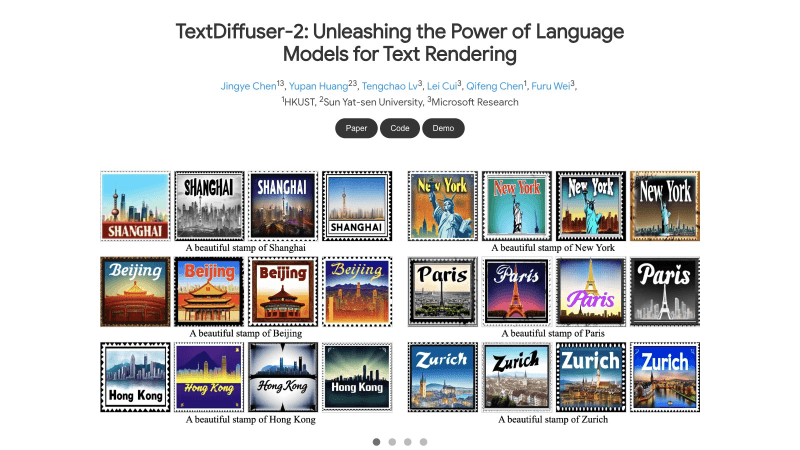
TextDiffuser-2 Official Website Entry
- Official project homepage:https://jingyechen.github.io/textdiffuser2/
- Hugging Face Demo:https://huggingface.co/spaces/JingyeChen22/TextDiffuser-2
- GitHub address:https://github.com/microsoft/unilm/tree/master/textdiffuser-2
- arXiv research paper:https://arxiv.org/abs/2311.16465
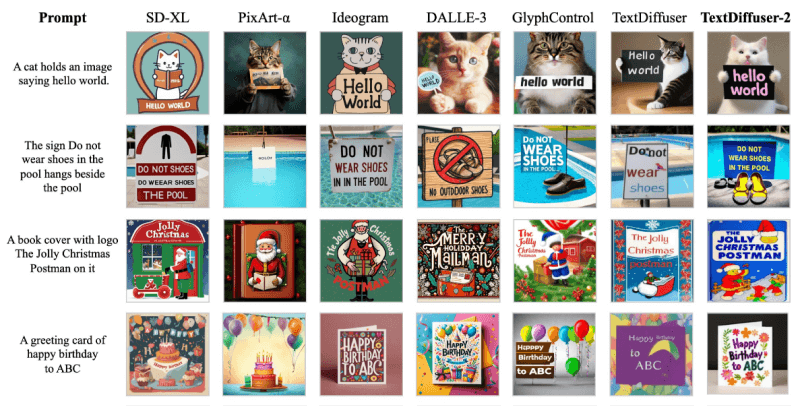
TextDiffuser-2 Features and Capabilities
- Text Layout Planning:Automatically infers keywords from the user's input prompt and plans the layout of text in the image, andallows users to specify keywords and determine their positions in the image. It also supportsdynamically adjusting text layouts through interactive chat with the user, such as regenerating, adding, or moving text elements.
- Text Layout Encoding:In the diffusion model, a language model is used to encode the position and content of text to generate text images.Uses line-level text encoding instead of character-level, to provide greater flexibility and style diversity.
- Text Image Generation:Generates images containing accurate and visually appealing text according to the planned text layout.Supports multiple text styles, including handwriting and artistic fonts, to enhance the visual diversity of images.
- Text Template Image Generation:When a template image is provided, TextDiffuser-2 can directly use existing OCR tools to extract text information and input it as a condition to the diffusion model, without needing to predict the layout from a language model.
- Text Inpainting:Similar to the first-generation TextDiffuser, TextDiffuser-2 can adapt to text inpainting tasks by modifying the input convolution kernel channels of the U-Net to train the model, so as to fill in text areas in images.
- Text-free Natural Image Generation:Even after fine-tuning on text data, TextDiffuser-2 can maintain its generation capability in the original domain (such as the COCO dataset), generating images that do not contain text.
- Handling Overlapping Layouts:TextDiffuser-2 shows higher robustness when handling overlapping text boxes in predicted layouts, and can generate more accurate text images.
How TextDiffuser-2 Works
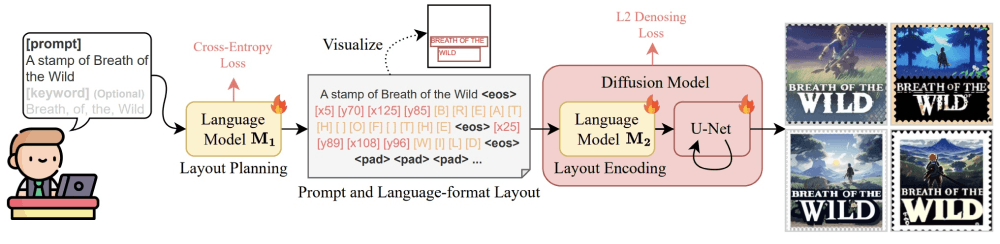
- User Input:The user provides a descriptive prompt, which can be a description of the text content and layout of the desired generated image.
- Layout Planning:Use a pretrained large language model (such as GPT-4), fine-tuned to automatically infer text content and layout based on user prompts. The model can handle two cases: first, automatically generating text and layout when no user-provided keywords are available; second, determining the layout positions of these keywords when the user provides keywords.The layout information output by the language model includes the coordinates of text lines, such as the top-left and bottom-right coordinates of each text line.
- Layout Encoding:Based on the results of layout planning, TextDiffuser-2 uses another language model to encode text layout information. This model combines the user prompt and layout information into a format suitable for processing by the diffusion model.To encode text positions, TextDiffuser-2 introduces special tokens to represent coordinates, such as "[x5]" and "[y70]" representing the values of the x-coordinate and y-coordinate, respectively.
- Diffusion Model Training:The diffusion model of TextDiffuser-2 is trained with a denoising L2 loss to learn how to generate images based on the encoded text layout information. This process involves gradually guiding the generation process from a random noise state to the target image.
- Image Text Generation:In the generation stage, the diffusion model generates images based on the encoded text layout information. This process usually requires multiple steps, and each step gradually brings the generated image closer to the final text layout and content.
- User Interaction:TextDiffuser-2 allows users to interact with the model through multi-turn chat to further adjust the text layout. Users can request to regenerate the layout, add or delete keywords, or move keywords to new positions.
- Evaluation and Optimization:The generated images are evaluated to ensure the accuracy of the text and the visual quality of the image. This may include using OCR tools to evaluate the readability and accuracy of the text, as well as evaluating the aesthetics and practicality of the image through user studies.