
What is Text to Bark
Text to Bark is ElevenLabs 's first-ever AI "dog language" text-to-speech model. Users enter text and select a dog breed, and the model can generate highly realistic dog barks, with 95% of dogs unable to distinguish them from real barks. The model was developed based on open-source canine linguistics research, supports personalized breed selection and tone adjustment, and can be deployed to "cloud barking infrastructure" such as smart home devices.
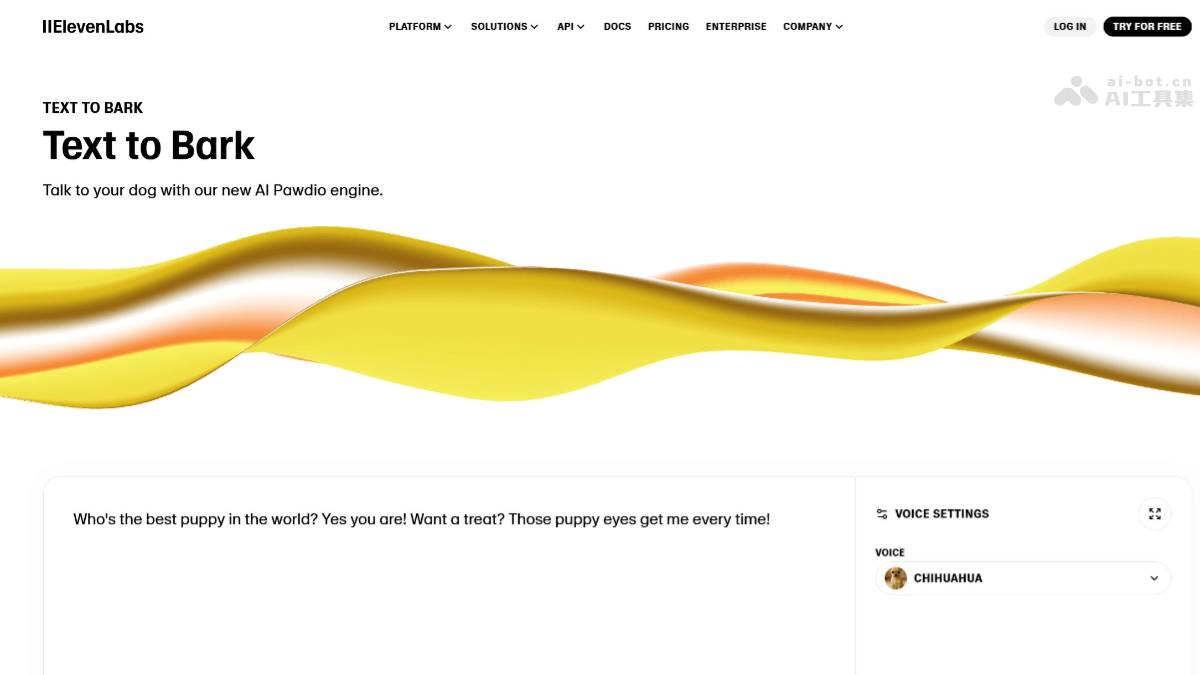
Main Features of Text to Bark
- Text-to-dog-bark: After users enter text, the model can convert it into highly realistic dog barks.
- Personalized selection: Supports selection of multiple dog breeds, such as Labrador, Chihuahua, German Shepherd, etc., and can adjust the tone and rhythm of the barks to suit different scenarios.
- Strong technical scalability: It has been adapted to major "cloud barking infrastructure" and can be integrated into smart home devices, pet monitoring systems, or mobile applications, making it convenient for pet owners to interact with their pets anytime and anywhere.
Technical Principles of Text to Bark
- Data collection and processing: The R&D team referred to a large amount of data on canine behavior and sound patterns.
- Feature extraction: Various features are extracted from the collected canine sound data, such as pitch, speed, and intonation, and converted into mathematical representations for processing by neural networks.
- Model training: Advanced machine learning algorithms, such as deep neural network models (possibly including recurrent neural networks or transformers, etc.), are used to learn and train on the extracted features, enabling the model to accurately simulate the barking characteristics of different dog breeds.
- Text-to-speech conversion:
- Text to semantic tokens: Convert the input text into semantic tokens that encode the audio to be generated.
- Semantic to coarse tokens: Convert the semantic tokens into the first two codebooks of the EnCodec codec.
- Coarse to fine tokens: Convert the first two codebooks of EnCodec into 8 codebooks.
- Synthesizing sound: After users enter text and select the target dog breed, the model generates audio output matching that breed's barking style based on the selected breed's acoustic characteristics.
How to Use Text to Bark
- Visit the platform: VisitElevenLabs's official website and find the "Text to Bark" page.
- Enter text and select voice type: Enter what you want the dog to hear in the text box, for example, "Dinner time!". Select the voice type you want the dog to use, such as "Chihuahua".
- Generate audio: Click the generate button, and the system will automatically convert the text into the corresponding dog sound.
- Play audio: Play the generated audio to interact with the dog and observe its reaction.
Application Scenarios of Text to Bark
- Pet training: Pet trainers can use the tool to issue command sounds to dogs, helping dogs better understand training content.
- Animal behavior research: Animal behaviorists can use the tool to study animal behavior and obtain more data support by simulating the barks of different dog breeds.
- Entertainment industry: Filmmakers can use technology to dub virtual dog characters.
- Family pet interaction: At family gatherings, owners use tools to interact with their dogs, adding fun to the gathering.