
What is TesserAct
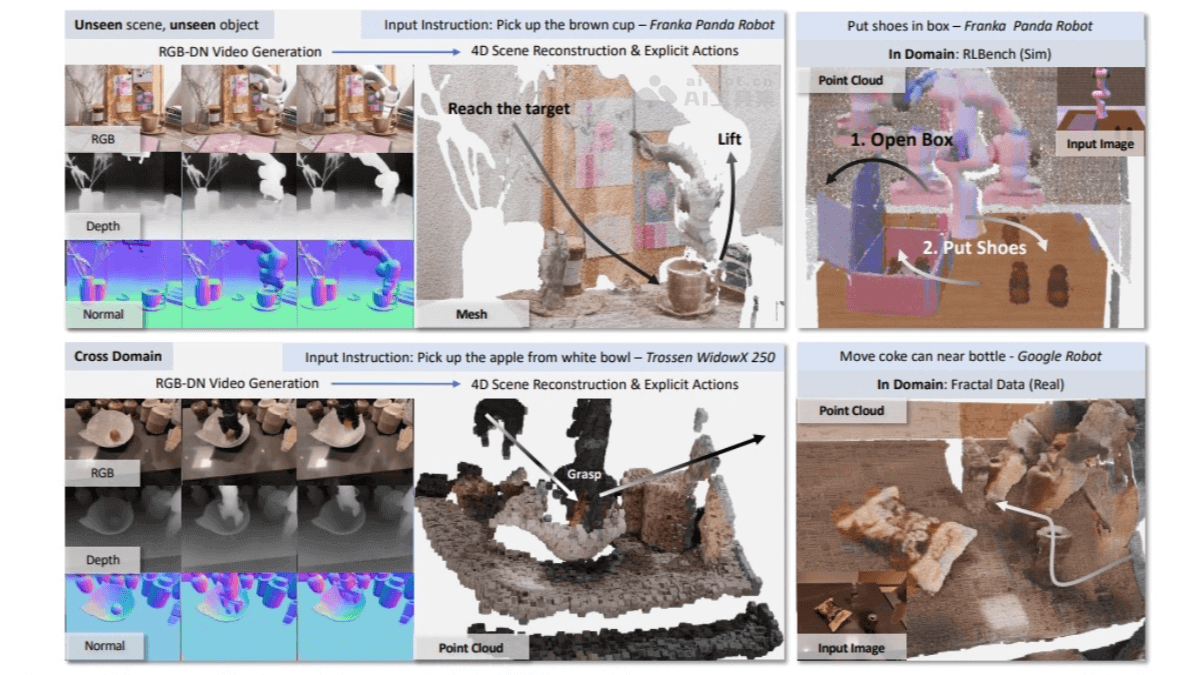
TesserAct is an innovative 4D embodied world model that can predict the dynamic evolution of 3D scenes over time and respond to the actions of embodied agents. By training on RGB-DN (RGB, depth, and normal) video data, it goes beyond traditional 2D models and can incorporate detailed shape, configuration, and temporal changes into predictions. The core advantage of TesserAct lies in its spatiotemporal consistency, which supports novel view synthesis and significantly improves the performance of policy learning.
Main Features of TesserAct
- 4D Scene Generation: TesserAct can generate video streams containing RGB (color images), depth maps, and normal maps, which together form a coherent 4D scene and help AI systems understand the shape, position, and motion of objects.
- Novel View Synthesis: The model supports generating images of scenes from different viewpoints, which is very helpful for robots navigating and operating in complex environments.
- Spatiotemporal Consistency Optimization: By introducing spatiotemporal continuity constraints, TesserAct ensures that the generated 4D scenes remain highly consistent in time and space, making them closer to real-world physical laws.
- Robotic Manipulation Support: Robots based on TesserAct perform excellently in various manipulation tasks, especially in tasks requiring precise spatial understanding, with success rates far higher than methods relying only on 2D images.
- Cross-Platform Generalization Ability: TesserAct performs stably across different platforms and environments and can adapt to a variety of complex scenarios.
Technical Principles of TesserAct
- Dataset Expansion: TesserAct first expands existing robot manipulation video datasets by adding depth and normal information to enrich the data content. Based on off-the-shelf models to obtain depth and normal data, it provides richer multimodal information for training.
- Video Generation Model Fine-Tuning: On the expanded dataset, TesserAct fine-tunes a video generation model that can jointly predict the RGB, depth, and normal information of each frame. This multimodal prediction capability enables the model to more comprehensively understand the shape, configuration, and temporal changes of scenes.
- Scene Conversion Algorithm: TesserAct proposes an algorithm that can directly convert the generated RGB, depth, and normal videos into high-quality 4D scenes. It ensures the temporal and spatial coherence of 4D scenes predicted from embodied scenes, supporting novel view synthesis and policy learning.
- Spatiotemporal Consistency Optimization: TesserAct ensures that the generated 4D scenes remain highly consistent in time and space by introducing spatiotemporal continuity constraints. This enables the model to more realistically reflect the dynamic changes of the physical world and provides embodied agents with more accurate environmental understanding.
- Inverse Dynamics Model Learning: TesserAct can generate high-quality 4D scenes and can learn the inverse dynamics model of embodied agents. This enables agents to more accurately predict the impact of their actions on the environment and perform better in complex tasks.
Project Address of TesserAct
- Project Website:https://tesseractworld.github.io/
- Github Repository:https://github.com/UMass-Embodied-AGI/TesserAct
- HuggingFace Model Library:https://huggingface.co/anyeZHY/tesseract
- arXiv Technical Paper:https://arxiv.org/pdf/2504.20995
Application Scenarios of TesserAct
- Robot Manipulation Tasks: TesserAct helps robots better understand and predict dynamic changes in the environment by generating high-quality 4D scenes. For example, in object grasping, sorting, and placement tasks, TesserAct can provide precise spatial information, significantly improving the success rate of robot operations.
- Virtual Environment Interaction: TesserAct supports novel view synthesis and spatiotemporally consistent 4D scene generation. For example, in virtual reality (VR) or augmented reality (AR) scenarios, TesserAct can provide users with a more realistic visual experience.
- Embodied Intelligence Research: TesserAct provides a powerful tool for embodied intelligence research, helping researchers better understand how agents interact with the environment through perception and action.
- Industrial Automation: In industrial automation scenarios, TesserAct can help robots better perform tasks, such as object recognition and manipulation in dynamic environments. Its spatiotemporal continuity optimization capability can adapt to complex working environments.