
What is Tencent Hunyuan Turbo S
Tencent Hunyuan Turbo S is Tencent's new-generation fast-thinking model. The model adopts an innovative Hybrid-Mamba-Transformer fusion architecture, effectively reducing the computational complexity of traditional Transformer, reducing KV-Cache memory usage, and significantly improving training and inference efficiency. As the industry's first practice of losslessly applying the Mamba architecture to an ultra-large MoE model, Turbo S performs excellently in multiple domains such as knowledge, mathematics, and reasoning, comparable to leading models such as DeepSeek V3 and GPT-4o.
The core advantage of Hunyuan Turbo S lies in its fast response, capable of achieving "instant replies," doubling wording speed and reducing first-token latency by 44%. It performs excellently in short chain-of-thought tasks (such as mathematics, code, and logical reasoning), while combiningHunyuan T1the long chain-of-thought capability of slow-thinking models, balancing stability and accuracy.
Main features of Tencent Hunyuan Turbo S
- Fast response capability: Hunyuan Turbo S can achieve "instant replies," doubling wording speed and reducing first-token latency by 44%, significantly improving interaction fluency and user experience.
- Multi-domain knowledge and reasoning capability: It performs excellently in multiple domains such as knowledge, mathematics, and logical reasoning, benchmarked against industry-leading models such as DeepSeek V3 and GPT-4o.
- Content creation and multimodal support: It supports high-quality literary creation, text summarization, multi-turn dialogue, and other functions, while also possessing multimodal capabilities for generating images from text.
- Low deployment cost and high cost-effectiveness: It adopts the Hybrid-Mamba-Transformer fusion architecture, reducing the computational complexity and deployment cost of traditional Transformer.
Technical principles of Tencent Hunyuan Turbo S
- Advantages of the Mamba architecture: The Mamba architecture is based on the State Space Model (SSM). By introducing a Selective Mechanism, it can efficiently process long-sequence data. It performs excellently when processing long texts, while significantly reducing computational complexity and KV-Cache memory usage.
- Retention of the Transformer architecture: The Transformer architecture excels at capturing complex contextual relationships. Hunyuan Turbo S retains this advantage, while by integrating the Mamba architecture, it breaks through the bottlenecks of traditional Transformer in long-text processing and inference cost.
- Optimization of the MoE model: Hunyuan Turbo S is the industry's first successful lossless application of the Mamba architecture to an ultra-large MoE (Mixture of Experts) model. It improves the model's memory and computational efficiency and reduces training and inference costs.
- Integration of long and short chain of thought: While maintaining the fast-response (fast-thinking) experience for humanities-type questions, Hunyuan Turbo S significantly improves scientific reasoning ability through self-developed long chain-of-thought data, achieving an overall improvement in model performance.
Performance of Tencent Hunyuan Turbo S
- Knowledge domain:
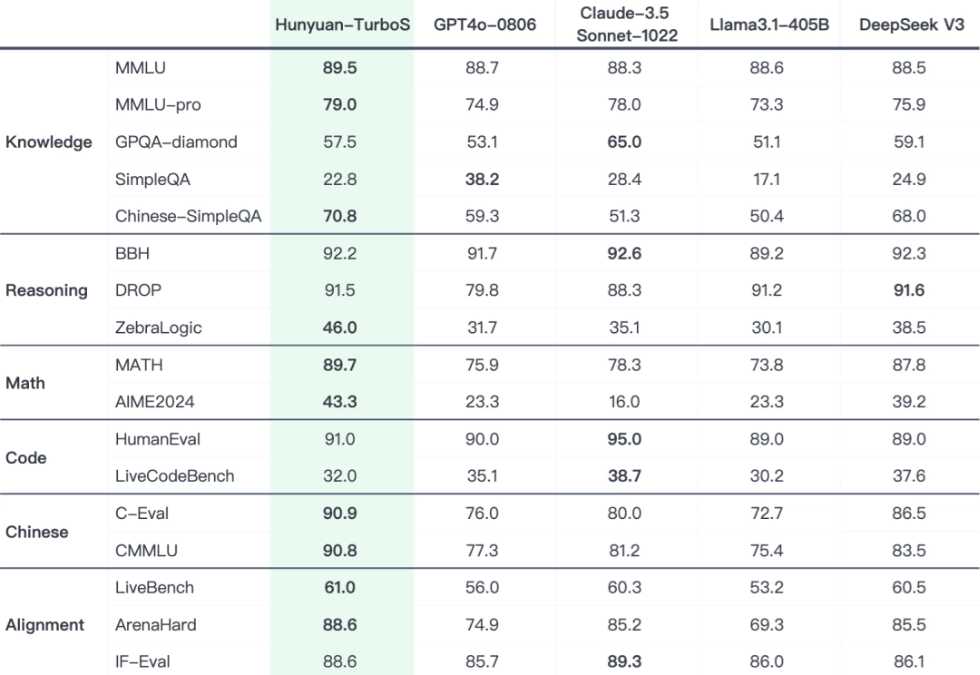
- In the MMLU benchmark test, Hunyuan Turbo S scored 89.5, slightly lower than DeepSeek V3's 88.5, but higher than other models.
- In the MMLU-pro test, Hunyuan Turbo S scored 79.0, performing better than GPT4o-0806 and Claude-3.5.
- In the GPQA-diamond test, Hunyuan Turbo S scored 57.5, performing better than Llama3.1-405B and DeepSeek V3.
- In the SimpleQA test, Hunyuan Turbo S scored 22.8, performing worse than other models.
- In the Chinese-SimpleQA test, Hunyuan Turbo S scored 70.8, outperforming GPT4o-0806 and Claude-3.5.
- Reasoning Domain:
- In the BBH test, Hunyuan Turbo S scored 92.2, outperforming all other models.
- In the DROP test, Hunyuan Turbo S scored 91.5, outperforming GPT4o-0806 and Claude-3.5.
- In the ZebraLogic test, Hunyuan Turbo S scored 46.0, underperforming compared with other models.
- Mathematics Domain:
- In the MATH test, Hunyuan Turbo S scored 89.7, outperforming GPT4o-0806 and Claude-3.5.
- In the AIME2024 test, Hunyuan Turbo S scored 43.3, outperforming GPT4o-0806 and Claude-3.5.
- Code Domain:
- In the HumanEval test, Hunyuan Turbo S scored 91.0, outperforming GPT4o-0806 and Claude-3.5.
- In the LiveCodeBench test, Hunyuan Turbo S scored 32.0, underperforming compared with other models.
- Chinese Language Domain:
- In the C-Eval test, Hunyuan Turbo S scored 90.9, outperforming GPT4o-0806 and Claude-3.5.
- In the CMMLU test, Hunyuan Turbo S scored 90.8, outperforming GPT4o-0806 and Claude-3.5.
- Alignment Domain:
- In the ArenaHard test, Hunyuan Turbo S scored 88.6, outperforming GPT4o-0806 and Claude-3.5.
- In the IF-Eval test, Hunyuan Turbo S scored 88.6, outperforming GPT4o-0806 and Claude-3.5.
How to use Tencent Hunyuan Turbo S
- Tencent Cloud official website: Hunyuan Turbo S has been officially launched on the Tencent Cloud official website. Developers and enterprise users can call the model through the API.
- Tencent Yuanbao: The model will gradually be rolled out in grayscale in theTencent YuanbaoAPP. Users can select the "Hunyuan" model in the APP and turn off the deep thinking feature to try it out.
- Free trial: Starting today, developers and enterprise users can call Hunyuan Turbo S through the API on Tencent Cloud and enjoy a one-week free trial. VisitTencent Hunyuan turbos model API free trial applicationaddress to fill out the application.
- Future plans: Hunyuan Turbo S will become the core foundation of Tencent Hunyuan series derived models, providing foundational capabilities for derived models such as reasoning, long text, and code.
Model pricing of Tencent Hunyuan Turbo S
- Model pricing: The API call pricing for Hunyuan Turbo S is 0.8 yuan per million tokens for input and 2 yuan per million tokens for output.
Application scenarios of Tencent Hunyuan Turbo S
- Daily conversation: Suitable for scenarios such as quick Q&A and intelligent customer service.
- Code generation and logical reasoning: Performs excellently in short chain-of-thought tasks such as mathematics, code generation, and logical reasoning.
- Content creation: Supports high-quality text generation and text-to-image features.