
What is Tianyi AI Open Platform
Tianyi AI Open Platform is an AI technology service platform officially launched by China Telecom. The platform uses China Telecom's self-developedXingchen Large Modelas its technology foundation, providing full-process services from AI technology capability display to product experience, access, and use. Individual users can use features such as the Q&A assistant,超大表格分析, Xingchen Huibi, multi-dialect recognition, and text-to-image. Government and enterprise users can experience development platform capabilities such as large model development, AI middle platform, data middle platform, Xinghai PaaS platform, and Xingchen Agent Platform, including nearly 30 core products, meeting the digital innovation needs of scenarios such as government affairs, finance, and industry.
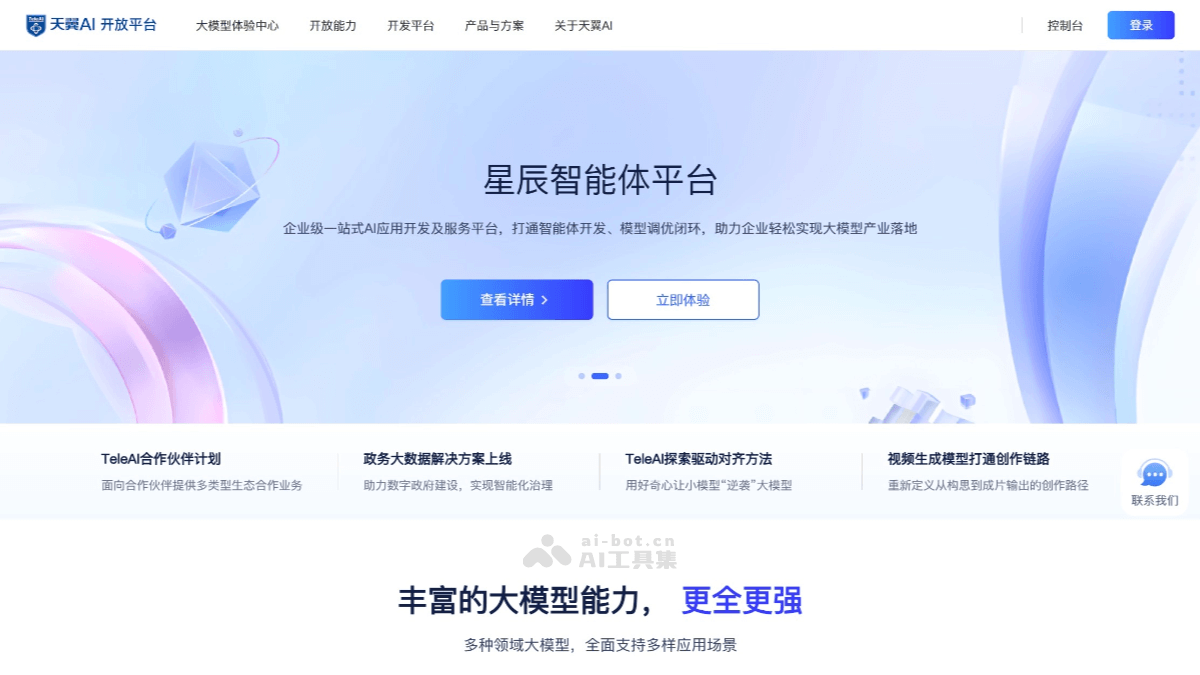
Main features of Tianyi AI Open Platform
- Q&A Assistant: Provides intelligent Q&A services based on the Xingchen Large Model, helping users quickly obtain information.
- Multi-dialect recognition: Supports mixed recognition of 50 dialects, breaking through the challenge of mixed speech in multiple dialects with a single model.
- 超大表格分析: Can efficiently process and analyze complex tabular data.
- Xingchen Huibi: Supports intelligent writing and content creation.
- Text-to-image feature: Through the Xingchen multimodal large model, enables one-click "text-to-image," improving creation efficiency.
- Large model development platform: Supports zero-code creation and publishing of agent applications, providing full-process tools from project creation to application testing.
- AI middle platform and data middle platform: Provides technical support for the full life cycle of AI R&D, helping enterprises standardize and modularize intelligent development processes.
- Xinghai PaaS Platform: Provides enterprises with flexible platform as a service, supporting a variety of application scenarios.
- Xingchen Agent Platform: Supports rapid development and deployment of agent applications.
- Industry solutions: Provides digital innovation solutions covering multiple fields such as government affairs, finance, industry, education, and urban governance.
- Xingchen Large Model: As the technology foundation, provides full-modal capabilities in areas such as semantics, speech, vision, and multimodality, supporting models with parameters ranging from billions to hundreds of billions.
- Supernatural speech generation: Can achieve highly realistic replication, accurately matching the speaker's timbre with just 5-10 seconds of speech, with a similarity of over 90%.
- Visual large model applications: Empower millions of cameras nationwide and are widely used in fields such as transportation, government affairs, and emergency response.
How to use Tianyi AI Open Platform
- Visit the platform: Visit the Tianyi AI Open Platform'sofficial website。
- Experience features:
- Q&A Assistant: Use the TeleChat Q&A assistant to directly enter questions and obtain intelligent answers.
- Multi-dialect recognition: Experience the feature that supports mixed recognition of 50 dialects.
- 超大表格分析: Upload a table file, and the platform will automatically perform data analysis.
- Xingchen Huibi: Used for intelligent writing and content creation.
- Text-to-image feature: In the Xingchen Huiying application, enter a text description to generate an image.
- Large Model Development: Use the large model development platform to create and publish agent applications with zero code.
- AI Middle Platform and Data Middle Platform: Realize the full process from data governance and model training to application deployment.
- Xinghai PaaS Platform: Obtain a flexible platform as a service, supporting a variety of application scenarios.
- Xingchen Agent Platform: Quickly develop and deploy agent applications.
Application Scenarios of Tianyi AI Open Platform
- Intelligent Office: Provide functions such as intelligent document processing and intelligent meeting minutes to improve government office efficiency.
- Risk Assessment: Analyze user behavior and data based on AI algorithms to improve the accuracy of risk prediction.
- Education: Provide personalized learning plans for students to improve learning outcomes. Assist teachers in lesson preparation and teaching, and provide teaching resource recommendations. Simulate experimental environments through AI technology to reduce experimental costs.
- Intelligent Creation: Provide functions such as text-to-image and intelligent writing to support content creation.