
What Is TaskWeaver
TaskWeaver is a code-first AI agent framework launched by Microsoft, focused on seamless planning and execution of data analysis tasks. It interprets user requests based on code snippets, efficiently coordinates various plugins (in the form of functions) to execute data analysis tasks, and supports a stateful execution approach. TaskWeaver supports rich data structures, supports users in encapsulating custom algorithms as plugins, and integrates domain-specific knowledge to improve the reliability of task execution. TaskWeaver provides security validation before code execution, supports basic session management to isolate different users' data, and is easy to debug and extend. TaskWeaver aims to simplify user interaction with technology, enabling users to handle complex data analysis tasks in natural language without needing an in-depth understanding of programming details.
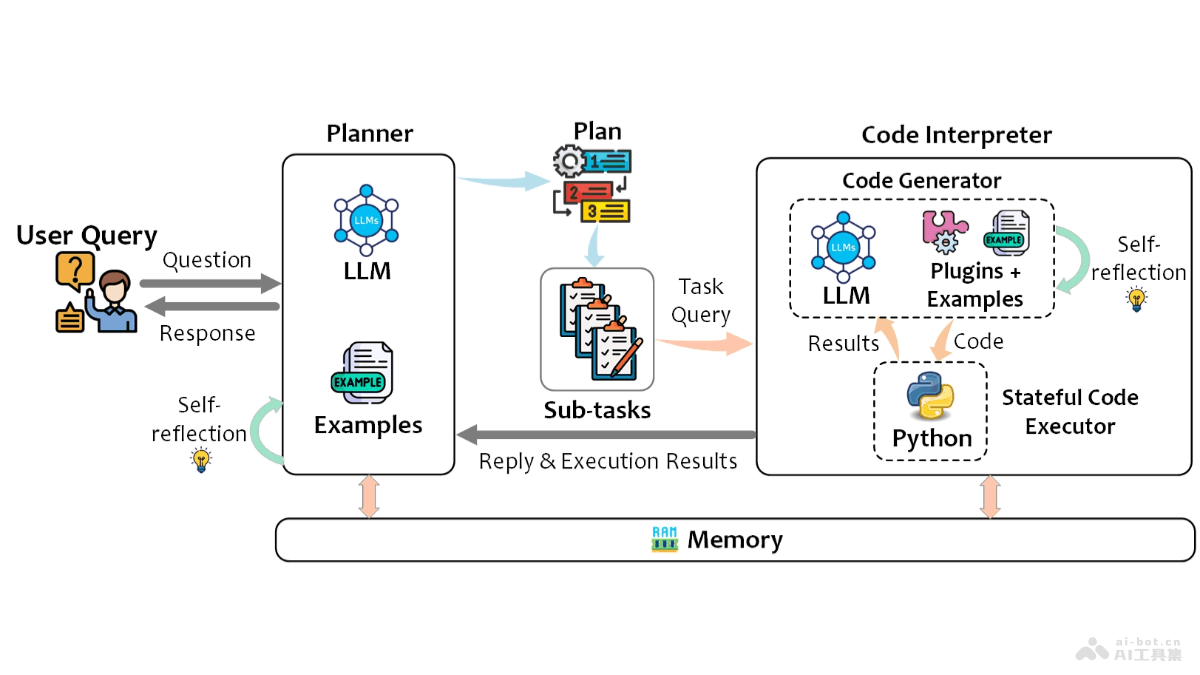
Main Features of TaskWeaver
- Code Generation: Converts natural language requests into executable code snippets.
- Plugin System: Supports user-defined plugins as callable functions, extending functionality and handling domain-specific tasks.
- Support for Complex Data Structures: Handles complex data structures including nested lists, dictionaries, or data frames.
- State Preservation: Maintains execution state across multiple interactions and supports data and state management across sessions.
- Secure Execution: Ensures generated code executes in a secure sandbox environment, preventing the execution of malicious code.
Technical Principles of TaskWeaver
- Code-First Approach: TaskWeaver is code-centric and implements complex logic based on the coding capabilities of large language models (LLMs).
- Planner and Code Interpreter: The system consists of a planner (responsible for task decomposition and planning) and a code interpreter (responsible for code generation and execution).
- Memory Module: Used to maintain the chat history and related information of the current session, supporting short-term and long-term memory.
- Concept of Roles and Plugins: Defines roles and plugins to implement different functions and interactions, increasing the flexibility and extensibility of the system.
- Self-Reflection and Iterative Improvement: The system can perform self-reflection based on execution results, adjust plans, and improve the code generation process.
TaskWeaver Project Address
- Project Official Website:microsoft.github.io/TaskWeaver
- GitHub Repository:https://github.com/microsoft/TaskWeaver
- arXiv Technical Paper:https://arxiv.org/pdf/2311.17541
Application Scenarios of TaskWeaver
- Data Analysis: Users request various analyses of datasets, such as statistics, forecasting, classification, etc., without manually writing code.
- Automated Report Generation: Generates automated reports based on databases or real-time data, such as financial reports or market trend analysis.
- Data Cleaning and Preprocessing: Automates data cleaning and preprocessing tasks to prepare data for machine learning or statistical analysis.
- Custom Algorithm Implementation: Supports users in encapsulating custom algorithms or business logic as plugins for convenient use in complex workflows.
- Education and Research: In academic research, students and researchers use TaskWeaver to quickly prototype and test hypotheses without needing an in-depth understanding of programming details.