
What is Talker-Reasoner
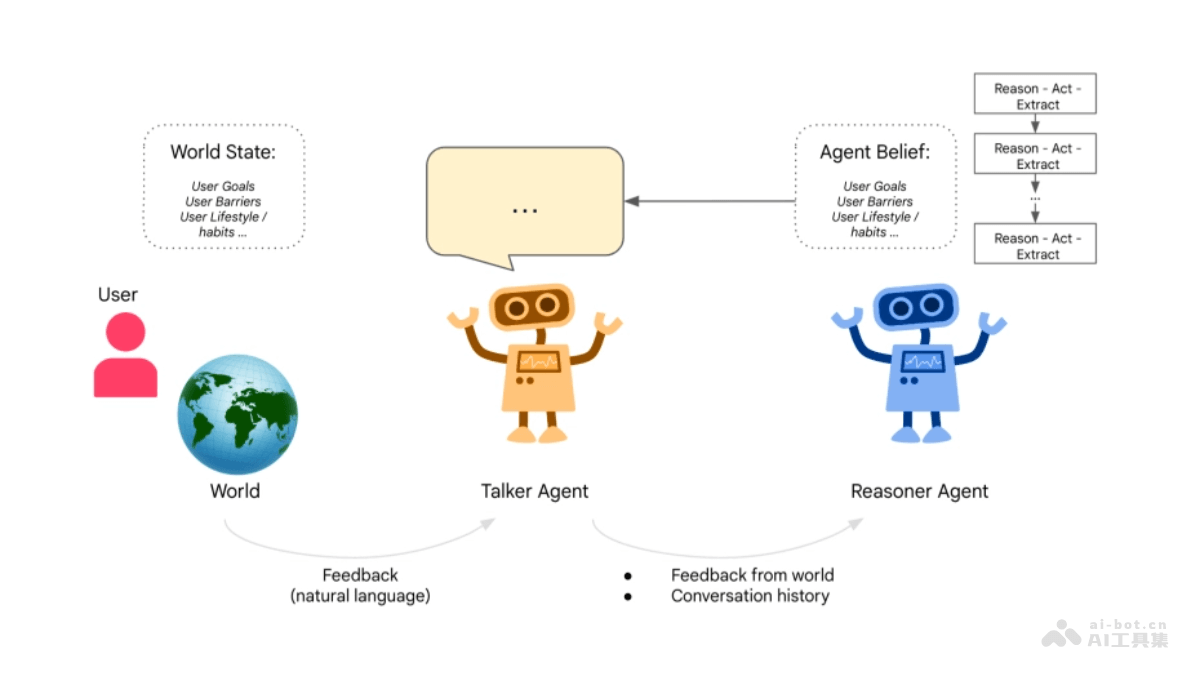
Talker-Reasoner is a dual-thinking AI agent architecture launched by Google DeepMind. Drawing on human cognitive theory, it divides the agent into two modules: Talker and Reasoner. Talker simulates human fast intuitive thinking (System 1), handling immediate conversation and reactions; Reasoner imitates slow logical reasoning (System 2), responsible for complex multi-step planning and decision-making. This architecture enables AI agents to communicate with humans more naturally and efficiently handle complex tasks, improving the interaction capabilities and problem-solving efficiency of intelligent agents.
Main Features of Talker-Reasoner
- Dialogue Generation (Talker): Quickly responds to user dialogue, generates natural language replies, and simulates human intuition and rapid reactions.
- Complex Reasoning and Planning (Reasoner): Executes multi-step reasoning and planning, handles complex tasks that require deep thinking, such as calling external tools and retrieving information.
- Belief State Modeling: The Reasoner module updates belief states about user goals, plans, obstacles, and motivations, stored in the form of structured language objects.
- Memory Interaction: Talker and Reasoner interact based on memory. Reasoner generates and stores new belief states, and Talker retrieves these states from memory to support dialogue.
- Parallel Processing: While Reasoner performs slow reasoning, Talker can continue interacting with the user, improving the responsiveness and efficiency of the AI agent.
- Adaptability: Talker decides whether to wait for Reasoner to complete its reasoning process based on the current dialogue stage and user needs.
Technical Principles of Talker-Reasoner
- Dual-System Architecture: The Talker-Reasoner architecture is based on human cognitive theory, dividing the AI agent into two independent modules, corresponding to human System 1 and System 2.
- Memory System: Talker and Reasoner interact based on a shared memory system, which stores belief states and historical interaction data.
- Natural Language Processing: The Talker module uses advanced language models to understand and generate natural language, achieving smooth dialogue with users.
- Multi-Step Reasoning: The Reasoner module performs multi-step reasoning, involving calling different tools and databases to obtain external knowledge to support its reasoning process.
- Belief Update: The Reasoner module updates its beliefs about user states based on user feedback and environmental changes. These beliefs can be stored in memory in a structured form.
- Context Awareness: The Talker module considers contextual information when generating dialogue, including the user's latest utterances, historical interactions, and belief states.
Project Address of Talker-Reasoner
- arXiv Technical Paper:https://arxiv.org/pdf/2410.08328v1
Application Scenarios of Talker-Reasoner
- Customer Service Agent: Provides 24*7 customer support, handles common question answering and complex queries, and maintains conversation coherence and naturalness.
- Personal Health Advisor: As a sleep coaching agent, interacts with users, provides suggestions and plans for improving sleep habits, and adjusts suggestions based on user feedback.
- Educational Tutoring: As a virtual teaching assistant, answers students' questions, provides personalized learning plans, and adjusts teaching content based on students' learning progress.
- Intelligent Assistant: In a smart home environment, understand and execute the user's instructions, and coordinate the smart devices in the home to optimize the home environment.
- Enterprise decision support: Help enterprises analyze market trends, provide data-based decision recommendations, and carry out multi-step strategic planning in complex business environments.