
What is TableGPT2
TableGPT2 is a new large multimodal model launched by Zhejiang University, designed for the integration and processing of tabular data. For the first time, it trains structured data as an independent modality, directly understands and operates data in databases, Excel, and more, and performs tasks such as SQL queries and data analysis. The model includes an innovative table encoder, strengthens the handling of irregular tables and ambiguous queries, and achieves significant performance improvements on multiple benchmarks.
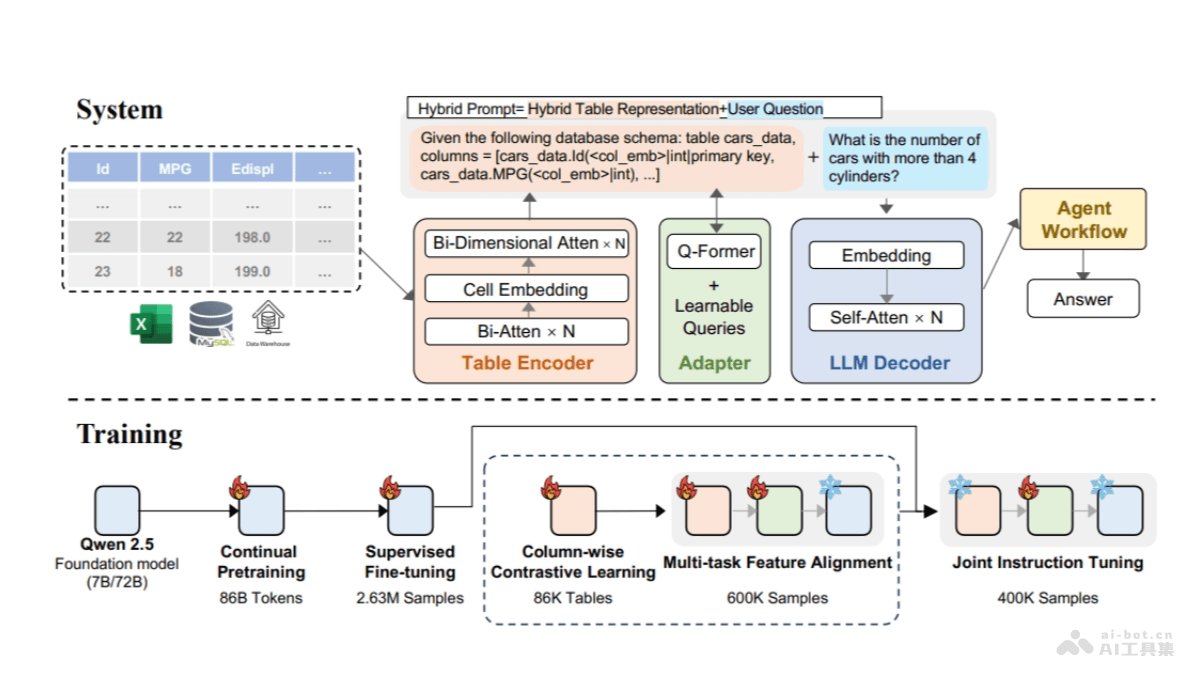
Main features of TableGPT2
- Tabular data understanding: TableGPT2 can understand complex tabular data, including handling irregular tables and ambiguous queries.
- Direct computation and analysis: The model directly performs computation and analysis tasks on tabular data, such as calculating new total export amounts and comparing them with actual data.
- SQL execution: Understands and executes SQL queries and directly interacts with databases.
- Data create, read, update, and delete: Supports adding, deleting, modifying, and querying data in databases or data warehouses.
- Multimodal processing: Combines the capabilities of natural language processing and structured data processing, enabling the model to handle text and tabular data at the same time.
Technical principles of TableGPT2
- Structured data as an independent modality: TableGPT2 treats structured data as an independent modality, similar to images or text, and the model can directly understand and process data in databases and Excel.
- Table encoder: The model includes a dedicated table encoder for reading and interpreting tabular data. The encoder processes the entire table, generates compact embeddings for each column, is based on a two-dimensional attention mechanism, requires no positional embeddings, and simultaneously performs hierarchical feature extraction to ensure that relationships between rows and columns are effectively captured.
- Two-dimensional attention mechanism: TableGPT2 uses a two-dimensional attention mechanism to process tabular data, enabling the model to capture the relationships between rows and columns of the table while maintaining awareness of the table structure.
- Column contrastive learning method: Based on a column contrastive learning method, the model is encouraged to learn meaningful, structure-aware semantic representations, which helps the model better understand and interpret tabular data.
- Q-former-style adapter: A Q-former-style adapter is used to align table embeddings and text input, introducing learnable queries and special tokens to distinguish table features from text, allowing the model to process both modalities simultaneously.
TableGPT2 project address
- Project official website:https://tablegpt.github.io/tablegpt-agent/
- GitHub repository:https://github.com/tablegpt/tablegpt-agent
- HuggingFace model library:https://huggingface.co/tablegpt/TableGPT2-7B
- arXiv technical paper:https://arxiv.org/pdf/2411.02059
Application scenarios of TableGPT2
- Business intelligence and data analysis: Based on natural language processing capabilities, TableGPT2 extracts information from complex datasets, generates reports and dashboards, and helps decision-makers quickly gain insights.
- Database and data warehouse interaction: By converting natural language queries into SQL statements, TableGPT2 directly interacts with databases to perform data queries and operations.
- Financial reporting and budget planning: TableGPT2 analyzes financial statements and assists with financial health assessment and budget planning.
- Market analysis and sales forecasting: Based on analyzing market data and sales trends, TableGPT2 helps enterprises conduct competitive analysis and sales forecasting.
- Supply Chain Optimization: TableGPT2 analyzes inventory and logistics data to optimize inventory levels and delivery routes.