
What is TabFM
TabFM is a zero-shot tabular foundation model released by Google Research, supporting classification (up to 10 classes) and regression on structured data with mixed numerical and categorical features. The model is trained on tens of billions of synthetic tabular data, requires no fine-tuning or hyperparameter search, and performs a single forward prediction using training rows as context, surpassing heavily tuned strong baselines such as gradient boosted trees on 51 datasets in the TabArena benchmark. TabFM provides two weight versions, PyTorch and JAX, is easy to install, and is suitable for fast tabular inference tasks.
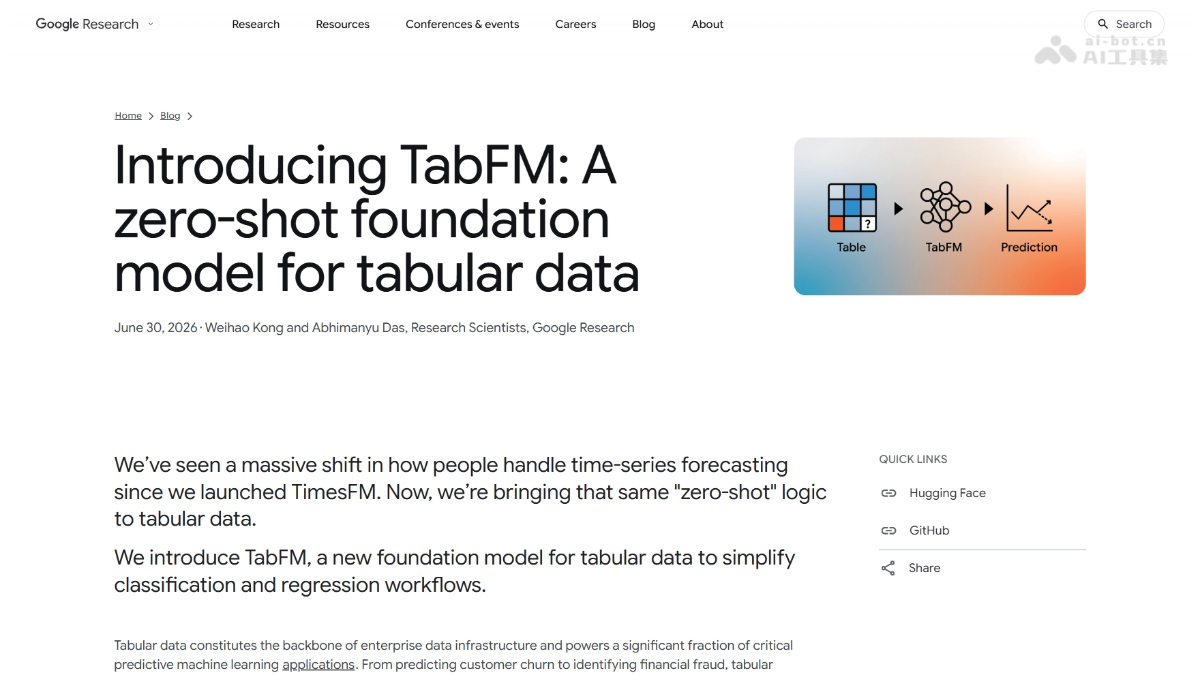
Main Features of TabFM
-
Zero-Shot Classification: Directly performs classification prediction on tabular data with up to 10 classes without training data tuning.
-
Zero-Shot Regression: Supports regression tasks with numerical target variables without model fine-tuning.
-
Mixed Feature Handling: Natively supports tabular data with mixed numerical and categorical features, automatically handling encoding and scaling.
-
In-Context Learning Inference: Reads training data as "context" and completes prediction through a single forward pass.
-
Dual Backend Compatibility: Provides two weight versions, JAX and PyTorch, allowing users to choose the backend framework as needed.
Technical Principles of TabFM
- Synthetic Data Pre-training: TabFM is pre-trained on tens of billions of synthetic tabular data generated based on structural causal models (SCM), defining causal structures between variables by randomly sampling directed acyclic graphs, and then generating the value of each feature based on the conditional distribution of parent nodes, thereby completely avoiding the privacy and copyright risks of real data.
- Transformer Sequence Architecture: The model uses Transformer to process tabular data, treating each row sample as a token sequence, encoding numerical features into continuous vectors via linear projection or binning, mapping categorical features into dense vectors through embedding layers, and using self-attention mechanisms to automatically capture high-order interactions between columns.
- In-Context Learning Inference: During inference, the user's training set is serialized as context and concatenated with test samples before being input to the model. The model reads the statistical patterns of training samples through attention and directly outputs predictions without updating any weights, achieving true zero-shot inference.
- Automated Preprocessing: An automated pipeline is encapsulated through a scikit-learn compatible interface, including Ordinal Encoding for categorical features, standardization scaling for numerical features, and robust handling of missing values, allowing users to directly pass in raw DataFrames without manual intervention.

Follow WeChat and reply "Open Source" to joinAI Open Source Project Communication Group
How to Use TabFM
- Clone the Repository: Execute
git clone https://github.com/google-research/tabfm.gitto download the source code. - Install Dependencies: After entering the directory, choose the installation according to the backend:
pip install -e .[pytorch]orpip install -e .[jax]。 - Load Pre-trained Weights: Import the corresponding backend module in the code (e.g.,
tabfm_v1_0_0_pytorch) and call.load()to automatically download the weights. - Initialize Classifier/Regressor: Use
TabFMClassifierorTabFMRegressorto wrap the model, and call.fit(X_train, y_train)to prepare the encoder. - Execute Prediction: Call
.predict(X_test)or.predict_proba()obtain zero-shot prediction results.
TabFM's Core Advantages
-
Truly Zero-Shot: No fine-tuning or hyperparameter search required, ready out of the box, lowering the barrier to use.
-
Privacy and Security: Trained on synthetic data, does not rely on real sensitive data, naturally avoiding privacy and copyright risks.
-
Strong Performance: On the TabArena benchmark of 51 real datasets, zero-shot performance surpasses carefully tuned gradient-boosted trees.
-
Flexible Framework: Provides both PyTorch and JAX weights, compatible with deployment environments across different tech stacks.
-
Friendly Interface: Fully compatible with the scikit-learn API, allowing data scientists to seamlessly integrate it into existing workflows.
TabFM's Project Addresses
- Project Website:https://research.google/blog/introducing-tabfm-a-zero-shot-foundation-model-for-tabular-data/
- GitHub Repository:https://github.com/google-research/tabfm
- HuggingFace Model Hub:https://huggingface.co/google/tabfm-1.0.0-pytorch
Comparison of TabFM with Similar Competitors
| Dimension | TabFM | TabPFN |
|---|---|---|
| Development Team | Google Research | University of Freiburg, Germany / AutoML Team |
| Training Data | Tens of billions of synthetic tables (SCM-generated) | Millions of synthetic datasets (sampled from prior distributions) |
| Classification Category Limit | Up to 10 classes | Up to 10 classes |
| Regression Support | Native support | Not supported in early versions, limited subsequent expansion |
| Backend Support | Dual versions: PyTorch + JAX | Mainly based on PyTorch |
| Data Scale | Suitable for small to medium-scale tables (<10,000 samples) | Also optimized for small to medium scale |
| Core Mechanism | In-Context Learning | Transformer-based approximate Bayesian inference |
TabFM's Application Scenarios
-
Financial Risk Control: Quickly assess loan application risk without retraining models on historical data, protecting customer privacy.
-
Medical Auxiliary Diagnosis: Classify diseases based on mixed patient features, avoiding leakage of sensitive medical data.
-
E-commerce Pricing Prediction: Perform zero-shot price regression for newly listed products, combining categorical and numerical features.
-
Advertising Click-Through Rate Estimation: Quickly predict ad CTR in cold-start scenarios without waiting to accumulate enough training data.
-
Scientific Research Data Exploration: Researchers can quickly build baseline models on sensitive datasets (such as censuses and social surveys) without accessing the original private data.