
In recent years, large language models (LLMs) represented by GPT-4, Claude, LLaMA, and others have penetrated every corner of human society at an unprecedented speed, from simple text generation to complex logical reasoning, with astonishing capabilities. As applications have deepened, people have gradually discovered that these seemingly omnipotent AIs also have limitations in their "thinking": sometimes they can answer tricky questions in seconds, while other times they "fail" in simple logical traps. This phenomenon closely resembles two modes of human thought—intuitive "fast thinking" and rational "slow thinking." Drawing on the "dual-process theory" from cognitive science proposed by Nobel Prize-winning economist Daniel Kahneman, this article analyzes the "fast thinking" and "slow thinking" mechanisms in current AI large models in an accessible way, discusses their technical implementation, capability boundaries, application scenarios, and future development trends, and unveils the mysterious process of AI "thinking" for ordinary users.

"Fast and Slow" in Human Thought
To understand AI's "thinking" modes, we first need to return to the source of inspiration—the human brain.
The Dual-Process Theory of Cognitive Science: System 1 and System 2
In his book Thinking, Fast and Slow, psychologist Daniel Kahneman divided human thought processes into two distinct systems:
- System 1: "Fast Thinking"
- Characteristics: This is an automatic, fast, intuitive, and effortless thinking system. It is based on our experience, memory, and emotions, and operates almost unconsciously.
- Everyday Analogy: Imagine seeing a red light while driving and stepping on the brake, or instantly recognizing a friend's face. These actions require almost no thinking and are entirely dominated by System 1. It is like an experienced, quick-reacting "autopilot," handling the vast majority of our daily decisions.
- Limitations: Although System 1 is efficient, it is susceptible to bias and heuristic thinking, and often makes wrong judgments in complex or unfamiliar situations—what we often call "taking things for granted."
- System 2: "Slow Thinking"
- Characteristics: This is a thinking system that requires deliberate effort, conscious participation, rigorous logic, and is slow in speed. It is responsible for complex calculations, in-depth analysis, and rational decision-making.
- Everyday Analogy: When you solve a complex math problem, or plan the detailed itinerary of a long trip, your brain activates System 2. It is like a "manual driver" that needs to concentrate and carefully deliberate, intervening when we encounter difficult problems to carry out prudent analysis and reasoning.
- Features: The operation of System 2 is very energy-consuming, so our brains tend to be "lazy" and let System 1 handle problems as much as possible.
Why Introduce This Theory into AI?
Current mainstream large language models are, to some extent, extremely similar to a "super-reinforced" System 1. By learning statistical regularities and patterns from massive amounts of data, they can quickly generate fluent, seemingly reasonable responses. This pattern-matching-based "intuitive" reaction enables them to perform excellently on tasks such as language understanding and content creation. When faced with complex problems that require multi-step reasoning, logical verification, or reflective judgment, the drawbacks of this "fast thinking" mode are fully exposed, making it prone to factual errors (i.e., "hallucinations"), logical contradictions, or an inability to engage in in-depth planning.
The AI research community has begun to draw on dual-process theory, attempting to introduce "System 2" capabilities into large models, that is, granting them a "slow thinking" mechanism, in the hope of building the next generation of artificial intelligence that is both broad and deep, both efficient and reliable.
AI's "Fast Thinking" — A Digital Simulation of Speed and Intuition
AI's "fast thinking" is the core of its current capabilities and the foundation for its widespread application. It mainly relies on massive model architectures and efficient inference techniques.
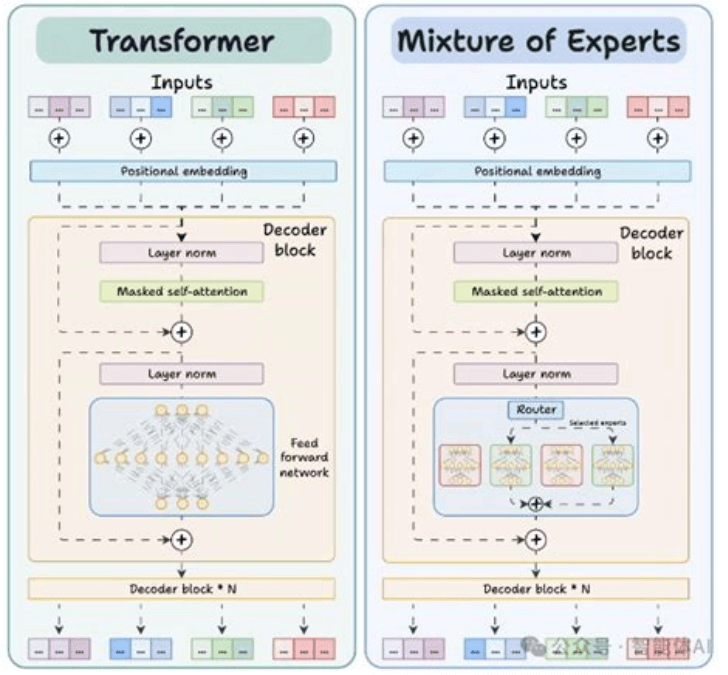
Core Engine: Transformer Architecture
Almost all mainstream large models (such as the GPT series, Claude, and LLaMA) are based onTransformerarchitecture. It can be imagined as an extremely complex "association network." When you input a word or a sentence, this network uses its "attention mechanism" to instantly calculate the strength of association between each word and all other words, and based on the probability distribution learned from massive amounts of text, predicts the most likely next word. This process repeats continuously, ultimately generating a complete response.
Visual Analogy: Super Association Master
Imagine an "Association Master" who has read every book and article on the internet. You say to him, "The sky is," and based on statistical probability, he instantly associates "blue," "clear," or "gray," and chooses the word that best fits the context.
AI's fast thinking is the ultimate embodiment of this "association" ability, except that its speed and scale far exceed those of humans.
Technical Accelerators: Making Inference "Fast"
In order to achieve second-level response, AI models adopt multiple optimization techniques during inference (i.e., generating answers), ensuring that "fast thinking" lives up to its name:
- Key-Value Caching (KV Caching) : When generating long texts, the model does not need to recalculate from scratch every time. KV caching technology can "remember" information that has already been calculated (keys and values), and directly call it when subsequently generating new words, greatly reducing repeated calculations. This is like when cooking, preparing the chopped vegetables in advance and then directly putting them in the pan next time, rather than washing and chopping the vegetables again every time.
- Model Quantization (Quantization) : Lowering the numerical precision used for calculations in the model (for example, from 32-bit floating point to 8-bit integers) can significantly reduce the model size and computational load, just like turning a thick hardcover book into a slim paperback pocket book. The essence of the content remains unchanged, but it is much faster to carry and flip through.
- Knowledge Distillation (Knowledge Distillation) : Use a huge and powerful "teacher model" (such as GPT-4) to teach a much smaller "student model." The student model learns the "essence of thinking" of the teacher model, thereby achieving faster inference speed while maintaining relatively good performance.
- Speculative Decoding (Speculative Decoding) : This is an innovative acceleration method. It allows a small "draft model" to first quickly generate a draft of text, and then a large "main model" verifies and corrects it all at once, in parallel. If the draft quality is high, the main model can accept multiple words at once, thereby achieving a severalfold speed increase. This is like an agile assistant first drafting a document, which is then reviewed in batches by a senior expert, far faster than the expert writing it word by word.
The Advantages and Weaknesses of "Fast Thinking"
- Advantages:
- Efficient: Fast response speed, capable of handling large-scale concurrent requests, suitable for instant interaction scenarios such as chat, search, and content generation.
- Fluent: Trained on massive data, the generated language is natural and coherent, conforming to human expression habits.
- Broad Knowledge: It has internalized a large amount of factual knowledge from the training data and can quickly answer various common-sense questions.
- Weaknesses:
- Prone to Hallucination: Because it is essentially probabilistic prediction, when encountering knowledge blind spots or ambiguous questions, the model will "fabricate" answers that seem reasonable but do not conform to facts.
- Poor Logical Ability: For complex problems requiring a rigorous logical chain (such as mathematical proofs and multi-step planning), intuitive pattern matching alone is insufficient.
- Lack of Reflection: It cannot self-examine and correct errors. Once it falls into an erroneous reasoning path, it may "keep going down one road to the end."
AI's "Slow Thinking" — A Key Step Toward Depth and Rationality
To overcome the limitations of "fast thinking," researchers have developed a series of techniques to guide AI toward more deliberate "slow thinking." The core idea of these techniques is:Decompose complex problems and systematically explore solutions。
Chain-of-Thought (CoT): Teaching AI to "think step by step"
CoT is one of the most famous and simplest and most effective methods for achieving "slow thinking." By adding a simple prompt when asking a question, such as "Let's think step-by-step," it encourages the model to generate a detailed reasoning process, not just the final answer.
Case: Solving a Math Word Problem
- Fast Thinking (Standard Questioning):
- User: "A farmer has 10 apples. He gives 3 to his neighbor and then buys 5 more. How many apples does he have now?"
- AI (may make errors) : "He has 12 apples." (Gives the answer directly and may make an error because it confuses the order of addition and subtraction.)
- Slow Thinking (CoT Questioning):
- User: "A farmer has 10 apples. He gives 3 to his neighbor and then buys 5 more. How many apples does he have now?Please think step by step.”
- AI: "Okay, let's analyze it step by step:
- The farmer initially has 10 apples.
- He gives 3 to his neighbor, so 10 – 3 = 7 apples remain.
- Then he buys 5 more, so now he has 7 + 5 = 12 apples. Therefore, he now has 12 apples."
- Effect Analysis: By breaking down a problem into intermediate steps, CoT significantly improves the model's accuracy on tasks such as arithmetic, common sense, and symbolic reasoning. It forces the model to slow down and transforms a complex reasoning task into a series of simple, "fast thinking"-like steps, thereby reducing the error rate. This is like when we solve a difficult problem, we take out scratch paper to work through it.
Self-Consistency: Letting AI "brainstorm collectively"
It is a further enhancement of CoT. Have the model, for the same question, use CoT to generatemultipledifferent reasoning paths, and then through "voting" select the most consistent and most frequently occurring answer.
Visual analogy: An expert panel consultation
Imagine that you are not consulting just one expert, but organizing an expert panel. Each expert independently analyzes the problem and gives their own reasoning process and conclusion. In the end, you adopt the conclusion that most experts agree on.
Self-consistency is letting the AI itself play the role of this "expert panel," improving the reliability of the final answer through diverse thinking paths.
Tree-of-Thoughts (ToT): Letting AI "think deeply and weigh the pros and cons"
Tree-of-Thoughtsis a more advanced "slow thinking" strategy. It is no longer a single chain, but constructs the reasoning process into a "tree." At each reasoning node, the model generates multiple possible "thoughts" or next steps as branches, then evaluates these branches, chooses the most promising path to continue exploring, and can even backtrack when it finds that a certain path does not work.
Case: Playing chess or solving puzzles
When you play chess, you do not consider only the next move, but think: "If I make this move, what responses might my opponent have? For each of his responses, how can I respond?" This process is constructing a "decision tree" in your mind. ToT precisely simulates this kind of systematic exploration and planning ability.
The costs and rewards of "slow thinking"
- Costs:
- High latency: Generating detailed reasoning steps or exploring multiple paths will undoubtedly increase computation time and response latency.
- High cost: More computation steps mean consuming more computing resources and API call costs.
- Possible "overthinking" : For simple questions, forcibly using slow thinking may generate lengthy and unnecessary steps, instead increasing the risk of errors.
- Rewards:
- Improved accuracy: On complex reasoning tasks, accuracy is significantly improved.
- Enhanced interpretability: Clear reasoning steps allow users to understand the model's "thinking" process, making it easier to discover and correct errors.
- Improved reliability: Through systematic exploration and verification, the occurrence of "hallucinations" and logical fallacies is reduced.
The "way of fast and slow" of mainstream models and performance comparison
Different large AI models show different strategies and capabilities in implementing and balancing "fast thinking" and "slow thinking." Although there is currently no unified benchmark that can perfectly measure both reasoning speed and multi-step reasoning quality at the same time, from public evaluations and research, we can still catch a glimpse.
Characteristics of major models
- GPT-4/GPT-4o(OpenAI): Regarded as the benchmark for complex reasoning capabilities. After activating "slow thinking" (such as CoT), it demonstrates outstanding performance on benchmarks in mathematics, programming, and logical reasoning (such as GSM8K, MMLU). Powerful reasoning capabilities come with relatively high latency and cost.
- Claudeseries (Anthropic): Possesses strong long-text processing capabilities and an emphasis on safety. Newer versions such as Claude 3.5 Sonnet demonstrate performance comparable to GPT-4o on reasoning and coding tasks, with advantages in speed and cost. Some reports indicate that early versions of the Claude model introduced "hybrid dual-mode reasoning," allowing users to switch between "fast mode" and "extended thinking mode," which was an attempt to explicitly productize fast and slow thinking.
- LLaMA series (Meta): As a representative of open-source models, theLLaMAseries provides powerful foundational capabilities while granting the community great flexibility. Although its base models still lag behind top closed-source models in complex reasoning, the community can customize and enhance its reasoning capabilities through fine-tuning and integration of advanced slow-thinking frameworks (such as CoT, ToT).
- PaLM/Gemini series (Google): Google's models also rank among the top in major benchmarks. In early research, PaLM already demonstrated that its powerful reasoning potential could be elicited through CoT prompting.GeminiAs a multimodal model, the series is committed to integrating the capabilities of fast and slow thinking into comprehensive understanding and reasoning over text, images, and code.

Performance Trade-offs
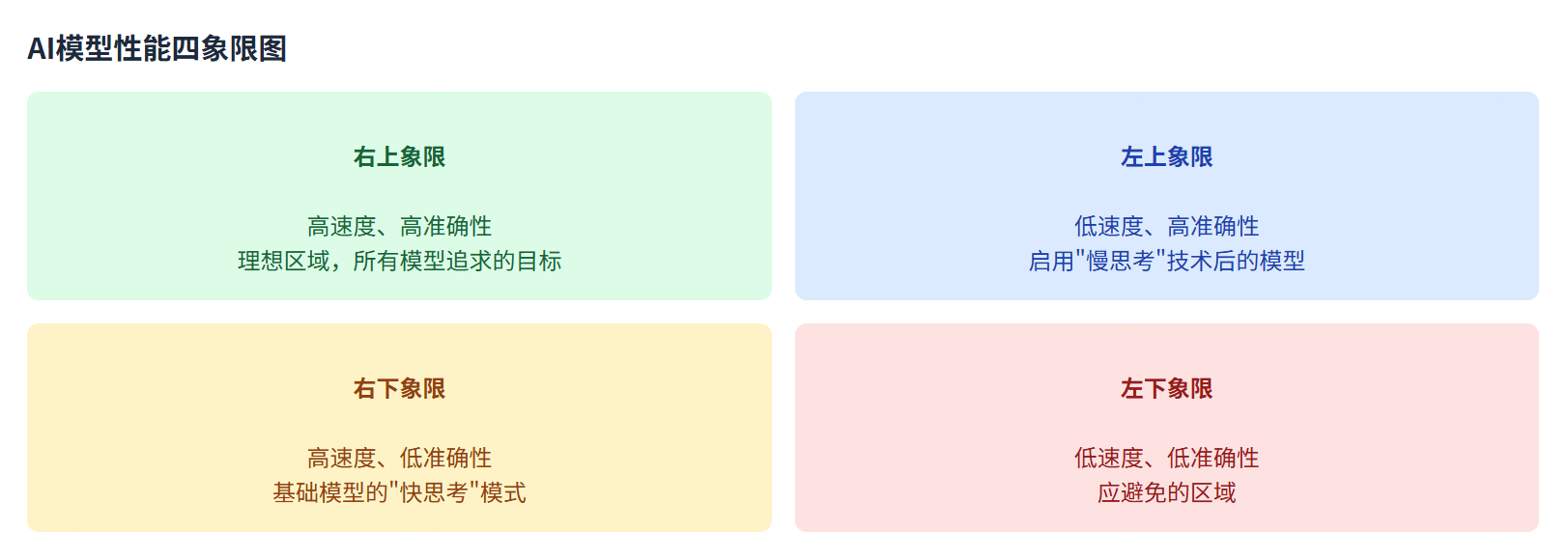
This figure intuitively shows that current AI models need to make trade-offs between speed and accuracy. Users or developers need to choose the appropriate mode based on the specific application scenario. For example, for customer service robots that require instant feedback, "fast thinking" should be prioritized; while for serious tasks such as scientific computing and legal document analysis, "slow thinking" must be enabled to ensure the reliability of the results.
Future Outlook — Toward "Fast and Slow at Will" General Artificial Intelligence
AI's "thinking" modes are evolving from a single "fast thinking" toward a dynamic system of "combining fast and slow." Future development will focus on how to enable AI to switch and integrate between these two modes more intelligently and efficiently.
Dynamic Decision-Making: Teaching AI to Learn "When to Be Fast, When to Be Slow"
Currently, enabling "slow thinking" mostly depends on explicit instructions from human users. The future research direction is to enable AI models themselves to possess "metacognitive" capabilities, that is, to be able toself-assess the difficulty of a problem, and then dynamically decide which thinking strategy to adopt.
Analogy: Just like us humans, when we see "1+1=?", we give the answer without thinking (System 1), while when we see a complex calculus problem, we automatically switch to a focused calculation mode (System 2).
Future AI should also be able to judge autonomously, using fast, low-cost reasoning paths for simple problems, and automatically invoking deep reasoning tools such as CoT and ToT for complex problems.
Integration and Optimization: Making "Slow Thinking" More Efficient
Researchers are exploring how to reduce the cost of "slow thinking." For example, by training models to generate more concise and efficient reasoning chains ("concise thinking"), or by "distilling" complex reasoning processes into smaller models, enabling them to both "think slowly" and "respond quickly."
From Language to Multimodality: Broader Application Scenarios
The concept of "fast and slow thinking" is expanding from the purely text-based domain to the multimodal world that includes images, sound, and video. Future multimodal large models will be able to, like humans, rapidly identify objects in images (fast thinking), and perform multi-step image editing or video content analysis based on complex instructions (slow thinking.
Applying the framework of "fast thinking" and "slow thinking" to AI large models not only provides us with a profound and intuitive perspective for understanding their current capabilities and limitations, but also points out a clear path toward more powerful and more reliable artificial intelligence. For current AI, its "fast thinking" is already impressive enough and capable of handling a large amount of辅助性 work; while its "slow thinking," although still in its infancy, represents the key to its leap from a "knowledgeable imitator" to a "thinker with deep reasoning capabilities."
Understanding these two "personalities" of AI can help us use these tools more effectively: when creativity and efficiency are needed, make full use of the advantages of its "fast thinking"; when dealing with serious and complex tasks, awaken the potential of its "slow thinking" through appropriate guidance. As technology continues to mature, an AI that can freely switch between and perfectly integrate fast and slow thinking will truly become a powerful extension of human intelligence, working with us to address more complex challenges.