
What is SynthID Text
SynthID Text is a text watermarking technology launched by Google DeepMind, used to identify and verify text generated by large language models (LLMs). By subtly adjusting the token probability scores during the generation process, it embeds an almost imperceptible watermark, achieving high detection accuracy without affecting text quality or user experience. SynthID Text is based on the Tournament sampling algorithm and supports both distortion-free and distorted modes, and can be implemented in large-scale production systems with extremely low additional computational overhead. The technology has been successfully applied to the Gemini and Gemini Advanced systems, providing new possibilities for the use of AI technology.
Main features of SynthID Text
- Text watermark embedding: It can embed digital watermarks in text generated by large language models (LLMs), and the watermark is used to identify and verify the source of the text.
- Quality preservation: In the process of embedding the watermark, the original quality and natural fluency of the text are maintained, without affecting the reading experience.
- High detection accuracy: The watermark design allows the embedded watermark to be efficiently detected, identifying whether the text was generated by a specific LLM.
- Minimized latency: The watermarking process is designed to have minimal impact on the latency of generated text, making it suitable for real-time or large-scale text generation scenarios.
- Does not affect LLM training: The watermarking process only modifies the sampling stage during text generation, without affecting the model's training process.
Technical principles of SynthID Text
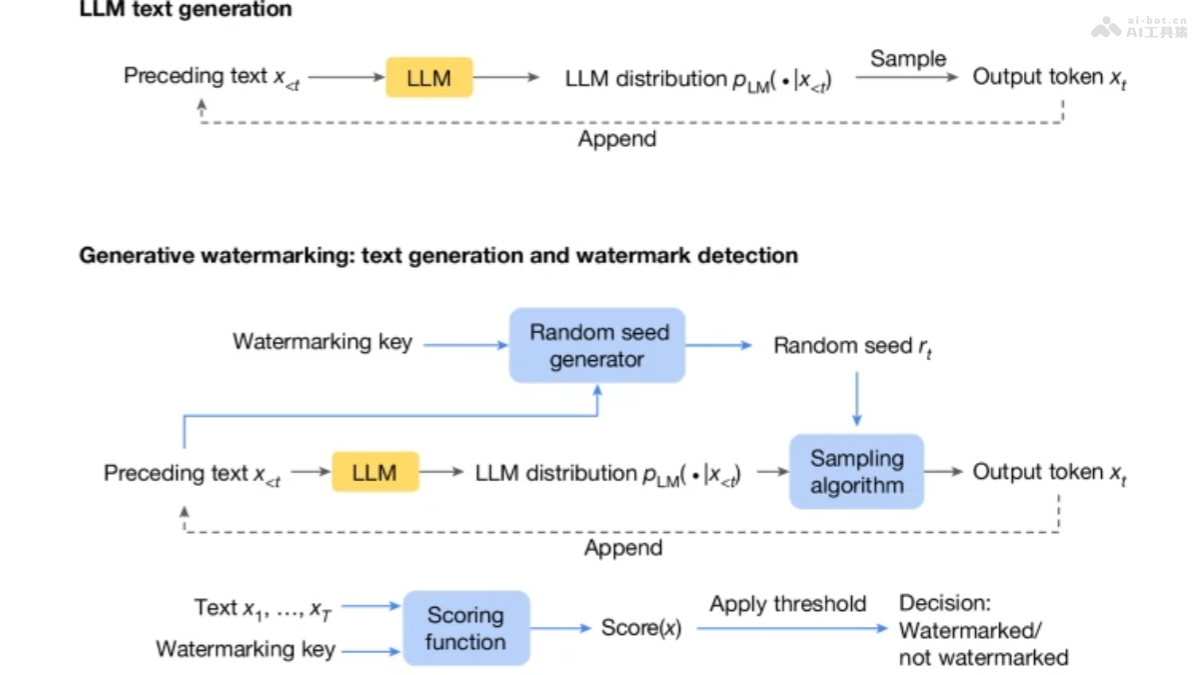
- Sampling algorithm modification: SynthID Text embeds watermarks by modifying the sampling algorithm of large language models (LLMs). When generating text, the model selects the next token according to a probability distribution, and SynthID Text adjusts the probabilities in this process to embed an imperceptible watermark.
- Tournament sampling: SynthID Text uses the Tournament sampling algorithm, which selects tokens by simulating a tournament process. In each round, multiple tokens are randomly selected, and the winner is chosen according to a score associated with the watermark function. The process is repeated for multiple rounds until a token is finally selected as the output.
- Random seed generation: At each step of text generation, SynthID Text requires a random seed to influence token selection. The seed is generated based on the previous text and the watermark key, ensuring the randomness and unpredictability of the watermark.
- Distortion-free configuration: SynthID Text can be configured in distortion-free mode, embedding watermarks while maintaining text quality. The embedding of the watermark does not affect the original probability distribution of the text, ensuring the naturalness and coherence of the text.
- Watermark detection: In the detection stage, SynthID Text determines whether the text contains a watermark by computing the statistical features of the text (i.e., g-values). If the text contains a watermark, the statistical features will show a bias consistent with the watermark function.
Project address of SynthID Text
- Paper address:https://www.nature.com/articles/s41586-024-08025-4
Application scenarios of SynthID Text
- Content verification: In the fields of news, publishing, and academia, verify whether articles are written by humans or generated by AI, ensuring the credibility of the content.
- Educational assessment: In educational environments, help detect whether assignments submitted by students use AI-generated text, maintaining academic integrity.
- Law and compliance: In the legal field, S detects whether legal documents or contracts contain AI-generated text, ensuring the legality and validity of legal documents.
- Social Media: On social media platforms, it helps identify and flag AI-generated content to prevent the spread of misleading information.
- Customer Service: In automated customer support systems, it distinguishes between automatically generated replies and human replies, improving customer service quality.