
What is SynCamMaster
SynCamMaster is the world's first multi-view video generation model jointly launched by researchers from Zhejiang University, Kuaishou Technology, Tsinghua University, and The Chinese University of Hong Kong. It can combine 6-degree-of-freedom camera poses to generate open-world videos from arbitrary viewpoints. SynCamMaster enhances a pretrained text-to-video model to ensure content consistency across different viewpoints and supports multi-camera video generation. Based on plug-in modules and a multi-view synchronization module, it achieves dynamic synchronization between viewpoints and maintains 4D consistency. SynCamMaster can be extended to novel view video synthesis, re-rendering input videos as viewed from new viewpoints.
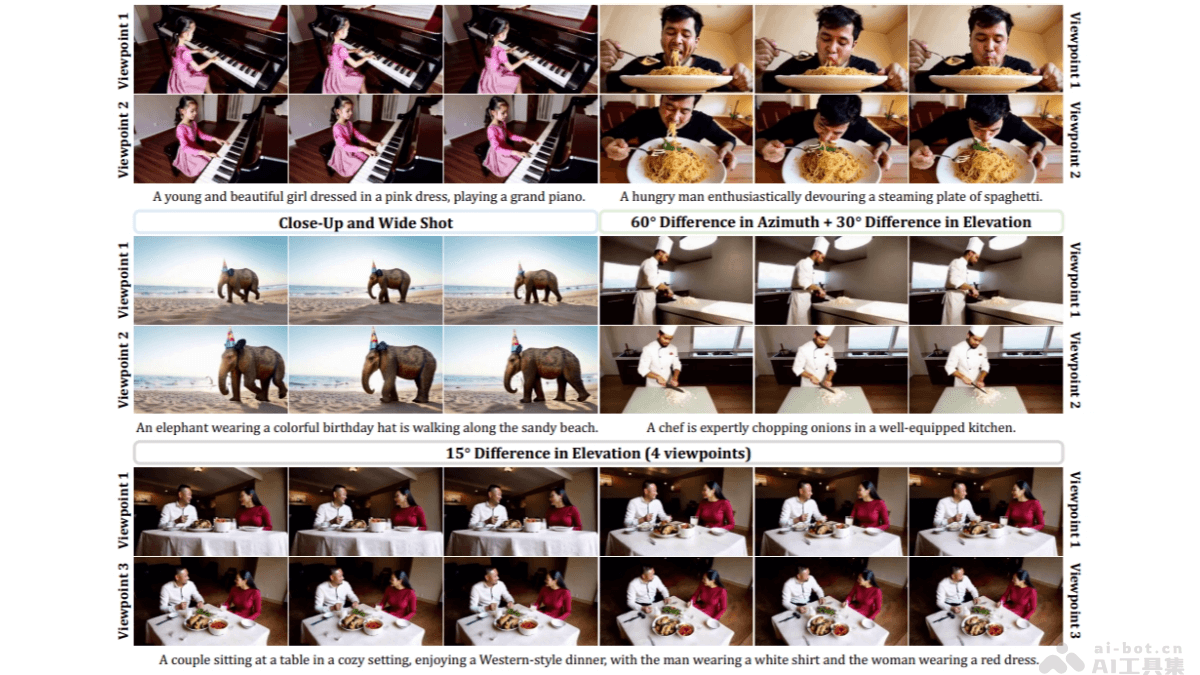
Main Features of SynCamMaster
- Multi-view video generation: SynCamMaster can generate multiple videos from different viewpoints of the same dynamic scene.
- Dynamic synchronization between viewpoints: It maintains dynamic synchronization across multiple viewpoints, ensuring temporal and spatial consistency of video content generated by different cameras.
- Open-world video generation: SynCamMaster supports generating open-world videos from arbitrary viewpoints.
- 6-degree-of-freedom camera poses: By incorporating 6-degree-of-freedom (6 DoF) camera poses, users can capture scenes from arbitrary viewpoints.
- Pretrained model enhancement: It uses plug-and-play modules to enhance pretrained text-to-video models for multi-camera video generation.
- Novel view video synthesis: SynCamMaster can be extended to novel view video synthesis, introducing a reference video into the multi-camera video generation model to re-render the input video from a new viewpoint.
Technical Principles of SynCamMaster
- Pretrained text-to-video model: It is based on a pretrained text-to-video diffusion model, generating consistent 3D video content according to text descriptions.
- Multi-view synchronization module: It introduces a multi-view synchronization module, which is integrated into each Transformer block to maintain appearance and geometric consistency across different viewpoints.
- Camera encoder: It uses a camera encoder to encode the camera's extrinsic parameters (such as the rotation matrix and translation vector) into an embedding space with the same dimensions as the spatial features.
- Cross-view self-attention: In the multi-view synchronization module, a cross-view self-attention layer aggregates features from different viewpoints to achieve information exchange and synchronization between views.
- Hybrid training dataset: It designs a hybrid training scheme that combines multi-camera images, monocular videos, and multi-camera videos rendered by Unreal Engine.
- Progressive training strategy: It introduces a progressive training strategy that gradually increases the relative angle differences between different viewpoints during training, improving the model's performance when handling large viewpoint differences.
SynCamMaste Project Address
- Project official website:jianhongbai.github.io/SynCamMaster
- GitHub repository:https://github.com/KwaiVGI/SynCamMaster
- arXiv technical paper:https://arxiv.org/pdf/2412.07760
Application Scenarios of SynCamMaster
- Virtual filming: In film and video production, it generates videos from multiple angles, helping directors and production teams preview scenes and achieve complex shot combinations.
- Game development: Game developers create dynamic game trailers or demo videos, showcasing interactions between game environments and characters from different viewpoints.
- Virtual Reality (VR) and Augmented Reality (AR): In VR and AR applications, generate dynamic content consistent with changes in the user's perspective to enhance the immersive experience.
- Simulation Training: For scenarios that require observation from multiple angles, such as driving simulation, surgical simulation, etc., provide real-time video from different perspectives to enhance training effectiveness.
- Surveillance Systems: In the field of security surveillance, integrate video streams from multiple cameras to generate video from a unified perspective, making it easier for surveillance personnel to better understand the development of events.