
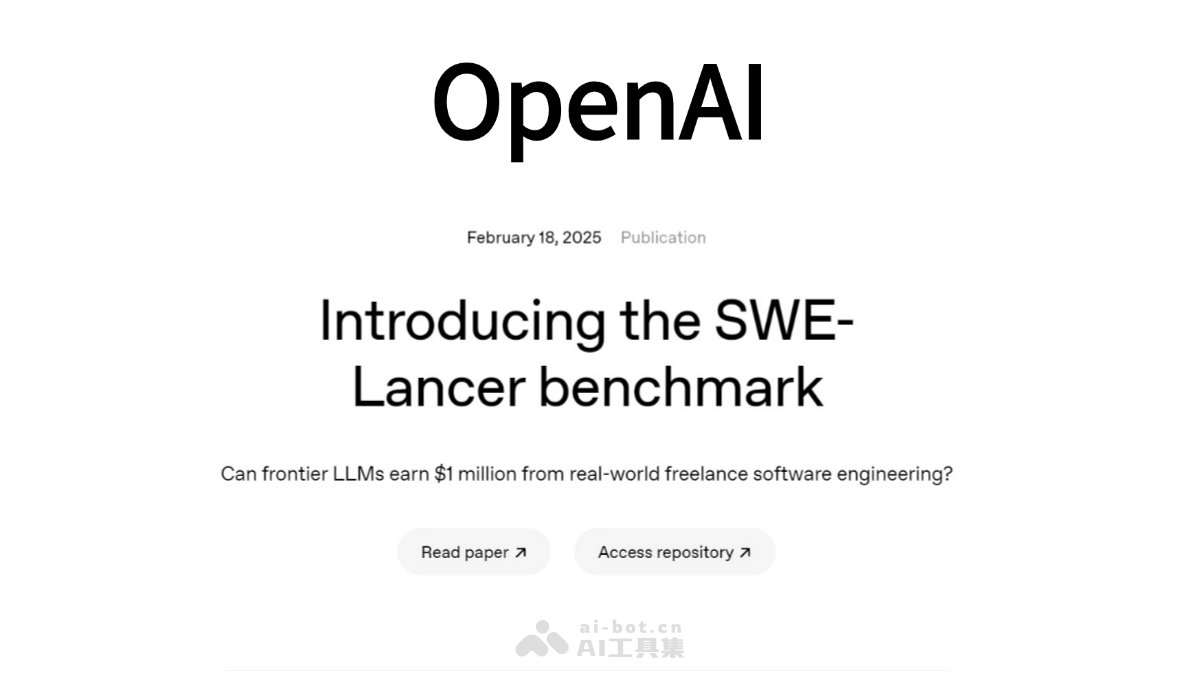
What is SWE-Lancer
SWE-Lancer is a large model benchmark launched by OpenAI that evaluates the performance of frontier language models (LLMs) on freelance software engineering tasks. It includes more than 1,400 tasks from Upwork, with a total value of $1 million, divided into individual contributor (IC) tasks and management tasks. IC tasks range from simple fixes to complex feature development, while management tasks require the model to choose the best technical solution. SWE-Lancer's task design is close to real software engineering scenarios, involving complex scenarios such as full-stack development and API interaction. Through validation and testing by professional engineers, the benchmark can evaluate a model's programming ability and measure the economic benefits in real tasks.
Main Features of SWE-Lancer
- Real task evaluation: SWE-Lancer includes more than 1,400 real software engineering tasks from the Upwork platform, with a total value of $1 million. The tasks range from simple bug fixes to complex large-scale feature implementation.
- End-to-end testing: Unlike traditional unit testing, SWE-Lancer uses an end-to-end testing method to simulate real user workflows and ensure that the code generated by the model can run in a real environment.
- Multi-option evaluation: The model needs to choose the best proposal from multiple solutions, simulating the decision-making scenarios software engineers face in actual work.
- Management capability evaluation: SWE-Lancer includes management tasks that require the model to play the role of a technical lead and choose the optimal solution from multiple options.
- Full-stack engineering capability testing: The tasks involve full-stack development, including mobile, web, API interaction, etc., comprehensively testing the model's overall capabilities.
Technical Principles of SWE-Lancer
- End-to-end testing (E2E Testing): SWE-Lancer uses an end-to-end testing method to simulate real user workflows and verify the complete behavior of the application. Unlike traditional unit testing, it verifies the functionality of the code and ensures that the solution can run normally in a real environment.
- Multi-option evaluation (Multi-Option Evaluation): SWE-Lancer's task design requires the model to choose the best proposal from multiple solutions. It simulates the decision-making scenarios software engineers face in actual work, testing the model's code generation ability, technical judgment, and decision-making ability.
- Economic value mapping (Economic Value Mapping): The total value of SWE-Lancer's tasks is as high as $1 million, and the task types range from simple bug fixes to complex large-scale feature development. This reflects the complexity and importance of the tasks and demonstrates the potential economic impact that the model's performance may have.
- User tool simulation (User Tool Simulation): SWE-Lancer introduces a user tool module that supports the model in running applications locally and simulating user interaction behavior to verify the effectiveness of the solution.
SWE-Lancer Project Address
- Project official website:https://openai.com/index/swe-lancer/
- Github repository:https://github.com/openai/SWELancer-Benchmark
Application Scenarios of SWE-Lancer
- Model performance evaluation: SWE-Lancer provides a real and complex testing platform for evaluating and comparing the performance of different language models on software engineering tasks.
- Software development assistance: The benchmark can help optimize the application of artificial intelligence in software development, such as automated code review and bug fix suggestions.
- Education and training: SWE-Lancer can serve as a teaching tool to help students and developers understand best practices in software engineering and the challenges they face.
- Industry Standard Development: SWE-Lancer's task design and evaluation methods are innovative and are expected to become an industry standard for evaluating the practicality of artificial intelligence in the field of software engineering.
- Research and Development Guidance: Through SWE-Lancer's test results, researchers can gain an in-depth understanding of the current performance of language models in the field of software engineering, identify their shortcomings, and provide direction for future research and development.