
What is SVFR
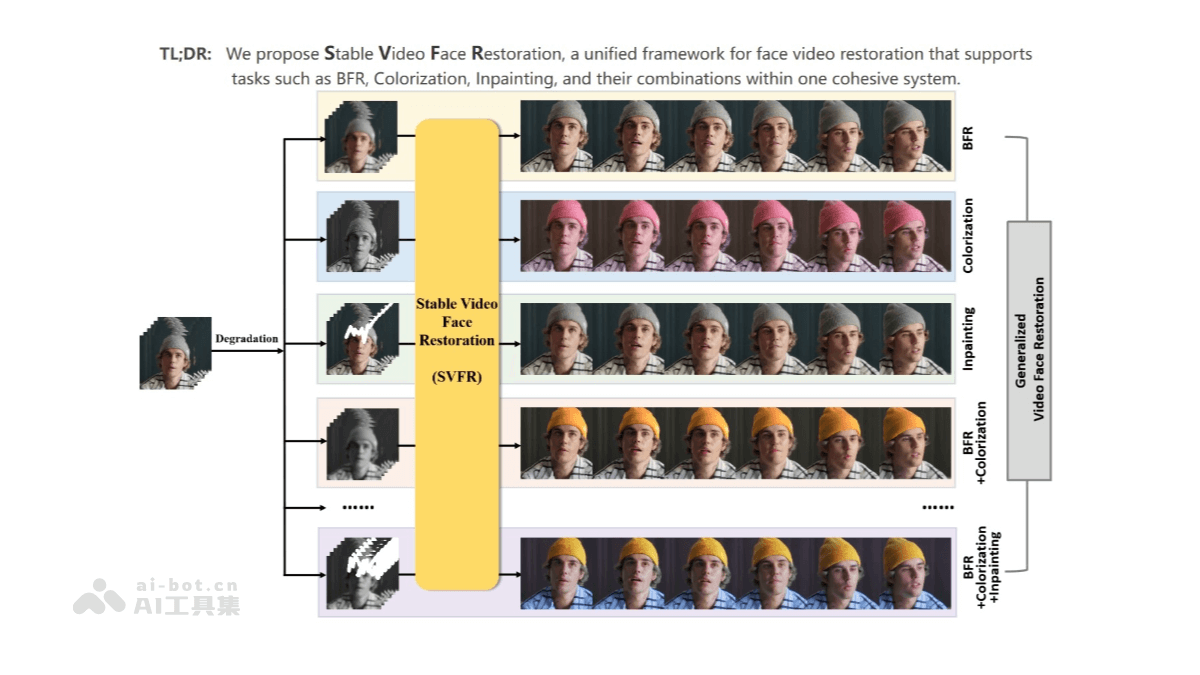
SVFR (Stable Video Face Restoration) is a unified framework for generalized video face restoration jointly launched by the Tencent Youtu Lab and Xiamen University. It integrates video face restoration (BFR), colorization, and inpainting tasks, builds on the generation and motion priors of Stable Video Diffusion (SVD), and integrates task-specific information through a unified face restoration framework. SVFR introduces learnable task embeddings to enhance task identification, while adopting a novel Unified Latent Regularization (ULR) to encourage shared feature representation learning across different subtasks. To further improve restoration quality and temporal stability, facial prior learning and self-reference refinement are also introduced as auxiliary strategies for training and inference.
Main Features of SVFR
- Video Face Restoration (BFR): Enhances the details and clarity of faces in videos, making blurry or damaged face footage clearer and more natural.
- Face Colorization: Adds vivid colors to black-and-white or color-distorted video faces, enhancing the visual effect.
- Face Inpainting: Repairs missing parts of faces in videos, such as occluded or damaged areas, restoring complete facial details.
Technical Principles of SVFR
- Task Integration: SVFR integrates video face restoration (BFR), colorization, and inpainting tasks, handling these tasks through a unified framework to achieve synergistic gains. This integration approach can leverage complementary information between different tasks to improve the overall restoration effect.
- Generation and Motion Priors: SVFR builds on the generation and motion priors of Stable Video Diffusion (SVD) to enhance restoration. SVD provides powerful generation capability and motion information, helping the model better understand and handle face motion in videos and ensuring temporal coherence.
- Task Embeddings: Introduces learnable task embeddings to enhance the model's ability to identify specific tasks. This enables the model to better understand the task type to which the input data belongs and perform restoration more accurately.
- Unified Latent Regularization (ULR): Adopts the ULR method to encourage feature sharing across different subtasks. By integrating the intermediate features of different tasks into a shared latent space, ULR helps the model learn more general feature representations and improve restoration quality.
- Facial Prior Learning: To further improve restoration quality, SVFR introduces facial prior learning. By using structural priors such as facial landmarks, the model can embed facial structure information more naturally and avoid facial structure abnormalities and texture distortion.
- Self-Reference Refinement: During inference, SVFR adopts a self-reference refinement strategy, optimizing the restoration result of the current frame by referring to previously generated frames and enhancing temporal stability. This strategy ensures smooth transitions and consistency of faces in videos.
SVFR Project Address
- Project Website:https://wangzhiyaoo.github.io/SVFR
- Github Repository:https://github.com/wangzhiyaoo/SVFR
- arXiv Technical Paper:https://arxiv.org/pdf/2501.01235
Application Scenarios of SVFR
- Film and Television Post-Production: Restores blurry and damaged face footage in old movies, restoring clear and natural facial details and improving the viewing experience.
- Online Video Content Creation: Restores video clips with poor face quality caused by poor shooting conditions, improving the overall video quality and enhancing audience appeal.
- Digital Archive Restoration: Restore the facial parts in video archives that have been stored for a long time and whose quality has degraded, preserving precious historical video materials.