
What is SuperEdit
SuperEdit is an instruction-guided image editing method jointly launched by the ByteDance Intelligent Creation Team and the Computer Vision Research Center of the University of Central Florida. It improves the precision and effectiveness of image editing by optimizing supervision signals. SuperEdit is based on corrected editing instructions, aligns more accurately with original image and edited image pairs, and introduces contrastive supervision signals to further optimize model training. SuperEdit does not require an additional vision-language model (VLM) or pretraining tasks, relying only on high-quality supervision signals, and achieves significant performance improvements on multiple benchmarks.
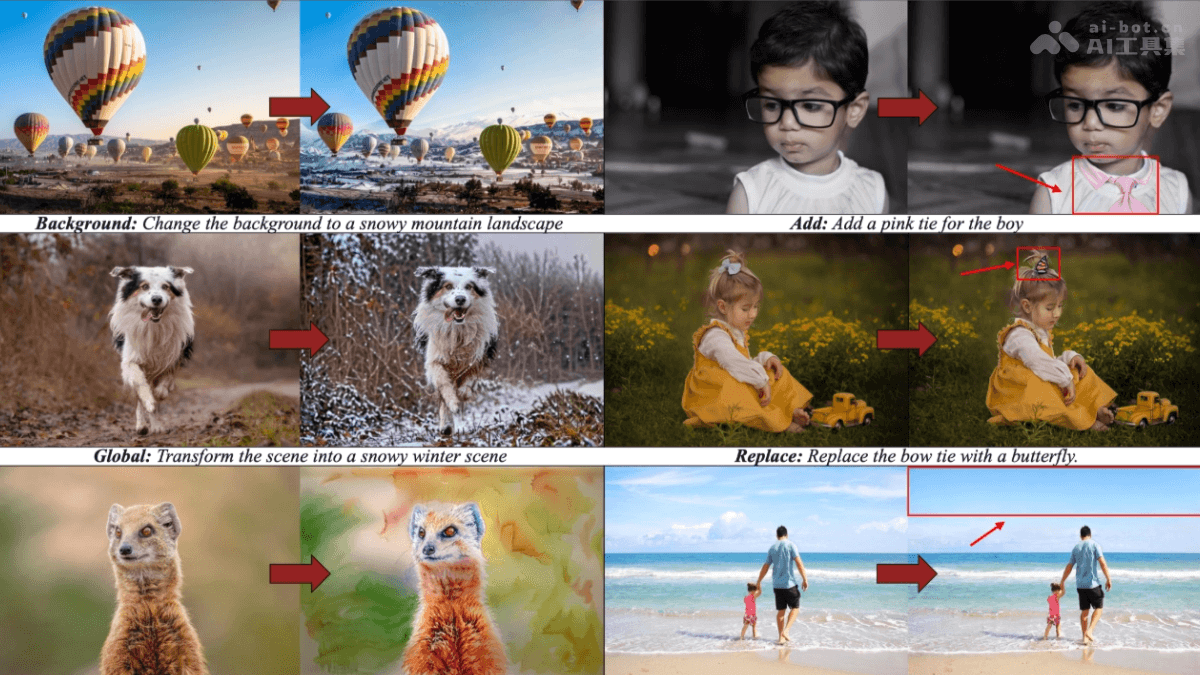
Main features of SuperEdit
- High-precision image editing: Accurately edit images according to natural language instructions, supporting various types of editing tasks such as global, local, and style editing.
- Efficient training: Achieve high performance with a small amount of training data and a smaller model scale, reducing training costs.
- Preserving original image quality: When performing editing tasks, preserve the structure and details of the original image to the greatest extent, avoiding unnecessary modifications.
Technical principles of SuperEdit
- Generative properties of diffusion models: Guide the correction of editing instructions based on the generative properties of diffusion models at different inference stages. Diffusion models focus on global layout in the early stage, local object attributes in the middle stage, and image details in the later stage, while style changes run through the entire sampling process.
- Editing instruction correction: Based on the input original image and edited image pair to a vision-language model (VLM), generate editing instructions that describe the differences between the two. Define unified correction guidelines to ensure that the generated editing instructions more accurately reflect the actual changes between the original image and the edited image.
- Contrastive supervision signals: Introduce contrastive supervision signals. By generating incorrect editing instructions, create positive and negative sample pairs, and train the model with a triplet loss function to better distinguish correct editing instructions from incorrect ones.
- Efficient training strategy: SuperEdit uses a small amount of high-quality editing data during training, avoiding the computational burden brought by large-scale datasets. Based on optimized supervision signals, it achieves performance comparable to or even better than complex architectures with a small amount of data and a smaller model scale.
- Model architecture: Based on the InstructPix2Pix framework, using a pretrained diffusion model (such as Stable Diffusion) as the base model, and fine-tuning based on corrected editing instructions and contrastive supervision signals.
Project address of SuperEdit
- Project official website:https://liming-ai.github.io/SuperEdit/
- GitHub repository:https://github.com/bytedance/SuperEdit
- HuggingFace model library:https://huggingface.co/datasets/limingcv/SuperEdit
- arXiv technical paper:https://arxiv.org/pdf/2505.02370
Application scenarios of SuperEdit
- Content creation and design: Used in advertising design, social media image creation, etc., to quickly generate images that match a specific style or theme and enhance content appeal.
- Film, television, and entertainment: In film and television special effects production and character design, quickly adjust scenes and character appearances, accelerating the film and television production process.
- Game development: Quickly edit game characters and scenes, generate concept art, and improve game development efficiency.
- Education and training: Create teaching materials and virtual laboratory images to assist teaching and research and enhance learning outcomes.
- Medical and health: Process medical images, create health promotion materials, support medical teaching and health promotion.