
What is StyleStudio
StyleStudio is a text-driven style transfer model jointly launched by the AI Lab of Westlake University, Fudan University, Nanyang Technological University, and The Hong Kong University of Science and Technology (Guangzhou). It can fuse the style of a reference image with the content of a text prompt. StyleStudio addresses style overfitting, control limitations, and text misalignment based on three strategies: a cross-modal AdaIN mechanism enhances the integration of style and text features; style-based classifier-free guidance (SCFG) supports selective control of style elements; and a teacher model is used in the early generation stage to stabilize the spatial layout and reduce artifacts. StyleStudio can significantly improve the quality of style transfer and text alignment, and can be integrated into existing frameworks without fine-tuning.
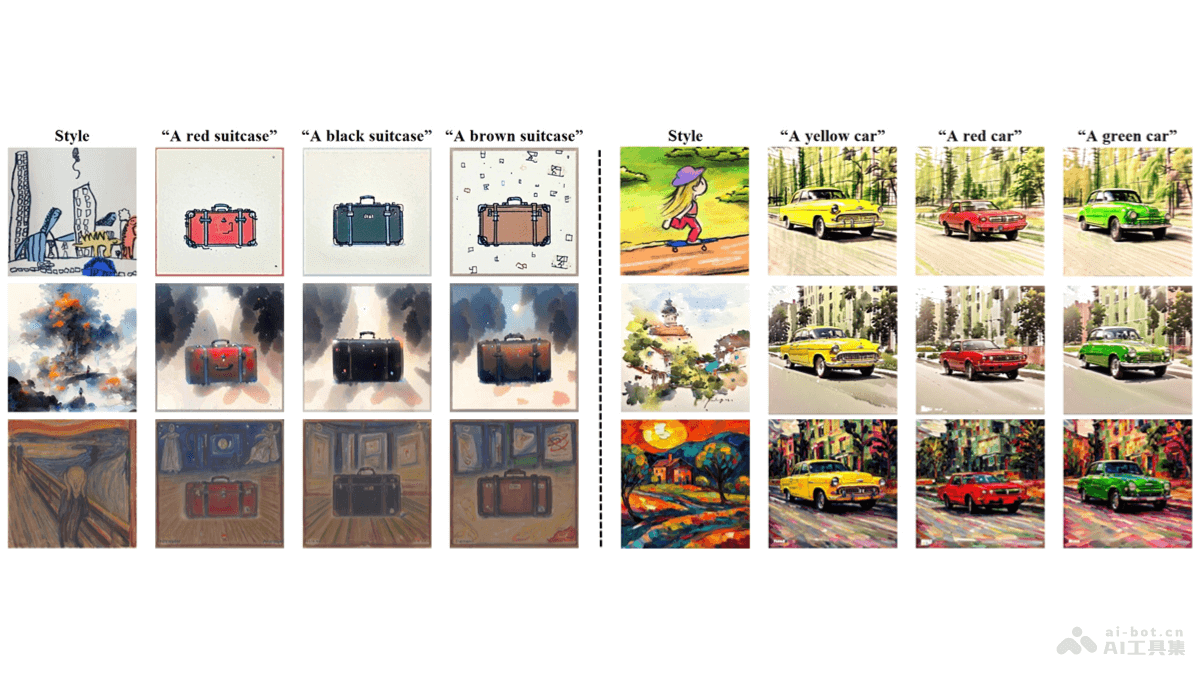
Main Features of StyleStudio
- Text-driven style transfer: Based on a text prompt, apply the style of a reference image to new image content.
- Selective control of style elements: Users emphasize or omit specific style components to achieve a more balanced and intentional style transfer.
- Reduce style overfitting: Effectively reduces the risk of the model excessively copying the features of the reference style image, improving the aesthetic flexibility and adaptability of the generated image.
- Improve text alignment accuracy: During the text-to-image generation process, maintain precise alignment with the text prompt.
- Reduce unwanted artifacts: Based on a stable spatial layout, reduce artifacts such as checkerboard effects and improve the quality of the generated image.
Technical Principles of StyleStudio
- Cross-modal adaptive instance normalization (AdaIN): Use the AdaIN mechanism to integrate style and text features, adjust content features to reflect style statistical characteristics, and achieve effective fusion of style features.
- Style-based classifier-free guidance (SCFG): Generate a "negative" image lacking the target style. SCFG supports the model in focusing on transferring specific style elements while filtering out unwanted style features.
- Teacher model: In the early stage of generation, use the teacher model to share spatial attention maps, ensuring that different style reference images maintain a consistent spatial layout for the same text prompt.
- Layout stabilization: Selectively replace the Self-Attention AttnMaps in the Stable Diffusion model to keep core layout features stable and maintain structural consistency during the style transfer process.
- Decoupling of style and content: Based on specific strategies, decouple style and content, allowing the model to better adapt to style changes while maintaining the integrity and accuracy of the content.
StyleStudio Project Address
- Project official website:stylestudio-official.github.io
- GitHub repository:https://github.com/Westlake-AGI-Lab/StyleStudio
- arXiv technical paper::https://arxiv.org/pdf/2412.08503
- Online experience Demo:https://huggingface.co/spaces/Westlake-AGI-Lab/StyleStudio
Application Scenarios of StyleStudio
- Digital painting and artistic creation: Artists and designers apply specific styles to digital paintings or create entirely new works of art.
- Advertising and brand marketing: Apply brand-specific styles or color schemes to advertising images to help brands maintain consistency in visual communication.
- Game design: Game developers quickly generate game assets and environments that fit the game's worldview and art style.
- Film and video production: In film or video production, generate concept art for scenes with a specific style, or use it for previewing visual effects.
- Personalized content generation: Users generate personalized image content based on their own preferences, such as customized avatars, wallpapers, etc.