
What is Strix
Strix is an open-source AI-driven security testing tool that helps developers and security teams quickly discover and verify vulnerabilities in applications. By simulating real hacker attacks, the tool dynamically runs code and reduces false positives. Strix supports security assessment of local codebases, GitHub repositories, and web applications, and features autonomous security tools, comprehensive vulnerability detection, and a distributed agent network. Strix provides an enterprise platform that supports large-scale scanning and CI/CD integration.
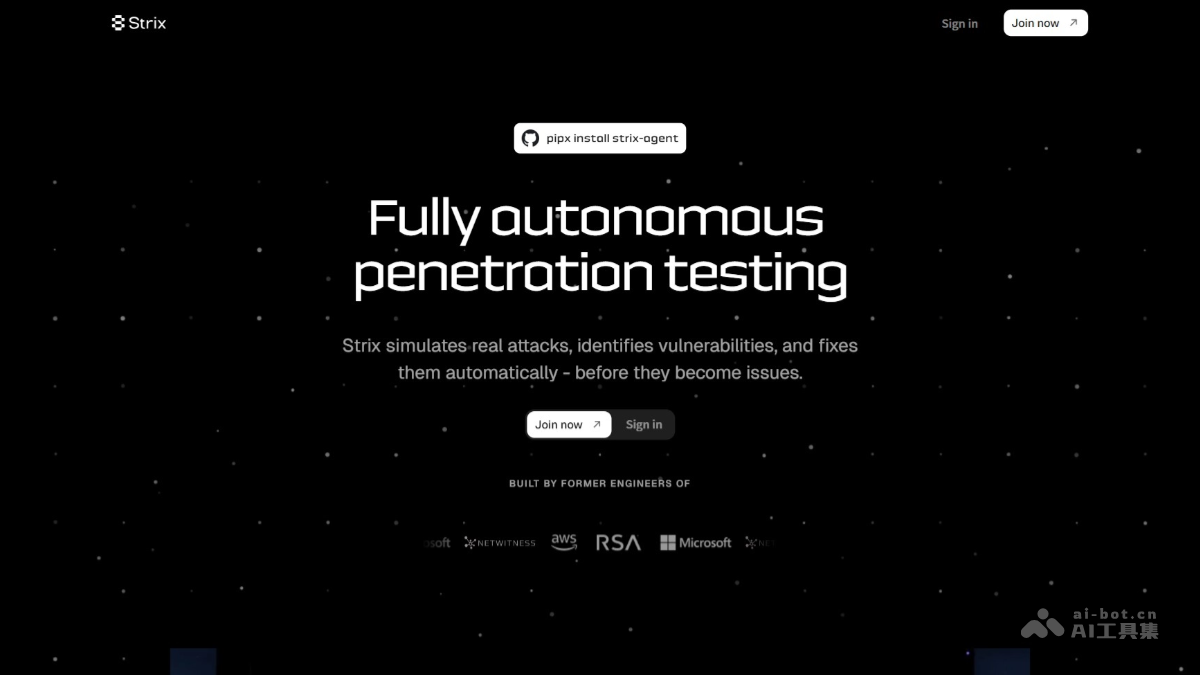
Strix's main features
-
Comprehensive vulnerability detection: Covers multiple vulnerability types, including access control, injection attacks, server-side vulnerabilities, client-side vulnerabilities, and business logic vulnerabilities.
-
Autonomous security tools: Built-in tools such as an HTTP proxy, browser automation, terminal environment, Python runtime, and code analysis support a variety of testing scenarios.
-
Dynamic testing and verification: By dynamically running code and actually exploiting vulnerabilities, it verifies exploitability and reduces false positives.
-
Distributed agent network: Supports distributed testing, is highly scalable, and can dynamically coordinate multiple testing nodes to improve testing efficiency.
-
Container isolation and security: All tests run in sandboxed Docker containers, ensuring test isolation and data security.
-
Automatic remediation and reporting: Automatically generates remediation suggestions and detailed reports to help developers quickly understand and fix vulnerabilities.
-
Enterprise-grade platform support: Provides features such as execution dashboards, custom fine-tuned models, CI/CD integration, large-scale scanning, and enterprise-grade support to meet enterprise needs.
Strix's technical principles
- AI-driven vulnerability discovery: Strix uses advanced artificial intelligence (AI) and machine learning (ML) technologies to analyze code and runtime behavior. AI models can identify potential security vulnerabilities, and through static code analysis, identify potential security issues such as injection attacks and insecure code implementations. In a dynamic runtime environment, it monitors application behavior in real time and discovers runtime vulnerabilities such as server-side request forgery (SSRF) and cross-site scripting (XSS).
- Simulating real attacks: Strix simulates real hacker attacks, verifies the existence of vulnerabilities through dynamic testing, intercepts and modifies HTTP requests and responses, and simulates various attack scenarios. It uses automation tools (such as Selenium) to simulate user interactions and test the security of web applications. It runs code in an isolated environment to simulate a real attack environment, ensuring the safety and accuracy of testing.
- Dynamic testing and verification: Strix verifies through dynamic testing whether these vulnerabilities actually exist. It attempts to exploit discovered vulnerabilities to verify exploitability. Through dynamic verification, it reduces false positives and improves the accuracy of test results.
- Distributed agent network: Strix supports distributed testing. Through an agent network, it coordinates multiple testing nodes, can handle multiple testing tasks simultaneously, and improves testing efficiency. It dynamically allocates resources according to testing needs and optimizes the testing process.
Strix's project address
- Project official website:https://usestrix.com/
- GitHub repository:https://github.com/usestrix/strix
Strix's application scenarios
-
Security testing during the development phase: Developers use Strix to perform security assessments on local code repositories, discovering potential vulnerabilities through static code analysis and dynamic testing, promptly fixing issues, and reducing security risks.
-
Continuous Integration and Continuous Deployment (CI/CD): Seamlessly integrates into the CI/CD process, automatically runs security tests, and ensures that every code commit meets security standards.
-
Web Application Security Assessment: Through HTTP proxies and browser automation tools, conduct security testing on web applications, detect common vulnerabilities, verify exploitability, and ensure the security of web applications.
-
Security Review of Open Source Code and Third-Party Libraries: Developers analyze open source code and third-party libraries, detect known security vulnerabilities, assess the security of introduced code, and avoid security issues introduced by third-party code.
-
Enterprise-Level Security Testing: Enterprises handle complex testing requirements, monitor testing progress and results in real time through execution dashboards, and generate detailed reports to meet compliance and security audit requirements.