
What is Story-Adapter
Story-Adapter is a novel long story visualization framework that can generate high-quality story image sequences with fine-grained interactions while maintaining semantic consistency. Through an iterative approach based on a global reference cross-attention module, it optimizes the image generation process and improves visualization performance in long story scenarios. The framework requires no extra training, is computationally efficient, can handle complex stories with up to 100 frames, reduces error accumulation, and improves the quality of interactions and detail representation between images.
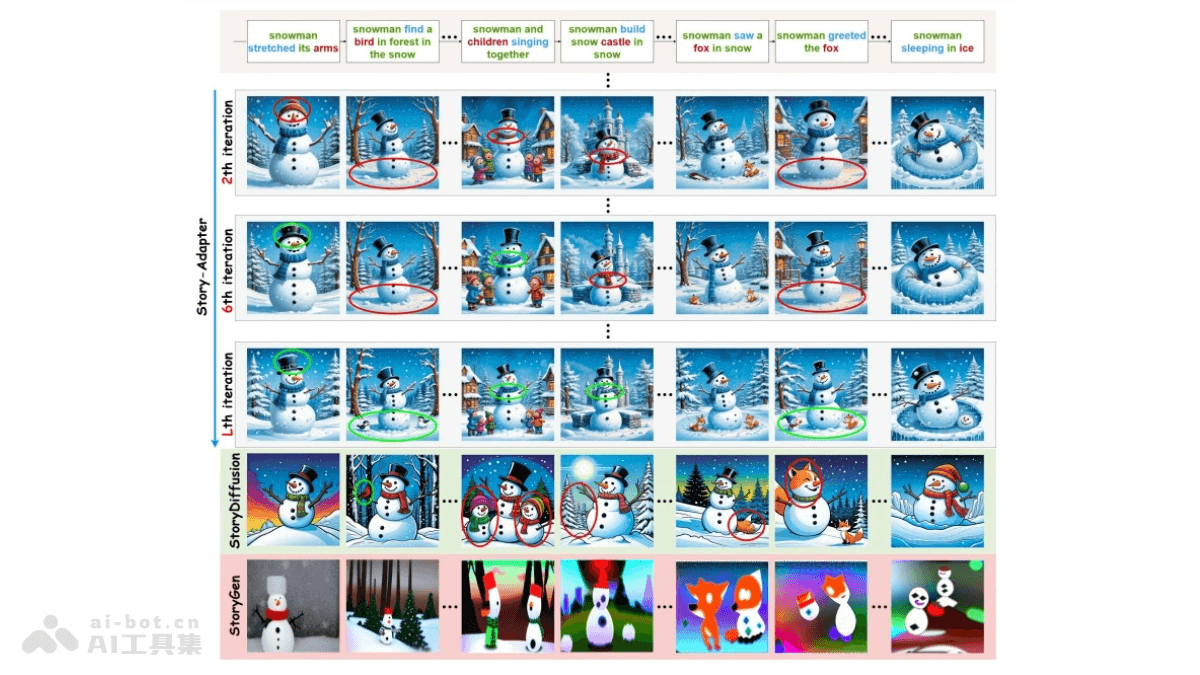
Main Features of Story-Adapter
- No Training Required: Story-Adapter is a framework that requires no extra training and can be directly applied to pre-trained Stable Diffusion models.
- Iterative Optimization: Through an iterative approach, Story-Adapter uses all images generated in the previous iteration to guide the generation of the current image in each iteration, progressively improving the semantic consistency and visual details of the image sequence.
- Global Reference Cross-Attention Module (GRCA): An efficient plug-in module that uses global image embeddings to reduce computational cost while maintaining the consistency of the story's global semantics.
- Handling Long Stories: Story-Adapter can handle long stories with up to 100 frames, maintain semantic consistency between images, and generate high-quality, detail-rich interactive scenes.
- Balancing Text Control and Visual Consistency: Story-Adapter introduces a linear weighting strategy to balance text control and visual consistency during the iterative process, generating image sequences that both match the text descriptions and have a coherent visual style.
Technical Principles of Story-Adapter
- Iterative Optimization Paradigm:Story-Adapter uses an iterative method to optimize image generation. Each iteration guides the generation of the current image based on all images generated in the previous iteration as well as the text prompt.The iterative process progressively improves the semantic consistency and visual details of the image sequence.
- Text Prompt and Image Fusion: In each iteration, Story-Adapter combines the text prompt and the images generated in the previous iteration, and refines image generation through a cross-attention mechanism.
- Multi-Round Refinement:Through multiple rounds of iteration, Story-Adapter progressively refines all generated images, including semantic consistency and visual details.The multi-round refinement process supports the model in progressively correcting errors and adding details in each round, ultimately generating a high-quality story image sequence.
Story-Adapter Project Address
- Project Website:jwmao1.github.io/storyadapter
- Github Repository:https://github.com/jwmao1/story-adapter
- arXiv Technical Paper:https://arxiv.org/pdf/2410.06244v1
Application Scenarios of Story-Adapter
- Story Creation: Writers and screenwriters can use Story-Adapter to convert text stories into a series of visualized scenes, helping them better conceive and plan story plots and making the creative process more intuitive and vivid.
- Education and Learning: In the field of education, teachers can use Story-Adapter to convert story content in textbooks into image sequences, which can enhance students' learning experience and improve their understanding and memory of the story content.
- Entertainment and Games: In game design and development, Story-Adapter can be used to generate story plot scenes in games, providing players with a richer and more dynamic visual experience.
- Advertising and Marketing: Marketers can use Story-Adapter to generate a series of engaging images based on product stories or advertising copy for advertising and marketing activities, enhancing the appeal and reach of advertisements.
- Film and Animation Production: In the pre-production of films or animations, Story-Adapter can help production staff quickly generate storyboards, transforming scripts into visual images, simplifying the production process and improving efficiency.
- Virtual Reality and Augmented Reality: In the fields of VR and AR, Story-Adapter can be used to create immersive story experiences, enhancing users' sense of immersion and interactivity by generating coherent image sequences.