
What is StockMixer
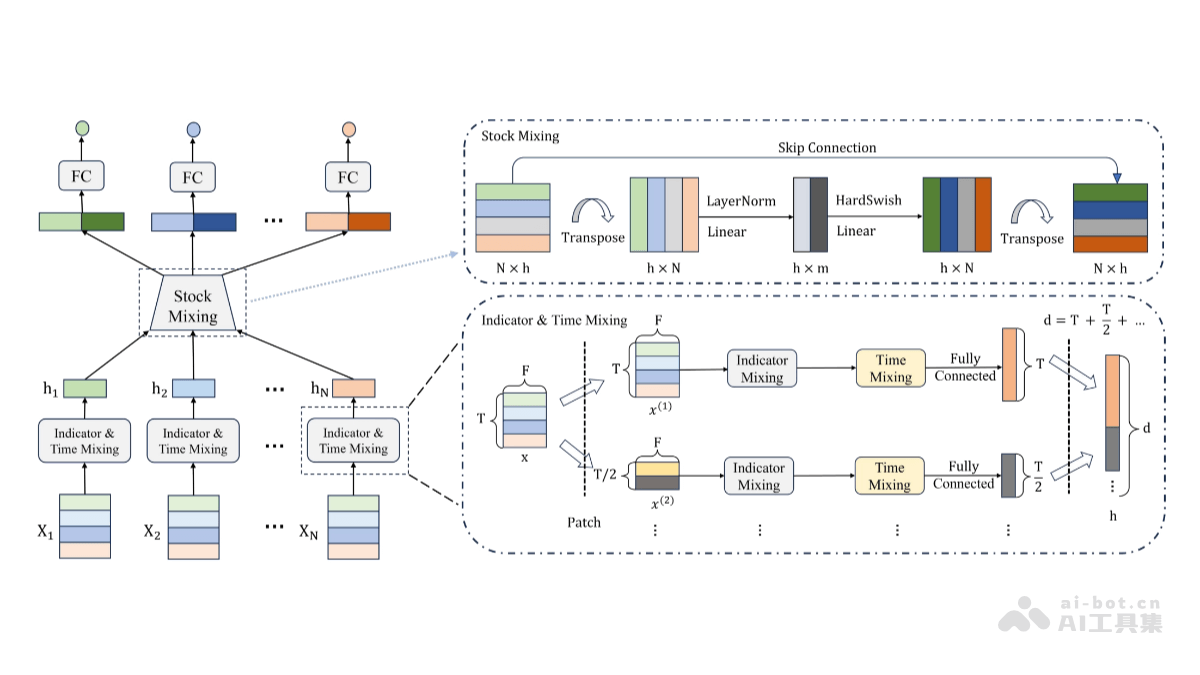
StockMixer is a multi-layer perceptron (MLP) architecture for stock price prediction from Shanghai Jiao Tong University, with simple and powerful predictive capabilities. The architecture processes and predicts stock data based on three steps: indicator mixing, time mixing, and stock mixing, effectively capturing the complex correlations among stock indicators, time, and stocks. Time mixing uses multi-scale time segment information, and stock mixing influences individual stocks based on market conditions, achieving more accurate predictions. While reducing memory usage and computational cost, StockMixer performs excellently on multiple stock market benchmarks, surpassing various advanced prediction methods.
StockMixer's Main Features
- Indicator Mixing: Uses matrix multiplication and activation functions to simulate the interactions among internal indicators for each stock-time pair, extracting high-level latent features that are informative for future stock trends.
- Time Mixing: Captures temporal trends and patterns in stock price movements based on information exchange across multi-scale time segments, enabling the model to extract features from different time scales.
- Stock Mixing: Learns stock states from the entire market to individual stocks and back to the entire market, simulating the complex correlations among stocks, and modeling stock correlations more robustly.
- Predicting Stock Prices: Combines the feature representations obtained from the above mixing to predict the closing price of the next trading day.
StockMixer's Technical Principles
- Multi-Layer Perceptron (MLP) Architecture: Based on MLP, processes stock data with linear computational complexity and a simple architecture.
- Information Exchange: Based on the MLP structure, exchanges information across different dimensions (indicators, time, and stocks) to enhance the model's expressiveness.
- Residual Connections and Layer Normalization: Uses residual connections to maintain a balance between input and mixed features, and layer normalization to reduce the impact of data shift.
- Multi-Scale Time Segments: Splits time series into segments of different sizes to capture features at different time scales.
- Stock-to-Market and Market-to-Stock Influence: Based on two MLP structures, learns latent stock states and uses these states to influence individual stocks, simulating correlations among stocks.
- Loss Function Design: Combines pointwise regression and pairwise ranking-aware loss, optimizing the model to minimize the mean squared error between predicted and actual returns while preserving the relative order of stocks with high expected returns.
StockMixer's Project Address
- GitHub Repository:https://github.com/SJTU-DMTai/StockMixer
- Technical Paper:https://ojs.aaai.org/index.php/AAAI/article/view/28681
StockMixer's Application Scenarios
- Quantitative Investment: Uses StockMixer to predict stock price movements, helping quantitative investment strategy makers formulate trading strategies and obtain excess returns.
- Risk Management: Financial institutions better assess and manage the market risk of investment portfolios.
- Algorithmic Trading: Provides fast stock price predictions in high-frequency trading, helping algorithmic trading systems make instant buy and sell decisions.
- Portfolio Optimization: Investment managers optimize portfolios, selecting stocks with better expected performance or avoiding potential risks.
- Market Analysis and Research: Analysts analyze market trends, conduct industry comparisons, and study the impact of specific events on stock prices.