
What is STIV
STIV (Scalable Text and Image Conditioned Video Generation) is a largevideo generationmodel launched by Apple. STIV has 870 million parameters and can handle text-to-video (T2V) and text-image-to-video (TI2V) tasks, improving video generation quality based on Joint Image-Text Classifier-Free Guidance (JIT-CFG). The STIV model is based on the PixArt-Alpha architecture, integrating spatiotemporal attention mechanisms, Rotary Position Embedding (RoPE), and a flow matching training objective to enhance the stability and efficiency of video generation. STIV supports a variety of downstream applications, such as video prediction, frame interpolation, and long video generation.
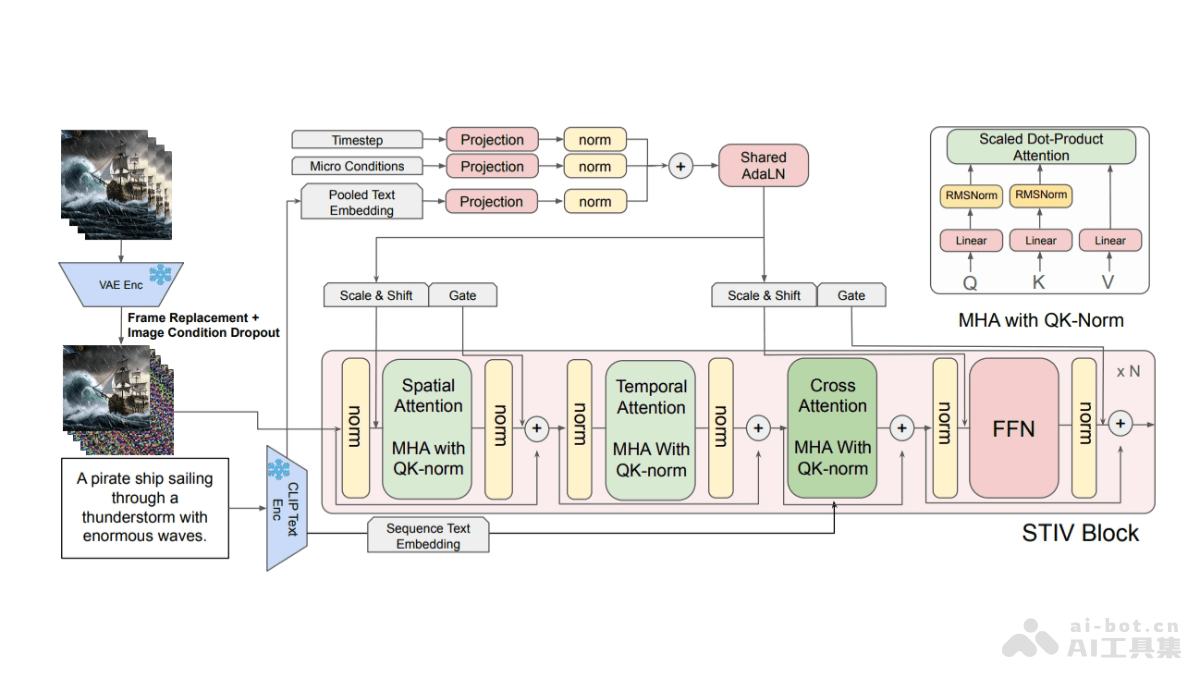
STIV's main features
- Text-to-video (T2V) and text-image-to-video (TI2V) generation: STIV can generate video content based on text prompts or a combination of text and an initial image frame.
- Multimodal condition support: The model supports video generation based on text and image conditions, enhancing the consistency between video content and input conditions.
- Video prediction: The model predicts future video frames and is suitable for fields such as autonomous driving and embedded AI.
- Frame interpolation: Generates intermediate frames between given frames, improving the smoothness and continuity of video.
- Multi-view generation: Generates new viewpoints of a video from a single viewpoint, enhancing the video's sense of depth and realism.
- Long video generation: Generates longer-duration video content based on keyframe prediction and frame interpolation technology.
STIV's technical principles
- Diffusion Transformer(DiT): Based on the DiT architecture, it can effectively process spatiotemporal data.
- Frame replacement: During training, noisy frames are replaced with noise-free image condition frames, enhancing the accuracy and consistency of video generation.
- Joint Image-Text Classifier-Free Guidance (JIT-CFG): A classifier-free guidance technique that adjusts the weights of text and image conditions to optimize the video generation process.
- Spatiotemporal attention mechanism: A decomposed spatiotemporal attention mechanism that processes features in the spatial and temporal dimensions separately, improving the model's efficiency and effectiveness.
- Rotary Position Embedding (RoPE): RoPE enhances the model's ability to handle relative spatiotemporal relationships, better adapting to generation tasks at different resolutions.
- Flow matching training objective: Replaces the traditional diffusion loss with a flow matching objective, achieving a better conditional optimal transport strategy and improving generation quality.
STIV's project address
- HuggingFace model library:https://huggingface.co/papers/2412.07730
- arXiv technical paper:https://arxiv.org/pdf/2412.07730
STIV's application scenarios
- Entertainment and social media: Users generate personalized video content, such as short videos of dancing, travel, or daily life, and share them on social platforms such as Douyin and Instagram.
- Advertising and marketing: Enterprises create dynamic advertising videos, quickly generating attractive video content based on product features or service advantages, improving the appeal and conversion rate of advertisements.
- Education and training: Educational institutions generate educational videos, such as simulations of experimental processes or historical events, providing students with a more intuitive and interactive learning experience.
- News and reporting: News organizations transform news reports into video content, quickly generating visual presentations of news stories, improving the efficiency of news dissemination and the audience's understanding.
- Autonomous Driving and Simulation: Autonomous driving technology companies generate videos of various traffic scenarios to test and train the decision-making and reaction capabilities of autonomous driving systems.