
What Is Still-Moving?
Still-Moving is an AI video generation framework launched by DeepMind that supports user customization of text-to-video (T2V) models without the need for specific video data. By training lightweight spatial adapters, Still-Moving can adjust the features of a T2I model on still images to match the motion characteristics of a T2V model. This approach preserves the personalization and stylization features of the T2I model while combining the motion capabilities of the T2V model, providing an effective way to customize videos without additional data.
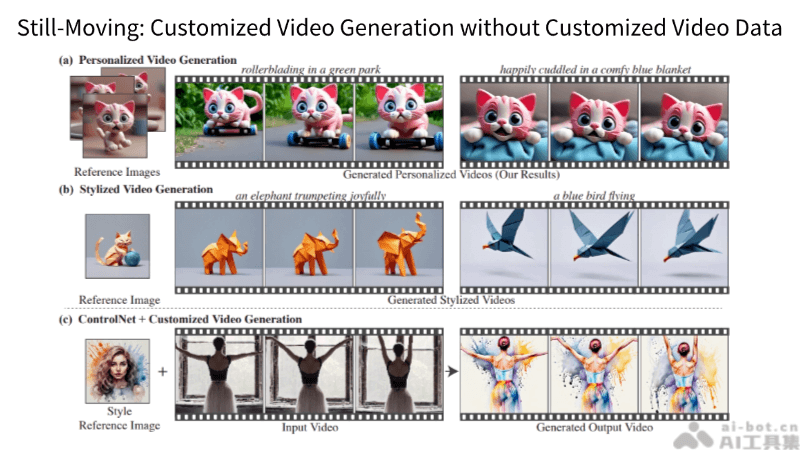
Main Features of Still-Moving
- Customized Video Generation: Supports users in adapting personalized text-to-image (T2I) model weights into text-to-video (T2V) models.
- No Customized Video Data Required: The framework can be trained without specific video data, reducing the need for data collection and processing.
- Lightweight Spatial Adapter: Adjusts the features of the T2I model by training adapters so that they match the motion characteristics of the T2V model.
- Motion Adapter Module: Used during the training phase to help the model learn how to simulate motion on still images.
- Remove the Motion Adapter at Test Time: In the final application, only the spatial adapter is retained to restore the original motion characteristics of the T2V model.
Technical Principles of Still-Moving
- T2I Model Customization: The user has a customized text-to-image (T2I) model trained on static images, adapted to a specific style or content.
- Spatial Adapter Training: To adapt the customized weights of the T2I model to video generation, Still-Moving trains lightweight spatial adapters. The adapters adjust the features produced by the T2I layers to ensure they match the motion characteristics of the video model.
- Motion Adapter Module: Used during the training phase, it supports the model in learning motion characteristics in videos constructed from still images generated by the customized T2I model. This module helps the model understand how to introduce motion into static images.
- Static Video Training: The adapters are trained on still videos constructed from image samples generated by the customized T2I model. The training method allows the model to learn how to simulate motion without actual motion data.
- Adapter Removal at Test Time: During the testing phase, the motion adapter module is removed, and only the trained spatial adapter is retained. The T2V model can restore its original motion priors while following the spatial priors of the customized T2I model.
- Integration of Prior Knowledge: Through this method, Still-Moving can seamlessly combine the personalization and stylization priors of the T2I model with the motion priors of the T2V model, generating videos that both meet user customization needs and have natural motion characteristics.
Project Address of Still-Moving
-
arXivTechnical Paper:https://arxiv.org/pdf/2407.08674
Application Scenarios of Still-Moving
- Personalized Video Production: Users can generate video content with specific characters, styles, or scenes according to their own needs.
- Artistic Creation: Artists and designers can use Still-Moving to create unique video art works, transforming static images into dynamic videos.
- Content Marketing: Enterprises and brands can use this framework to generate engaging video advertisements or social media content to enhance user engagement.
- Film and game production: In film post-production or game development, Still-Moving can be used to quickly generate or edit video materials, improving production efficiency.
- Virtual reality and augmented reality: In VR and AR applications, Still-Moving can generate realistic dynamic backgrounds or characters, enhancing the user experience.